tauro-, taur-, tauri- +
(Greek > Latin: bull, steer)
2. Also applied to any person or thing that devours or destroys.
3. Etymology: from Greek minotauros, from Minos, king of Crete plus tauros, "bull". A flesh-eating monster half man, half bull; son of Pasiphæ, wife of Minos, and a bull.
2. A killer of a bull or a steer.
Because of the gravitational effect of planets, especially Jupiter, the Taurids have spread out over time, allowing separate segments labeled the Northern Taurids and Southern Taurids to become observable.
2. Shaped like a bull, or the head or horns, of a bull.
2. Referring to bull-fighting: Taurine contests involve people and animals in an attempt to physically subdue the animal, or even kill it, and is accomplished by certain rules or in the way the culture in that particular country uses.
3. Relating to the zodiacal sign Taurus: In the celestial sphere, the taurine figure in the sky in the Northern Hemisphere close to Orion and Aries is said to influence people born between April 21 and May 22.
4. Etymology: from Greek tauros, "bull"; from Latin taurinus "bull" + the chemical suffix -ine, because it was first found in ox bile which aids in the digestion of fats in the duodenum.
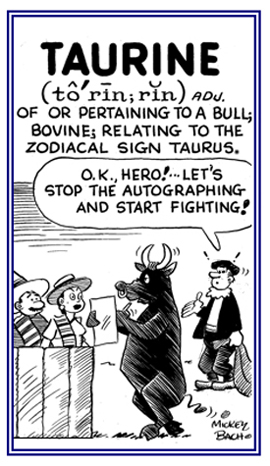
Go to this Word A Day Revisited Index
so you can see more of Mickey Bach's cartoons.
2. A representation of the killing of a bull, as in Mithraic art.
2. The representation of such a slaughter or sacrifice in sculpture, etc.
2. In the shape of a bull's head.
The literal act of sacrifice is known as taurobolium.
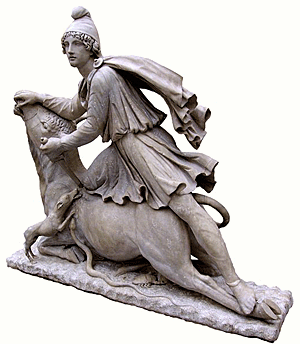
Mithras is identified as a Persian god in the Zoroastrian tradition and Persian mythology. He was the god of light, truth, and goodness. He is often shown with a bull, which he is said to have slain before fertilizing the world with its blood.
Mithras was the nominal object of devotion in a Greco-Roman mystery religion of late antiquity. Mithras is the development of Greco-Roman syncretic beliefs (union, or attempted fusion, of different systems of thoughts or beliefs; especially, in religion or philosophy), and the name simply reflects the high regard that the Greeks held for the figure of Zoroaster.