
syco-
(Greek > Latin: fig [sweet, hollow, pear-shaped, multiple fruit that has numerous tiny seedlike fruits that are eaten fresh or preserved or dried])
sycoceric (adjective), more sycoceric, most sycoceric
Of, pertaining to, or derived from the waxy resin of an Australian species of fig, Ficus rubiginosa.: "The sycoceric tree resin got all over Kent's hands and also onto his shirt."
Divination or fortune-telling by using figs and/or fig-leaves: Meg went to a fortune teller who practiced the unusual art of sycomancy by using the leaves of the mediterranean tree with edible fruit, called figs.
1. A species of fig-tree, Ficus Sycomorus, common in Egypt, Syria, and other countries, and having leaves somewhat resembling those of the mulberry: "In the experimental arboretum at the university, they were growing sycomore and other kinds of fig trees."
2. Etymology: from Middle English, from Old French sic(h) amor, from Latin and from Greek sukomoros; from, sukon, "fig" + moron, "mulberry".
2. Etymology: from Middle English, from Old French sic(h) amor, from Latin and from Greek sukomoros; from, sukon, "fig" + moron, "mulberry".
In botany, fleshy fruit that develops into a multiple fruit; such as, those in the fig: "When Sally went to the Farmers’ Market, she was able to purchase some more syconia which were her favorite fruit."
Anyone who eats figs: "Martha and her husband were both sycophages; especially, when they could get the syconia fresh from the market."
sycophagous (adjective), more sycophagous , most sycophagous
Relating to the consumption or eating of figs: "The merchant at the fruit market who specialized in the sale of figs often remarked to Martha and Jason they were his most sycophagous customers."
The practice of eating figs: "The farmer at the market demonstrated the proper sycophagy when on a picnic."
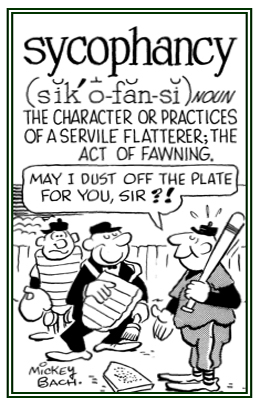
The characteristics of those who strive to do whatever is possible to please another person; such as, an employer, supervisor, etc.: Monroe often used sycophancy to improve his occupational status with his company.
© ALL rights are reserved.
Go to this Word A Day Revisited Index
Whenever Glenda's manager asked for volunteers to work overtime, she would use sycophancy as a method of securing her job; especially, during the time of high unemployment conditions.
Go to this Word A Day Revisited Index
so you can see more of Mickey Bach's cartoons.
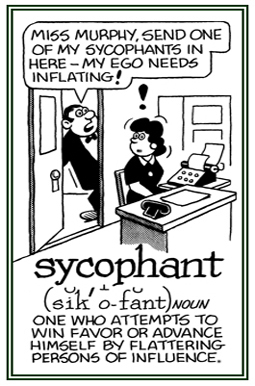
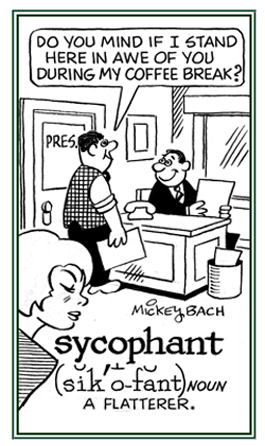
1. Someone who tries to please another person in order to gain a personal advantage: Julie was a sycophant who flattered her brother so he would loan her his car.
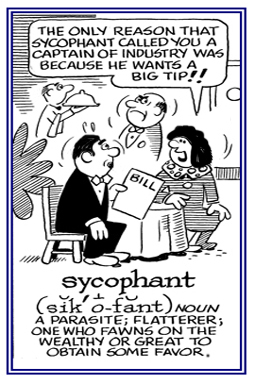
2. A person who attempts to win favor by overly praising influential people; especially, those who are famous or rich: There are sycophants who will say wonderful things to others who are their superiors so they can promote themselves towards greater success in their careers or desires.
© ALL rights are reserved.
© ALL rights are reserved.
© ALL rights are reserved.
Go to this Word A Day Revisited Index
2. A person who attempts to win favor by overly praising influential people; especially, those who are famous or rich: There are sycophants who will say wonderful things to others who are their superiors so they can promote themselves towards greater success in their careers or desires.
Since a sycophant is defined as someone who wants to win favor or advance himself or herself by flattering people in high positions; such a person is also referred to as: "a bootlicker, a flunky, a fawner, an apple polisher, a backslapper, or a toady."
3. Etymology: from Greek sykophantesand from Latin sycophanta, "servile flattery."Go to this Word A Day Revisited Index
so you can see more of Mickey Bach's cartoons.
sycophantic (sik" oh FAN tik) (adjective), more sycophantic, most sycophantic
Characteristic of someone who uses flattery by praising a powerful person of influence in order to win favor or advancement: "The company's servile self-seekers gave sycophantic praise to every word the company chief executive officer said."
"There were often many sycophantic women who surrounded the famous movie actor whenever he was scheduled to appear in public."
sycophantical (adjective), more sycophantical, most sycophantical
Servilely or excessively courting favor; being slavish: "Jack was often described in office gossip as the most sycophantical person in the office, always being excessively flattering to the supervisor."
sycophantically (adverb), more sycophantically, most sycophantically
Characteristic of someone who excessively compliments someone in order to win favors: "Bryan was sycophantically praising his supervisor in hopes that he might get a raise in pay."
sycophantish (adjective), more sycophantish, most sycophantish
Relating to being very eager to help or to obey someone important: "Garrett, the office administrator, was often complimented by sycophantish assistants who were trying to gain his favor in order to get higher wages."
sycophantishly (adverb), more sycophantishly, most sycophantishly
A reference to anyone who is overly praising of someone who is in a high position: "Pam was sycophantishly expressing how wonderful her employer was so she could gain advantages in job assignments."
The practice of self-serving or servile flattery: "Sabina's supervisor was aware that she was trying to use sycophantism in order to gain more job advantages from him."

Showing page 1 out of 2 pages of 18 main-word entries or main-word-entry groups.