super-, supra-, sur-
Sur- is a variation of super- developed through the French and shouldn't be confused with another assimilated sur- form that comes from sub- and means: "under, below, beneath".
In some words, super- is amplified to mean: "on top of; higher in rank or position than; superior to; greater in quality, amount, or degree than others of its kind".
anterosuperior
(s) (noun), anterosuperiors
(pl)
In anatomy, situated before or in front of; and above or higher in place or position of, another bodily part.
archaeological survey, archeological survey
(s) (noun); archaeological surveys; archeological surveys
(pl)
A method used to examine an area to determine if there are any deposits available of people and their cultures: An archaeological survey is a kind of field research to look for archaeological sites, gather information about that locality, in addition to other detailed investigational activities.
Relating to the upper ribs of the body.
cybersurfer
(s) (noun), cybersurfers
(pl)
People who spend a great deal of time using the internet: Many cybersurfers spend hours on their computers looking for information or visiting blogs and social networks.
electromagnetic surveying
(s) (noun), electromagnetic surveyings
(pl)
A method of prospecting below the surface of the earth: The process involves the use of
electromagnetic surveying during which the use of electric current waves on the top level are utilized to penetrate into the soil and to indicate if there are any new ores down below.
Such electromagnetic surveying can determine if there is gold, silver, or other metals by finding them and then recording their existence to those who are looking for the minerals.
electronic article surveillance, EAS
(s) (noun); electronic article surveillances
(pl)
Simple electronic tags that can be turned on or off to indicate check-out or check-in status of products: When an item is purchased (or borrowed from a library), the
electronic article surveillance is turned off.
When someone passes a gate, or door, of a place holding an item with an electronic article surveillance that hasn't been turned off, an alarm sounds.
geodetic survey
(s) (noun), geodetic surveys
(pl)
An examination of a large area of land in which corrections are made to account for the curvature of the Earth: A geodetic survey involves research in which the form and the size of this planet are considered and for which corrections are made.
geoelectric survey
(s) (noun), geoelectric survey
(pl)
An active geophysical method which employs electrical current to examine subsurfaces of earth materials: The
geoelectric survey measures ground characteristics by sending direct signals into the soil and measuring the resulting potentials, or voltages, that are created.
The geoelectric survey involves a process that is done to determine various discoveries, such as:
- Groundwater Exploration
- Coal Exploration
- Gold Exploration
- Iron Ore Exploration
- Manganese Exploration
- Chromites Exploration
geological survey
(s) (noun), geological surveys
(pl)
The research of the earth in order to compile maps, and to perform reconnaissance work and comprehensive analytical work: A geological survey is a systematic study of the distribution, structure, composition, and history of land features of a selected region of the world.
inexsuperable
(adjective), more inexsuperable, most inexsuperable
Not capable of being passed over; insurmountable: Her excellent performance that evening was absolutely inexsuperable and the audience applauded forever!
insuperable
(adjective), more insuperable, most insuperable
A reference to the inability of overcoming a difficulty or hinderance; insurmountable: The weather suddenly became an
insuperable barrier of getting back home as early as Mike and his family had planned.
Jim's less experienced football team won the championship despite the insuperable odds presented by the more successful team.
 © ALL rights are reserved.
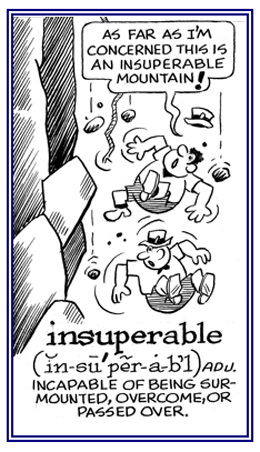 © ALL rights are reserved.
Go to this Word A Day Revisited Index
so you can see more of Mickey Bach's cartoons.
insuperably
(adverb), more insuperably, most insuperably
Pertaining to how something is impossible to overcome or to solve: Jack was overwhelmed with the many insuperably difficult and mandatory classes he had to take during his first year in college!
insurmountable
(in" sur MOUN tuh b'l) (adjective), more insurmountable, most insurmountable
1. Regarding something which cannot be passed over, overcome, or conquered: An insurmountable obstacle and an insurmountable task are both insuperable and invincible.
2. Impossible to master; insuperable; unachievable: Sam had insurmountable difficulties getting back into his house, so he had to call a locksmith.
Related "above, over, beyond the normal, excessive" word units:
epi-;
hyper-;
ultra-, ult-.
Inter-related cross references, directly or indirectly, involving word units meaning "more, plentiful, fullness, excessive, over flowing":
copi-;
exuber-;
hyper-;
multi-;
opulen-;
ple-;
pleio-;
plethor-;
poly-;
total-;
ultra-;
undu-.

