
string-, strict-, strain-, -stringence, -stringency, -stringe, -stringent
(Latin: draw tight, to bind, to compress)
astrict (verb); astricts; astricted; astricting
1. To bind up; to confine; to constrict; to contract.
2. To constrain; to restrict; to limit.
2. To constrain; to restrict; to limit.
1. In medicine, a contraction of parts by applications; such as, the stopping of hemorrhages.
2. The power of contracting the parts of the body; that quality in medicines or other substances which causes contraction of the organic textures.
2. The power of contracting the parts of the body; that quality in medicines or other substances which causes contraction of the organic textures.
astrictive (adjective), more astrictive, most astrictive
1. Binding; astringent or something that causes the contraction of skin cells and other body tissues: The doctor recommended that Kate use a more astrictive skin lotion to stop the itching.
2. A reference to something that is sharp or severe in manner or style: Joan's astrictive words had their effect on her son's misbehavior.
2. A reference to something that is sharp or severe in manner or style: Joan's astrictive words had their effect on her son's misbehavior.
astrictively (adverb), more astrictively, most astrictively
A reference to an astringent or something that causes the contraction of skin cells and other body tissues: The physical therapist suggested that Max use lotion which has a mildly astrictively improving of the feeling of the open pores on his legs.
astringe (verb), astringes; astringed; astringing
In medicine, causing contraction, usually locally after an application: An agent that astringes does this sometimes in order to stop bleeding.
1. A sharp taste experience when a substance causes the mouth to pucker: Astringency is a tasting term used for wine, tea, and other consumable substances which are drunk.
2. The ability to contract or to draw together soft body tissues to check blood flow or to restrict the secretion of fluids: Astringency is the drying sensation created in the mouth and throat and primarily on the surface of the tongue.
2. The ability to contract or to draw together soft body tissues to check blood flow or to restrict the secretion of fluids: Astringency is the drying sensation created in the mouth and throat and primarily on the surface of the tongue.
1. Something that causes a contraction of tissues, arrest of secretion, or control of bleeding.
2. A substance or preparation; such as, alum, that draws together or constricts body tissues and is effective in stopping the flow of blood or other secretions.
2. A substance or preparation; such as, alum, that draws together or constricts body tissues and is effective in stopping the flow of blood or other secretions.
Astringents act as protein precipitants; they arrest discharge by causing shrinkage of tissue.
Some astringents; such as, tannic acid, have been used in treating diarrhea; others; such as, boric acid and sodium borate, help relieve the symptoms of inflammation of the mucous membranes of the throat or conjunctiva of the eye.
Skin lotions often contain astringents; such as, aluminum acetate that help to reduce oiliness and excessive perspiration. Witch hazel is a common household astringent used to reduce swelling.
Styptic pencils, used to stop bleeding from small cuts, contain astringents. Zinc oxide and calamine are astringents used in lotions, powders and ointments to relieve itching and chafing in various forms of dermatitis.
astringently (adverb), more astringently, most astringently
1. A reference to the tendency of drawing together or constricting tissues.
3. Sharply penetrating; pungently or severely: Shirley made remarks astringently disturbing to her husband about not going to see a movie.
3. Sharply penetrating; pungently or severely: Shirley made remarks astringently disturbing to her husband about not going to see a movie.
boa constrictors
As a group-name, a crush of boa constrictors.
constrain (verb), constrains; constrained; constraining
1. To compel by physical, moral, or circumstantial force to do something: William felt constrained to object to the way his neighbor was treating her dog.
2. To keep within close bounds; to confine: Henry had a life that had been constrained by habit to do the same activities with his friends and family.
2. To keep within close bounds; to confine: Henry had a life that had been constrained by habit to do the same activities with his friends and family.
constrainable (adjective), more constrainable, most constrainable
Liable to limitation; inclined to hold back or to curb: The size of the building project was constrainable due to the amount of credit the bank had offered.
constrained (adjective), more constrained, most constrained
Descriptive of that which causes someone to appear unnaturally forced or compelled to do something, typically because of embarrassment or of a social situation with someone: Bill was quite constrained when he accidentally met his girlfriend while he was shopping with his mother at the department store.
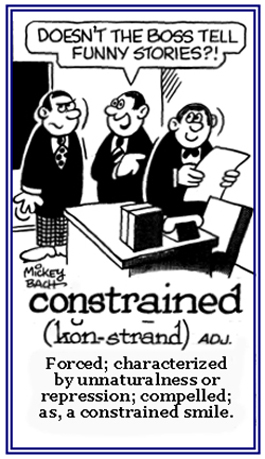
© ALL rights are reserved.
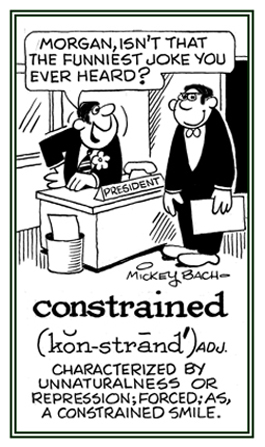
© ALL rights are reserved.
Go to this Word A Day Revisited Index
Go to this Word A Day Revisited Index
so you can see more of Mickey Bach's cartoons.
constrainedly
1. In a constrained manner, or compelled by physical, moral, or circumstantial force.
2. In an inhibited or restrained condition.
2. In an inhibited or restrained condition.
constrainer
1. Someone who constrains, or forces, compels, or obliges.
2. Anyone who represses or restrains.
2. Anyone who represses or restrains.
constrainingly
1. A reference to persuading by strong pressure or force, compellingly.
2. Characterizing ill at ease and embarrassment through repression of natural feelings.
2. Characterizing ill at ease and embarrassment through repression of natural feelings.
