
stratio-, strati-, strato-, strat-, -stratus; ster-, stern-
(Latin: horizontal layer; stretched, spread out; layer, cloud layer; strew, scatter, disperse)
The Latin stratum meant "something laid down". It was used as a noun for the past participle of sternere, "to spread out, to lay down, to stretch out" which produced consternation and prostrate plus many other words from the same etymological sources which are listed in this unit.
A primary cloud type consisting of rain, snow, and ice pellets and appearing as a striated, fibrous, or uniform cloud in a gray or bluish sheet or layer: Altostratatus clouds usually cover most of the visible sky, with parts thin enough so the sun's position can be seen and such cloud formations exist at heights from 6,000 to 20,000 feet (2,000 to 6,100 meters) and they often produce long, steady rain showers.
consternate (verb), consternates; consternated; consternating
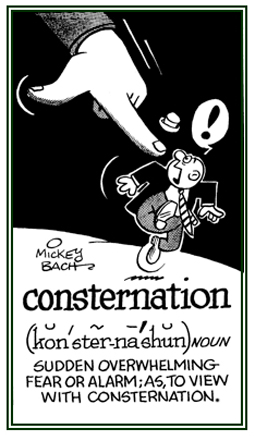
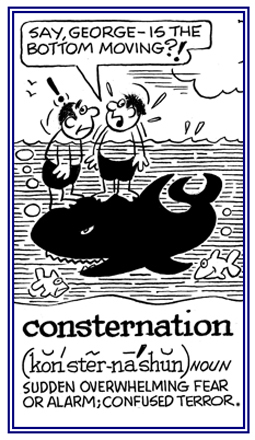
1. A feeling of alarm, confusion, or dismay; often caused by something unexpected: Janet invited her ex-husband, Jack, over for dinner, which was met with much consternation by her new boyfriend, Ted, who was quite surprised about her friendliness with her former spouse.
2. A shocked or worried feeling, usually a result of something that happens unexpectedly: The serious illness of Tom's mother caused him much consternation, dread and anxiety; so, he went to be with her until she became well again.
3. Surprise and alarm, which results in panic, deep disappointment, or total confusion: There was general consternation when the terrifying news was published about the airport shootings.
4. Etymology: from French consternation, "dismay, confusion"; from Latin consternationem, "confusion, dismay"; from consternat-, the past participle stem of consternare, "to overcome, to confuse, to dismay, to perplex"; related to consternere, "to throw down, to prostrate"; from com-, "with, together" + sternere, "to spread out".
© ALL rights are reserved.
© ALL rights are reserved.
Go to this Word A Day Revisited Index
2. A shocked or worried feeling, usually a result of something that happens unexpectedly: The serious illness of Tom's mother caused him much consternation, dread and anxiety; so, he went to be with her until she became well again.
3. Surprise and alarm, which results in panic, deep disappointment, or total confusion: There was general consternation when the terrifying news was published about the airport shootings.
4. Etymology: from French consternation, "dismay, confusion"; from Latin consternationem, "confusion, dismay"; from consternat-, the past participle stem of consternare, "to overcome, to confuse, to dismay, to perplex"; related to consternere, "to throw down, to prostrate"; from com-, "with, together" + sternere, "to spread out".
Go to this Word A Day Revisited Index
so you can see more of Mickey Bach's cartoons.
prostrate (adjective), more prostrate, most prostrate
1. A reference to someone who is lying prone or stretched out with his or her face downward; for example, in worship or submission to a superior power.
2. Stretched out in a horizontal position, often because of illness or injury.
3. Drained of physical strength or incapacitated by overexertion or powerful emotion.
4. In botany, used to describe a plant that grows or trails along the ground.
2. Stretched out in a horizontal position, often because of illness or injury.
3. Drained of physical strength or incapacitated by overexertion or powerful emotion.
4. In botany, used to describe a plant that grows or trails along the ground.
1. A condition in which someone is laying flat on his or her face or bowing very low.
2. Something that causes a person to become physically or emotionally weak or helpless.
2. Something that causes a person to become physically or emotionally weak or helpless.
straticulate, straticulation
1. Used to describe a rock formation that is made up of thin layers.
2. Arranged in thin layers.
2. Arranged in thin layers.
1. The formation of layers in sedimentary rocks through biological, chemical, or physical changes in the sediments forming them.
2. The formation of layers, castes, classes, or other types of strata.
3. A situation or condition where something is arranged in several strata.
4. A layered arrangement or appearance of successive rock strata.
5. The storing of seeds in a chilled moist environment or material in order to induce germination or to preserve them.
6. In hydrology, the arrangement of water masses in a lake or other body of water into two or more horizontal layers having different characteristics.
7. The formation of layers in snow, ice, or firn as a result of snow sedimentation or other processes [a "firn" is a loose, permeable, granular material that is over a year old, and which is transitional between snow and glacier ice].
2. The formation of layers, castes, classes, or other types of strata.
3. A situation or condition where something is arranged in several strata.
4. A layered arrangement or appearance of successive rock strata.
5. The storing of seeds in a chilled moist environment or material in order to induce germination or to preserve them.
6. In hydrology, the arrangement of water masses in a lake or other body of water into two or more horizontal layers having different characteristics.
7. The formation of layers in snow, ice, or firn as a result of snow sedimentation or other processes [a "firn" is a loose, permeable, granular material that is over a year old, and which is transitional between snow and glacier ice].
stratified (adjective), more stratified, most stratified
1. In geology, pertaining to something that has been formed, arranged, or laid down in layers or strata.
2. Relating to the statistics of a population that has been divided into parts on the basis of certain features; such as, ages or geographical locations.
2. Relating to the statistics of a population that has been divided into parts on the basis of certain features; such as, ages or geographical locations.
stratifier
stratiform
1. Composed of layers, or with a layered appearance or arrangement.
2. Forming or formed as a layer.
3. Like or having the form of a stratus cloud.
4. In meteorology, of a cloud, having a predominantly horizontal development; the opposite of cumuliform.
2. Forming or formed as a layer.
3. Like or having the form of a stratus cloud.
4. In meteorology, of a cloud, having a predominantly horizontal development; the opposite of cumuliform.
stratiformis
In meteorology, a cloud species characterized by an extensive horizontal layer or series of layers, either continuous or noncontinuous; the most common form for the altocumulus and stratocumulus genera, and occasionally found in cirrocumlus.
stratify (verb), stratifies; stratified; stratifying
1. To form something into a layer or layers: Rock is often stratified between other kinds of sedimentary stone or earth.
2. To form or be formed into castes, classes, or other groups based on status.
3. The storing of seeds in a chilled moist environment or material in order to induce germination or to preserve them.
2. To form or be formed into castes, classes, or other groups based on status.
3. The storing of seeds in a chilled moist environment or material in order to induce germination or to preserve them.
stratigrapher, stratigraphist
In geology, a geologist who specializes in the study of stratigraphy.
stratigraphic
A composite diagram which illustrates in a columnar form which illustrates the subdivisions of the oldest rocks at the bottom showing the geologic times when they existed: There are sequences of stratigraphic columns with their horizontal layers of a given region on the walls of the geology class.
The professor of geology discussed the chronological or vertical arrangement of rock units that were illustrated by their stratigraphic columns during his lecture.
