
stheno-, sthen-, -sthenia, -sthenic, -asthenic
(Greek: strength)
The condition of abnormally great glandular activity; hypersecretion: Adenohypersthenia is an obsolete word for the excessive production of secretion by the glands.
amyosthenia
amyosthenic
angiasthenia
Instability or loss of tone in the vascular system.
angiosthenia
1. The pressure of the blood on the walls of the arteries, dependent on the energy of the heart action, the elasticity of the walls of the arteries, and the volume and viscosity of the blood.
2. The tension in a blood vessel.
2. The tension in a blood vessel.
antasthenic
Strengthening or invigorating.
asthenic
1. Relating to or exhibiting asthenia; weak.
2. Having a slender, lightly muscled physique.
2. Having a slender, lightly muscled physique.
asthenobiosis
1. A period of reduced metabolic activity (chemical and physical processes involved in the maintenance of life).
2. Either the condition of an inactive larva not yet metamorphosed to a pupa or autointoxication, particularly among insects.
2. Either the condition of an inactive larva not yet metamorphosed to a pupa or autointoxication, particularly among insects.
asthenometer
An unexplained fear of weakness, such as by losing one's physical, social, or some kind of political control: When a person has asthenophobia , he or she may also be afraid of fainting when working too hard.
asthenopia (s) (noun)
Eye weakness, or strain; often causing a headache, ocular discomfort, dimness of vision, etc.: Nigel's asthenia included such symptoms as fatigue, red eyes, eye strain, pain in or around the eyes, blurred vision, and occasional double vision.
1. Gymnastic exercises that are designed to develop muscular tone and promote physical well-being: Sit-ups, trunk twists, and other calisthenics were parts of the group activities at the sports center.
2. The practice or art of participating in physical exercises: Calisthenics is recommended to relax the muscles before a person starts running; especially, long distance runs.
3. From Greek kalli-, "beautiful" (kallos, "beauty") plus sthenos, "strength".
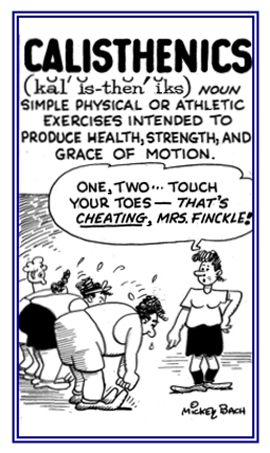
© ALL rights are reserved.
Go to this Word A Day Revisited Index
2. The practice or art of participating in physical exercises: Calisthenics is recommended to relax the muscles before a person starts running; especially, long distance runs.
3. From Greek kalli-, "beautiful" (kallos, "beauty") plus sthenos, "strength".
Go to this Word A Day Revisited Index
so you can see more of Mickey Bach's cartoons.
cardiasthenia
hypersthenia
Abnormal strength, or excessive tension, of the entire body or a part of the body.
myasthenia
Abnormal muscle fatigue or weakness.

Showing page 1 out of 2 pages of 20 main-word entries or main-word-entry groups.