
art-, arti-
(Latin: skill, handicraft, trade, occupation, art)
2. The class of objects subject to aesthetic criteria: "The works of art collectively, including paintings, sculptures, or drawings; such as, a museum of art; an art collection."
3. A field, genre, or category of what is attractive: "Dance is an art that Sara loves."
"The fine arts collectively, often excluding architecture."
4. Illustrative or decorative materials: "Do you have any art work to illustrate your web site?"5. The principles or methods governing any craft or branch of learning: "The art of baking and the art of selling."
6. Skill in conducting any human activity: "Trisha is a master at the art of conversation."
"Art is skilled workmanship, execution, or agency, as distinguished from nature."
7. A branch of learning or university study: "Joseph is studying one of the fine arts or the humanities; including music, philosophy, and literature."8. Etymology: from about 1225, "skill as a result of learning or practice", from Old French art, from Latin artem, ars, "art, skill, craft"; from base ar-, "fit together, join".
In Middle English, usually with the sense of "skill in scholarship and learning" (c.1305); especially, in the seven sciences, or liberal arts (divided into the trivium: grammar, logic, rhetoric; and the quadrivium: arithmetic, geometry, music, astronomy). This sense remains in Bachelor of Arts, etc.
The meaning, "human workmanship" (as opposed to nature) is from 1386. The sense of "cunning and trickery" was first attested about 1600. The meaning, "skill in creative arts" is first recorded 1620; especially, regarding painting, sculpture, etc., from 1668.
In fine arts, "those which appeal to the mind and the imagination" was first recorded in 1767. Arts and crafts, "decorative design and handcraft" was presented in the "Arts and Crafts Exhibition Society", founded in London, in 1888.
The motto of the University of Michigan, USA.
The motto of the New Mexico Highlands University, Las Vegas, New Mexico, USA.
2. Skillful in accomplishing a purpose; especially, by the use of cunning or craft; slyly crafty; deceitful; tricky: "Scott practiced artful schemes to get people to come into his store and to buy his products."
2. Characterized by skillfulness in accomplishing a purpose; especially, by the use of cunning or craft.
2. Something that appears to exist because of the way an object or data is examined: Sam's behavior presented an artifact of his abnormal relations with other people.
3. A structure or feature not normally present but visible as a result of an external agent or action: The decline in the high school test scores was obviously an artifact of the way the test was administered to the students.
4. An inaccurate observation, effect, or result; especially, one resulting from the technology used in scientific investigation or from an experimental error: The pattern in the data which was presented by the government agency was an artifact of the incompetent way it was collected.
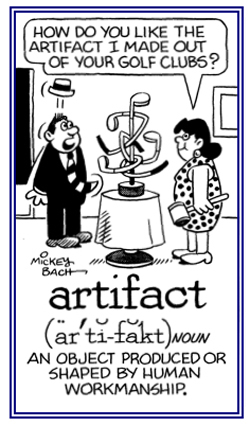
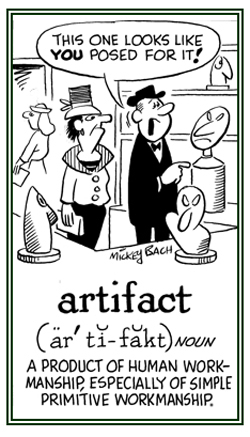
Go to this Word A Day Revisited Index
so you can see more of Mickey Bach's cartoons.
2. A subtle but base deception; trickery: Ben's story was just an artifice to win sympathy from his colleagues.
3. Cleverness or skill; ingenuity: People need artifices to get others to participate in certain activities or to do something.
4. Etymology: borrowed from Old French meaning "craftsmanship"; from Latin artificium, "trade, craft"; from artifex, "craftsman".
A compound construction from ar(t)s, "art, craft" +-fex, fic-, "maker" from facere, "to make".
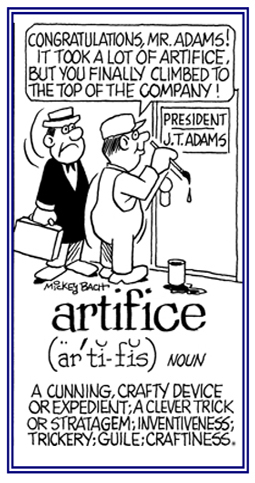
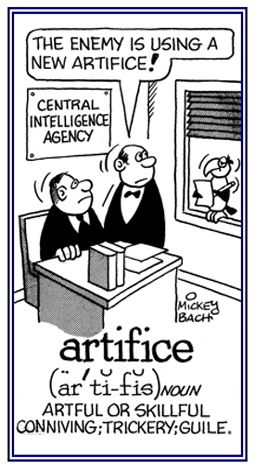
Go to this Word A Day Revisited Index
so you can see more of Mickey Bach's cartoons.
2. A person who is skillful or clever in devising ways of making things; an inventor.
3. A skilled worker who practices some trade or handicraft.
2. Descriptive of something that is imitated; simulated; sham: Barbara used artificial vanilla flavoring when baking her cake.
3. Pertaining to the lack of naturalness or spontaneity; forced; contrived; feigned: Sally greeted the guests with an artificial smile.
4. Concerning something that is full of affectation; affected; stilted: The guests felt very uncomfortable and showed artificial manners in their behaviour and spoke in an artificial way..
5. Relating to something made without regard to the particular needs of a situation, person, etc.; imposed arbitrarily; unnatural: Jack thought the club presented artificial rules for membership.
6. Based on arbitrary, superficial characteristics rather than natural, organic relationships: The botanists presented an artificial system of classification for the plants.
7. Concerning something manufactured to resemble a natural gem in jewelry, with chemical composition, and appearance: The artificial stone in Lynn's ring glistened in the sun.
2. Not by natural means: "The report consisted of artificially induced conditions."
3. Made in imitation of something natural; simulated: "Bill had artificial teeth in his mouth."
