
soli-, sol- +
(Latin: one, alone, only)
desolate (des uh LAYT) (verb), desolates; desolated; desolating
1. To make a place barren or deserted: "The continuous terrorist acts desolated or devastated the village."
2. To make someone feel sad and lonely; having the feeling of being abandoned by friends or by hope: "When her father divorced her mother and moved away, the girl was desolated."
3. Literally, "to leave alone" to be "without companions"; also, "uninhabited", from Latin desolatus, desolare "to leave alone, to desert"; from de-, "completely" + solare, "to make lonely".
2. To make someone feel sad and lonely; having the feeling of being abandoned by friends or by hope: "When her father divorced her mother and moved away, the girl was desolated."
3. Literally, "to leave alone" to be "without companions"; also, "uninhabited", from Latin desolatus, desolare "to leave alone, to desert"; from de-, "completely" + solare, "to make lonely".
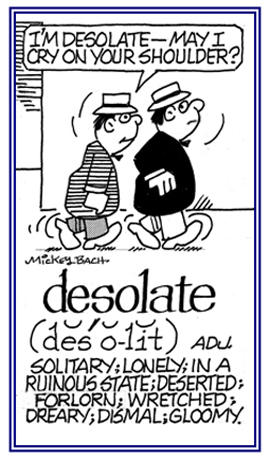
desolate (DES uh lit; DEZ uh lit) (adjective), more desolate, most desolate
1. Relating to the absence of inhabitants; deserted: Jack and Mildred drove for hours along a desolate stretch of the highway before they finally reached a town.
2. Descriptive of a very sad and lonely situation; especially, because someone who is loved has died or gone away: The desolate parents grieved over the death of their daughter.
3. Referring to places that are uninhabited, laid waste, and deserted: The residents could only see a devastated, treeless, and desolate landscape after the fire in their area.
4. Characteristic of a dismal, joyless, gloomy, and without hope condition: Without a job, Henry had desolate prospects for his future.
© ALL rights are reserved.
Go to this Word A Day Revisited Index
2. Descriptive of a very sad and lonely situation; especially, because someone who is loved has died or gone away: The desolate parents grieved over the death of their daughter.
3. Referring to places that are uninhabited, laid waste, and deserted: The residents could only see a devastated, treeless, and desolate landscape after the fire in their area.
4. Characteristic of a dismal, joyless, gloomy, and without hope condition: Without a job, Henry had desolate prospects for his future.
Go to this Word A Day Revisited Index
so you can see more of Mickey Bach's cartoons.
desolately (adjective)
In a desolate manner; solitarily, by oneself; drearily, dismally, cheerlessly.
desolateness (noun)
The state or quality of being desolate; desertedness, dismal barrenness; cheerlessness, dreary misery.
Someone who or that which makes desolate.
desolatingly (adverb)
In a manner that desolates or saddens.
1. A feeling of loneliness and despair: "After the death of her husband, she sank into a state of desolation and despair."
2. A condition of devastation or ruin in a place: "After the powerful earthquake, the country was in utter desolation."
3. The act or process of devastating or laying waste to a place: "The terrible storm was leaving desolation in its path."
2. A condition of devastation or ruin in a place: "After the powerful earthquake, the country was in utter desolation."
3. The act or process of devastating or laying waste to a place: "The terrible storm was leaving desolation in its path."
desolative (adjective)
Having the quality or tendency of desolating.
desolatory (adjective)
Characterized by causing desolation; desolative.
feme sole (s) (noun)
In law, an unmarried woman; specifically, a single woman, including those who have been married, but whose marriage has been dissolved by death or divorce, and, for most purposes, those women who are judicially separated from their husbands.
The opposite is feme covert, "a married woman".
feme sole trader (noun), feme sole traders (pl)
In old English law, a married woman, who, by the custom of London, trades on her own account, independently of her husband; so called because, with respect to her trading, she is the same as a feme sole.
The term is also applied to women who have been deserted by their husbands, who do business as femes sole.
isolate (verb),isolates; isolated; isolating
1. To separate a person or place from others of the same type.
2. In medicine, to keep someone who is infected away from others to prevent the spread of a contagious disease.
3. In biology, to separate out a chemical or biological material, such as a virus or bacterium, in order to identify and study it.
2. In medicine, to keep someone who is infected away from others to prevent the spread of a contagious disease.
3. In biology, to separate out a chemical or biological material, such as a virus or bacterium, in order to identify and study it.
The process of separating someone or something from others, or the fact of being alone and separated from others.
isolationism (s) (noun)
A government policy based on the belief that national interests are best served by avoiding economic and political alliances with other countries.
One who believes in and practices isolationism.
