
sinu-, sin-
(Latin: curve, curving; winding; turning; hollow)
Inflammation of the paranasal sinuses caused by pressure difference within the sinus relative to ambient pressure, secondary to obstruction of the sinus orifice: barosinusitis; sinus squeeze; sinus barotrauma: Aerosinusitis is sometimes due to high altitude flying affecting the occupants of aircraft during flight, particularly during descent, or soon after descent.
"Barotrauma" is a trauma (serious or critical bodily injury, wound, or shock) caused by the rapid or extreme changes in air pressure, especially affecting enclosed cavities within the body, such as the middle ear (otic barotrauma), the sinuses (sinus barotrauma), and the lungs (pulmonary barotrauma.
An inflammation of the mucous membrane of the paranasal sinuses caused by pressure difference within the sinus relative to ambient pressure, secondary to the obstruction of the sinus ostium and occurring during a descent or coming down in the altitude.
1. The inflammation of the lacrimal duct and ethmoid sinus.
2. The inflammation of the lacrimal drainage system in association with ethmoidal sinusitis.
2. The inflammation of the lacrimal drainage system in association with ethmoidal sinusitis.
insinuate (verb), insinuates, insinuated, insinuating
1. To hint at something unpleasant or to suggest it indirectly and gradually.
2. To introduce oneself gradually and cunningly into a position; especially, a place of confidence or favor.
3. To suggest slyly: Shirley insinuated that the boys were lying.
4. To introduce or to insert (oneself) by subtle and artful means.
5. Etymology: from Latin insinuatus, insinuare "to bring in by windings and curving, to wind one's way into"; from in-, "in" + sinuare, "to wind, to bend, to curve", from sinus, "a curve, a winding".
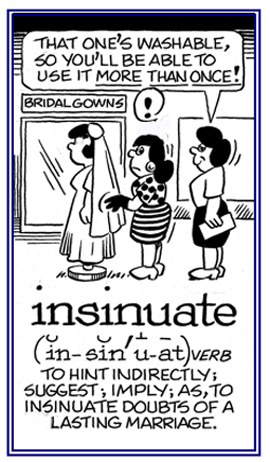
© ALL rights are reserved.
Go to this Word A Day Revisited Index
2. To introduce oneself gradually and cunningly into a position; especially, a place of confidence or favor.
3. To suggest slyly: Shirley insinuated that the boys were lying.
4. To introduce or to insert (oneself) by subtle and artful means.
5. Etymology: from Latin insinuatus, insinuare "to bring in by windings and curving, to wind one's way into"; from in-, "in" + sinuare, "to wind, to bend, to curve", from sinus, "a curve, a winding".
Go to this Word A Day Revisited Index
so you can see more of Mickey Bach's cartoons.
insinuating (adjective), more insinuating, most insinuating
Referring to provoking gradual doubt or suspicion; suggestive: She made insinuating remarks about how unreliable the speaker is.
When anyone describes someone's words or voice as insinuating, he or she means that a person is saying in an indirect way that something bad is the case.
insinuatingly (adverb), more insinuatingly, most insinuatingly
Relating to the tendency to gradually cause doubt, distrust, or a change of outlook often in a slyly subtle manner.
1. Something unpleasant which is artfully and indirectly suggested to another person.
2. The act of hinting at something unpleasant or indicating anything indirectly and gradually.
3. An artfully indirect, often derogatory indication regarding a fact or a situation.
2. The act of hinting at something unpleasant or indicating anything indirectly and gradually.
3. An artfully indirect, often derogatory indication regarding a fact or a situation.
insinuative (adjective), more insinuative, most insinuative
Descriptive of trying to gain confidence or affections or having the power to gain favor from someone.
Someone who makes hints about something that is going on but who is not detailed.
A sinus infection or an inflammation of the air cavities within the passages of the nose: Physicians prescribe antibiotics if bacterial infection is indicated.
The removal of the diseased membrane of all of the paranasal sinuses on one side of the nose.
A sinus infection that exists when one or more of a person's paranasal sinuses becomes inflamed or irritated; however, when all of the paranasal sinuses are inflamed or irritated, then that means someone has pansinusitis.
Pansinusitis may feel like a severe sinus infection, but it often clears up over time without medical treatment.
Inflammation of the nose and paranasal sinuses.
The diseases of the nose and paranasal sinuses.
sinuate (SIN yoo ate) (verb), sinuates; sinuated; sinuating
To curve, to bend, or to wind in and out.

Showing page 1 out of 2 pages of 20 main-word entries or main-word-entry groups.