
sepsi-, sep-, septi-, septico-, septo-, -sepsis, -septic, -septicemia, -septicemic
(Greek: decay, rot, putrefactive)
The sign over the sink in the restaurant cautioned all workers to wash their hands thoroughly as an antisepsis against the spread of disease.
2. A substance that inhibits the growth and reproduction of any disease-causing microorganisms; free of contamination or pollution: Health specialists say that the best antiseptic against illnesses and infection is a thorough hand washing with soap and warm water for at least 30 seconds; especially, whenever one is exposed to things handled by other people; such as, shopping carts or baskets.
One researcher said that people would be safer if they use a disinfectant or an antiseptic to wite the handle of the shopping cart just before they use it.
Researchers say they actually found more fecal bacteria on grocery cart handles than those that are normally found in some bathrooms, primarily because many bathrooms are disinfected more often than an antiseptic is used on the shopping cart handles.
2. Free of disturbing or unpleasant features; sanitized: The historian wrote a revised antiseptic version of the history of Roman times.
2. Free from microorganisms that produce disease, fermentation, or putrefaction: A minimal procedure to ensure one's hands are asepsis is to not only carefully wash them with soap and water, but also to use special alcoholic antiseptics.
Asepsis is a term that is used to distinguish it from "antisepsis" and it applies to the principle in surgery of not applying strong germicides like corrosive sublimate or carbolic acid to wounds.
All of the dressings, swabs, and instruments used in the surgery process are sterilized by steaming, boiling, or dry heat in order to support asepsis.
Asepsis is maintained by using thin, sterilized plastic, or rubber, gloves and gowns with disposable masks which are worn by surgeons to prevent the risk of infection from their hands and wearing apparel.
Surgery that continually utilizes asepsis has the advantage of allowing the germ-destroying activity of the body tissues and their healing powers to increase by not letting antiseptics decrease the vitality of the tissues.
2. The absence of harmful microorganisms: Hospitals are expected to make every effort to keep operating rooms aseptic so patients won’t be contaminated with infectious germs during an operation.
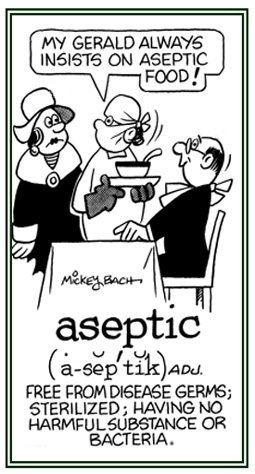
Go to this Word A Day Revisited Index
so you can see more of Mickey Bach's cartoons.
2. Designed to prevent infection from pathogenic microorganisms: Ted, the health practitioner, taught the homeless people some basic lessons in asepticism in order to help them maintain better health.
3. Free of pathogenic microbes: An asepticism of surgical instruments and environment is always a major objective of hospitals.
4. Using methods to protect against infection by pathogenic microorganisms: Dr. Payne insists on preparing a condition of asepticism for patients before any surgical procedures take place.
5. Lacking animation or emotion: Jim's facial asepticism was difficult to maintain all the time while the seals were performing at the aquarium.
2. A system of packaging sterilized products in airtight containers so that freshness is preserved for several months: The packaging industry was always looking for ways to increase aseptics in their productions.
2. The prevention of a severe illness caused by an overwhelming poisoning of the bloodstream by toxin-producing bacteria: Mark takes his vitamins on a daily basis to support his natural autoantisepsis which helps him to stay healthy.
2. A sickness arising from germs within the body; also "endosepsis": The doctor was treating the autosepticemia in Zara’s blood with antibiotics.
Word families with similar applications about: "decay, rotten; wasting away; putrid, pus" word units: phthisio- (decay, waste away); puro- (pus); pus (viscous fluid via an infection); pustu- (blister, pimple); putre- (rotten, decayed); pyo- (pus; purulent); sapro- (rotten, putrid, putrefaction, decay); suppurant- (festering, forming or discharging pus); tabe- (wasting away, decaying).
