agricultural science
(s) (noun), agricultural sciences
(pl)
A broad, multidisciplinary area in the study of agriculture: The field of agricultural science encompasses the parts of exact, natural, economic, and social sciences which are used in the practice and understanding of agriculture.
artes, scientia, veritas
Arts, science, truth.
The motto of the University of Michigan, USA.
Artes/scientias/humanitates.
Translation: "Arts/sciences/humanities."
The motto of the New Mexico Highlands University, Las Vegas, New Mexico, USA.
attoscience
(s) (noun), attosciences
(pl)
The study of the physical processes which occur in less than a fraction of a cycle of visible light, in times less than a quadrillionth of a second.
biobehavioral sciences
(noun) (a plural form used as a singular)
Any of the various branches of the life sciences; such as, neurobiology, neurochemistry, or neuroendocrinologiy, that deal with biological aspects of behavior.
bioscience
(s) (noun), biosciences
(pl)
1. A collective term for the biological sciences including physics, chemistry, etc. wherein all are applicable.
2. A science that studies structures, functions, interactions, or other aspects of living organisms.
3. Any science that deals with the biological aspects of living organisms.
bioscientist
(s) (noun), bioscientists
(pl)
A specialist in any of the life sciences; for example: biology, ecology, physiology, or molecular biology.
Bonitatem et disciplinam et scientiam doce me.
Teach me goodness and discipline and knowledge.
Motto of Marycrest College, Davenport, Iowa, USA; and College of Mount Saint Vincent, Riverdale, New York, USA.
Motto of College of Mount Saint Vincent, Riverdale, New York, USA.
B.S., B.Sc.; Baccalureus Scientiae
Bachelor of Science Degree which university or college students earn after four years of study.
computer science, computer-science
(s) (noun); computer sciences, computer-sciences
(pl)
A branch of science that promotes knowledge which is concerned with information processes, the structures and procedures that represent these processes, and their implementation in the various information-processing systems of computers.
conscience
(s) (noun), consciences
(pl)
1. Inward knowledge or the inmost thought of the mind: While trying to decide what she should do in certain situations, Jane always asked her own inward
conscience and it always lead her to the correct solution.
2. The internal acknowledgement or recognition of the moral quality of one's motives and actions; the sense of right and wrong as regards things for which one is responsible: Jack suddenly had a pang of
conscience regarding his unkind remark to his mother and so he told her he was sorry right away.
3. Etymology: from Old French
conscience, from Latin
conscientia, "knowledge within oneself, a moral sense"; from
con-, "with" +
scire, "to know".
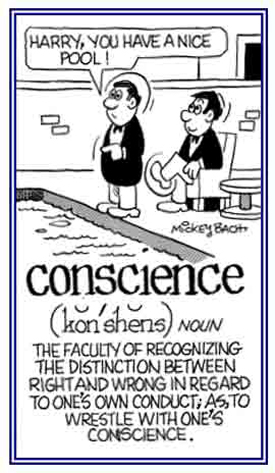 © ALL rights are reserved.
Go to this Word A Day Revisited Index
so you can see more of Mickey Bach's cartoons.
conscientious
(adjective), more conscientious, most conscientious
A reference to what a person has performed or someone who is obedient and loyal to his or her sense of what is right and proper: Doug was very
conscientious about completing his homework everyday after school because he definitely wanted to please his parents and his teachers.
 © ALL rights are reserved.
 © ALL rights are reserved.
Go to this Word A Day Revisited Index
so you can see more of Mickey Bach's cartoons.
conscientiously
(adverb), more conscientiously, most conscientiously
1. A reference to being awake and able to understand what is going on: Being CEO of the company was an objective that Harriet had conscientiously worked for over the years.
2. Descriptive of a regard for right and wrong.
3. Relating to what is done after thinking about the facts and reasons for accomplishing something.
conscious
(adjective), more conscious, most conscious
1. A reference to sharing in the knowledge of, having cognizance of, being a witness to; mentally alive or awake.
2. Relating to having internal perception or consciousness.
3. Conveying an awareness of what one is doing or intending to do: The teacher has a purpose and intention to relate understanding information for students in his class.
4. Etymology: from Latin conscius, "knowing, aware"; from conscire; from Latin scire, "to know"; probably a loan-translation of Greek syneidos.
consciously
(adverb), more consciously, most consciously
1. Conveying an awareness of one's self, acts, and surroundings.
2. A reference to a state of alertness characterized by response to external stimuli.
Related articles about science:
"Science Race";
STEM, Part 1;
STEM, Part 2;
Scientific Specialties.
Inter-related cross references, directly or indirectly, involving word units meaning "know, knowledge; learn, learning":
cogni-;
discip-;
gno-;
histor-;
intellect-;
learn, know;
math-;
sap-;
sopho-.

