
sap-, sapi-
(Latin: wise, wisdom, to be wise, to have wisdom; to know, knowledge; to taste [of], to perceive)
Homo sapiens
Literally "wise man"; the modern human being, the only extant species of the genus, or family, that also included other species named Homo. Of the family, Hominidae.
insipid (adjective), more insipid, most insipid
1. Relating to a person who is uninteresting or has no stimulating qualities: Henry's neighbor was said to have an insipid personality.
2. A reference to something being without sufficient taste to be pleasing; such as, food or drink; bland: Ella told the waiter at the restaurant that he had served her an insipid soup.
3. Etymology: from Latin insipidus, "tasteless", from in-, "not" + sapidus, "savory, tasty".
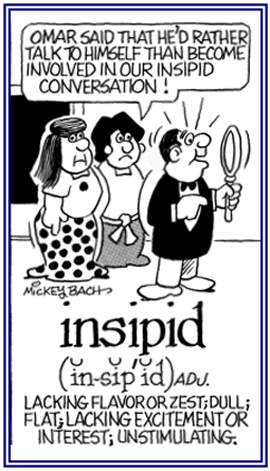
© ALL rights are reserved.
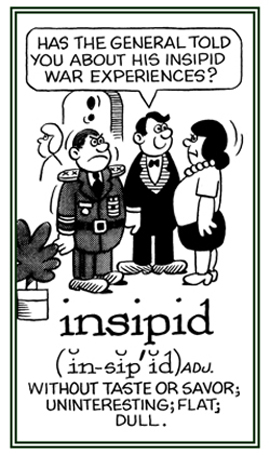
© ALL rights are reserved.
Go to this Word A Day Revisited Index
2. A reference to something being without sufficient taste to be pleasing; such as, food or drink; bland: Ella told the waiter at the restaurant that he had served her an insipid soup.
3. Etymology: from Latin insipidus, "tasteless", from in-, "not" + sapidus, "savory, tasty".
Go to this Word A Day Revisited Index
so you can see more of Mickey Bach's cartoons.
insipidity
Lacking a strong taste or character, or lacking interest or energy.
1. A lack of intelligence, wisdom, or understanding; stupidity or foolishness: Mark's incipience regarding hockey is not surprising because he has never played or even attended a hockey game.
2. Etymology: from Middle English which came from Old French that came from Latin insipientia, from insipins, insipient, "not wise; from in-, "not" + sapins, "wise".

© ALL rights are reserved.
Go to this Word A Day Revisited Index
2. Etymology: from Middle English which came from Old French that came from Latin insipientia, from insipins, insipient, "not wise; from in-, "not" + sapins, "wise".
Go to this Word A Day Revisited Index
so you can see more Mickey Bach illustrations.
insipient
1. Lacking wisdom; stupid; foolish.
2. An unwise or foolish person.
2. An unwise or foolish person.
insipiently
Unwisely, unfoolishly.
resipiscence
Wisdom derived from severe experience; hence, repentance.
resipiscent
1. Having returned to a saner mind or to have one's sanity restored.
2. To learn from experience.
2. To learn from experience.
sage
1. A reference to a person who is considered to be wise, discreet, and judicious.
2. Practically wise, rendered prudent or judicious by experience.
3. With reference to advice, conduct, etc.; characterized by profound wisdom; based on sound judgement.
4. Exhibiting sageness or profound wisdom.
5. A man of profound wisdom; especially, one of those people in ancient history or legend who were traditionally famous as the wisest of mankind; hence, one whose exceptional wisdom entitles him to a degree of veneration or respect.
6. Etymology: "wise" from Old French sage, from Latin sapere, "to have taste, to have good taste or discernment, to be wise".
2. Practically wise, rendered prudent or judicious by experience.
3. With reference to advice, conduct, etc.; characterized by profound wisdom; based on sound judgement.
4. Exhibiting sageness or profound wisdom.
5. A man of profound wisdom; especially, one of those people in ancient history or legend who were traditionally famous as the wisest of mankind; hence, one whose exceptional wisdom entitles him to a degree of veneration or respect.
6. Etymology: "wise" from Old French sage, from Latin sapere, "to have taste, to have good taste or discernment, to be wise".
sapid
1. With reference to food, etc.; readily perceptible by the organs of taste, having a decided taste or flavor; especially, having a pleasant taste, savory, palatable.
2. In a neutral sense; having the power to affect the organs of taste; having taste or flavor.
3. Grateful to the mind or mental taste.
2. In a neutral sense; having the power to affect the organs of taste; having taste or flavor.
3. Grateful to the mind or mental taste.
sapidity
1. The quality of being sapid or having taste and flavor.
2. Perceptible to the sense of taste; having flavor.
3. Having a strong pleasant flavor; savory.
4. Pleasing to the mind; engaging.
2. Perceptible to the sense of taste; having flavor.
3. Having a strong pleasant flavor; savory.
4. Pleasing to the mind; engaging.
sapience
1. Wisdom and understanding; the ability to apply knowledge or experience or understanding or common sense and insight.
2. Spiritual wisdom, knowledge of divine things.
3. Having great wisdom and discernment.
4. The ability to apply knowledge or experience or understanding or common sense and insight; wisdom.
2. Spiritual wisdom, knowledge of divine things.
3. Having great wisdom and discernment.
4. The ability to apply knowledge or experience or understanding or common sense and insight; wisdom.
sapient
1. Acutely insightful and wise.
2. Having or showing great wisdom or sound judgment.
2. Having or showing great wisdom or sound judgment.
sapiential
1. Containing, exhibiting, or affording wisdom; characterized by wisdom.
2. Characterized by wisdom; especially, the wisdom of God: "They tried to have a sapiential government."
3. Having or offering wisdom.
2. Characterized by wisdom; especially, the wisdom of God: "They tried to have a sapiential government."
3. Having or offering wisdom.
sapiently, sapientially
In a sapient manner.
Don't confuse this sap-, sapi- with another sap- [sapo-] that means "soap" or another sap-, sapro- which means, "rotten, putrid".
Inter-related cross references, directly or indirectly, involving word units meaning "know, knowledge; learn, learning": cogni-; discip-; gno-; histor-; intellect-; learn, know; math-; sci-; sopho-.

Showing page 1 out of 2 pages of 26 main-word entries or main-word-entry groups.