sali-, salt-, -sili-, sult-, -salta-
(Latin: to leap, leaping; to jump, jumping; to hop, hopping; to spring forward, springing forward)
Don't confuse this sali-, salt-; "jump" unit with another sal-, sali- unit which refers to "salt".
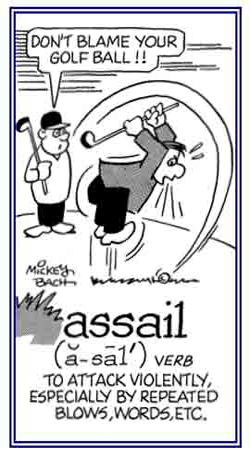
It is difficult to believe that Mike could be assailed by so many bad things; he lost his job, his wife became very ill, and the roof of his house was damaged by a storm that caused severe leaks when it started to rain.
2. To attack with arguments, criticism, ridicule and to abuse: As a politician, Thomas was always ready to assail his opponents with slander.3. To undertake a task with the purpose of mastering it: Joanne assailed her university studies with new determination.
4. To impinge upon; to make an impact on; to beset: The minds of members of the audience were assailed by all of the conflicting arguments presented by the speakers.
Go to this Word A Day Revisited Index
so you can see more of Mickey Bach's cartoons.
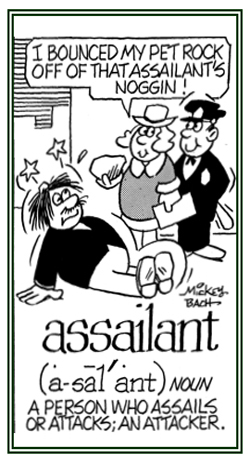
2. People who strike, raid, or invade with violence to others: Mike and Jill were assailants who were arrested for committing burglary when they were caught leaving the house with the property of the people who lived there.
Go to this Word A Day Revisited Index
so you can see more of Mickey Bach's cartoons.
So many members of the assailed family were killed or seriously wounded by the bomb that was thrown into their house.
Rufus, the robber, was charged by the police with robbery and assault with a deadly weapon.
2. A military raid or onslaught: The military forces were involved in assaults that lasted for several months.Diana accused her next door neighbor of sexually assaulting her daughter.
2. To use violent force or to bombard someone or the senses with something undesirable or unpleasant: The ears of the people were assaulted by the loud music from the neighbor's apartment.3. To carry out a military offensive against an enemy using weapons: The unit of special forces parachuted into the camp and assaulted the gang and rescued the hostages that were abducted by the criminals.
The people in the neighborhood were relieved to hear that Jack, the assaulter of their houses, was finally arrested by the police.
2. Someone who is extremely aggressive or forcefully assertive: Gary had a loud and assaultive style of playing that sometimes made the other players cautious.
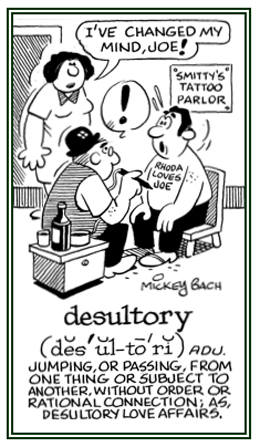
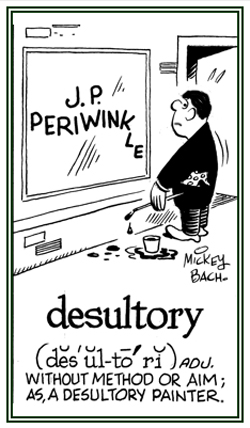
The politician, Mr. Swift, was going from one subject to another in a desultorily halfhearted way.
2. Pertaining to something which occurs randomly or occasionally: As a result of the poor economy, the fashionable clothing store has desultorily sold anything.2. Relating to a random, disorganized, or unmethodical way of doing something: Hans, the candidate, had a desultory conference with the reporters.
People were casually strolling in the park during the pleasant day in a desultory way.
3. Marked by a lack of a definite course, regularity, or purpose; jumping from one thing to another: When John was asked what his speech would be about, he could only come up with desultory ideas.Daniel made a desultory effort to improve his tennis skills by playing for three hours on one day and then not playing again for several days.
4. A reference to being unconcerned and without having any particular arrangement: Yvonne scolded her son for throwing his clothes around on his bed in a desultory way.