
rupt-, -rupting, -ruption
(Latin: break, tear, rend; burst)
The open-air concert came to an abrupt end when the rain storm started.
There was an abrupt change in the weather from sunshine to a thunder storm.
2. Pertaining to something that is surprisingly curt; brusque, such as a quick answer made in anger: Leonard's abrupt reply hurt the couple's feelings.In an effort to avoid appearing abrupt in her mannerisms, the teacher smiled in a friendly fashion.
Mike's abrupt response was obviously made in anger and it hurt Jean's feelings.
3. Regarding short comments made by skipping from one subject to another with sudden transitions: The speaker made abrupt references to several different topics during the few minutes he spoke.4. Steeply inclined; having a sharp inclination; precipitous: The cliff made an abrupt descent to the sea.
5. In botany, terminating suddenly rather than gradually; truncate: a leaf with a shortened stalk: The stem of the leaf became abrupt and narrowed close to the main branch of the tree.
6. Etymology: made up of ab-, "off" + rumpere, "to break", "to break off".
The past participle abruptus resulted in the English word abrupt, "broken off". In Modern English this meaning has been applied figuratively to the manner of a person who speaks or acts suddenly and curtly, or to things that change suddenly; "breaking off" unexpectedly.
"Rupture" is an English word that still retains the literal meaning of "breaking", as do disrupt and interrupt, all derived from the same Latin "rump ere".
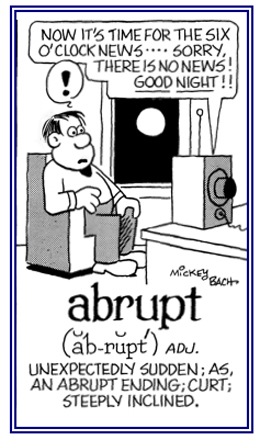
Go to this Word A Day Revisited Index
for a list of additional Mickey Bach illustrations.
The trail for the donkeys ended abruptly and the tourists had to hike the remaining distance to the lookout point.
2. The state of being abrupt or broken; craggedness; ruggedness; steepness.
- Increasing Political Accountability
- Strengthening Civil Society Participation
- Creating a Competitive Private Sector
- Institutional Restraints on Power
- Improving Public Sector Management
To reduce the corrosive impact of corruption in a sustainable way, it is important to go beyond the symptoms to tackle the causes of corruption. Since 1996, the World Bank has supported more than 600 anticorruption programs and governance initiatives developed by its member countries.
"Indian anti-corruption leader organizes mass rally. Thousands of people have poured into the streets in various Indian cities to support Mr. Hazare and his campaign to create a new, independent anti-corruption agency with powers to investigate governmental officials."
2. Opposing moral perversion, degeneracy, and depravity.
3. Working against the destruction of honesty or opposed to undermining moral integrity.
4. Making efforts to stop the bribery of public officials who are willing to violate their proper responsibilities as office holders: "Australia's anti-corruption for development policy provides a framework for planning, resourcing, and reviewing anti corruption activities on a country and regional basis. Australia's approach to anti-corruption will focus on three mutually reinforcing elements."
5. Making efforts to stop decay or progressive putrescence, rottenness, or decay: "Keeping meat, dairy products, etc. in the refrigerator before consumption is a form of anticorruption."
2. Any insolvent debtor; a person, or organization, that is unable to satisfy any justified monetary claims made upon it: "As a result of being bankrupt, the company went out of business."
3. A person who is totally lacking in a specified resource or quality: "Jerome was considered to be intellectually bankrupt."
4. Etymology: from Italian banca rotta, from banca "moneylender's shop"; litterally, "bench" + rotta "broken, defeated, interrupted" from (and remodeled on) Latin rupta, past participle of rumpere "to break".

Being bankrupt or insolvent started long before our modern times
The original meaning in Italian was the ruin or breaking up of a trader's business because of his failure to pay creditors, or the abandonment of business to avoid paying debts. The modification of this sense to mean "an insolvent person" is peculiar to English.
In medieval times, Italian moneylenders used a small bench in the markeplace to conduct their business. The Latin word for such a bench, banca, is in fact the source for the English word bank. These money lenders, the "bankers" of their day, were required to break up their benches if they failed in business.
The term bankrupt appeared in 1543 and was borrowed through Middle French banqueroute, and directly from Italian banca rotta, "bankruptcy" (literally, "bank broken"; rotta from rompere, "to break", from Latin rumpere, "to break"; the modern form -rupt is an alteration of Medieval Latin ruptus, "broken", and as a noun meaning "a bankrupt"), later became the English word bankrupt.
2. To ruin: "The newspaper had an administration that bankrupted its credibility by seeking to manipulate the news."
2. A lack of resources; the complete lack of a particular quality; especially, good or ethical qualities; moral bankruptcy.
2. A reference to being depleted of valuable qualities or characteristics: "The senator turned out to be a morally and ethically bankrupted politician."
3. Characteristic of being totally depleted; destitute: "Jerome was bankrupt of new ideas for the project." 4. Relating to being in a ruined state: "The country had in a bankrupted foreign policy and a bankrupted economy."
