
rudi-, rud-
(Latin: rough, unformed, unwrought; ignorant, untutored)
erudite (ER yuh dight", ER uh dight") (adjective), more erudite, most erudite
1. Descriptive of someone who has great learning that has been gained from study and reading: After graduation from medical school, Kim had erudite knowledge which was very substantial and comprehensive.
2. Relating to a style of writing that shows a high level of scholarly or profound knowledge: At the library, Max checked out two very erudite books about philosophy.
3. Etymology: from the Latin eruditus, “learned, well-instructed”; from the past participle of the verb erudire, “to educate, train”; from the prefix ex–, “out, out of”, and the adjective rudis, “untaught, untrained”.
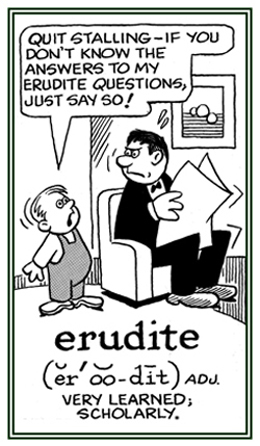
© ALL rights are reserved.
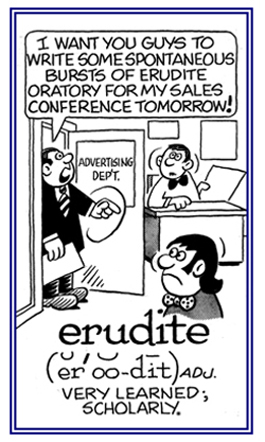
© ALL rights are reserved.
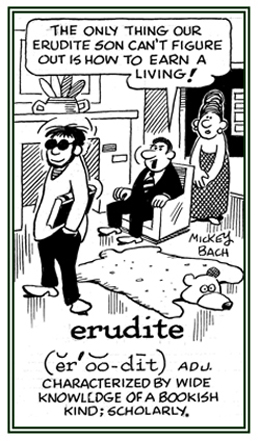
© ALL rights are reserved.
Go to this Word A Day Revisited Index
2. Relating to a style of writing that shows a high level of scholarly or profound knowledge: At the library, Max checked out two very erudite books about philosophy.
3. Etymology: from the Latin eruditus, “learned, well-instructed”; from the past participle of the verb erudire, “to educate, train”; from the prefix ex–, “out, out of”, and the adjective rudis, “untaught, untrained”.
Go to this Word A Day Revisited Index
so you can see more of Mickey Bach's cartoons.
eruditely
With erudition; in an erudite manner; for example, "He talked eruditely about computer technology."
eruditeness
Profound, scholarly knowledge; enlightenment, education that results in understanding and the spread of knowledge.
Eruditio et meritum pro omnibus.
Translation: "Learning and benefit for all."
Motto of Isothermal Community College, Spindale, North Carolina, USA.
Eruditio, ductus, societas.
Learning, leadership, fellowship.
Motto of Indian River Community College, Ft. Pierce, Florida, USA.
Knowledge acquired through study and reading: Henry was a reporter with great erudition despite the fact that he never completed his high school education.
eruditional
eruditionist
Someone who devotes himself/herself to erudition or training.
inerudite
Not erudite; unlearned, uninstructed.
inerudition
Lacking in erudition; unlearned condition.
nonerudite
noneruditely
noneruditeness
omnierudite
Someone who is educated in all subjects, or who possesses universal knowledge.

Showing page 1 out of 2 pages of 23 main-word entries or main-word-entry groups.