
ripari-, ripa-, rip-, riv-
(Latin: ripa, river, stream; bank, river bank, shore)
2. An aircraft, train, or bus reaching an airport or station.
3. The reaching of a goal or objective as a result of some effort or a process.
The coming to, or reaching a place, from a distance, whether by water, as in its original sense, or by land.
4. Etymology: from Middle English arrivaile; from Old French arriver, "to arrive"; from Vulgar Latin arripare, "to touch the shore"; from ad-, "to" and Latin ripa, "shore, bank".2. To be delivered, or brought, to someone or something: Mildred was waiting for the mail to arrive.
3. To begin, or to happen, after a period of time or of waiting: The contractors were told that they would have to complete the construction work before winter arrives.
4. To reach a decision after thinking about or discussing a problem: Joe was asked how he was able to arrive at a decision to write so many pages.
5. To enter life by being born: The baby arrived on the day that the doctor had predicted.
6. Having reached a destination or place: Jane arrived at the hotel and went to her room after the taxi took her there from the airport.
7. Etymology: from Old French ariver, "to come to land"; from Latin arripare, "to touch the shore"; from ad ripam, "to the shore"; from ad, "to" + ripa, "shore", with an original meaning of "coming ashore after a long voyage".
2. A reference to anything that can be received from ancestors: A derivable estate often comes from a relative.
2. The formation of a term, from another one or from a basic form.
3. The historical origin and development of an entry: An etymology is an example of a derivation
4. A mathematical, or logical argument, whose steps show that the conclusion follows necessarily from initial assumptions.
5. The act of obtaining something from a source or issuing from a source.
6. Etymology: from Latin derivare, "to lead or to draw off (a stream of water) from its source".
Then from Old French deriver. "to flow, to pour out; to originate".
2. A word that is formed from another word; for example, "quickly" from "quick" or "electricity" from "electric".
3. A chemical substance that is formed from a related substance; such as, an opium derivative.
4. A financial product that can be traded and whose value depends on the value of some other asset or combination of assets.
A contract, or security, that derives its value from that of another form ov security or from the value of a rate; such as, interest or a currency exchange, or the index of a stock index.
Derivatives often take the form of customized contracts transacted outside of security exchanges, while other contracts; such as, standard index options and futures, are openly traded on such exchanges.
A derivative is also defined as a contract to buy or to sell an asset or to exchange cash, based on a specified condition, event, occurrence, or another contract.
5. Etymology: from French derivatif (15th century), from Latin derivativus, from the past participle stem of derivare, "to lead or to draw off (a stream of water) from its source"; from de, "from" + rivus. "stream".2. To arrive at by reasoning; to deduce or to infer: Mildred always strives to derive a conclusion from facts rather than from guessing.
3. To trace the origin, or development, of a word.
4. To develop from another word or a source word or term.
5. To create a chemical substance from another substance.
6. Etymology: from Old French deriver; from Latin derivare, "to lead" or "to draw off (a stream of water) from its source"; from the phrase de rivo, from de, "from" + rivus, "stream".
2. Anyone who receives, or obtains something; especially, from a specified person or place.
The Riparias nest in tunnels usually produced by the birds themselves in a natural sand bank or earth mound along streams or rivers.
Riparias lay white eggs, which are incubated by both parents, in a nest of straw, grass and feathers in a chamber at the end of the burrow.
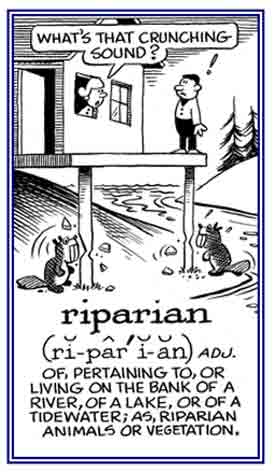
Go to this Word A Day Revisited Index
so you can see more of Mickey Bach's cartoons.
Cross references of word families that are related directly, or indirectly, to: "river, stream": amni-; fluvio-; meand-; oceano-; potamo-.
