
re-, red-
(Latin: back, backward, again; used as a prefix)
recalcitrant (adjective), more recalcitrant, most recalcitrant
1. Marked by stubborn resistance to and defiance of authority or guidance: A recalcitrant person is someone who is not obedient or compliant with anyone who tries to control him or her.
2. Etymology: from Latin recalcitrantem; literally, "kicking back", past participle of recalcitrare, "to kick back"; from re-, "back" + calcitrare, "to kick."
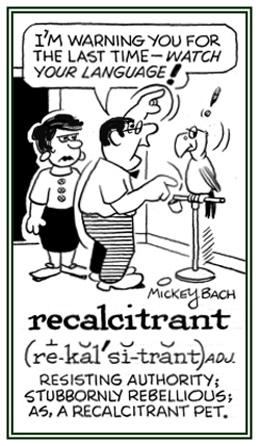
© ALL rights are reserved.
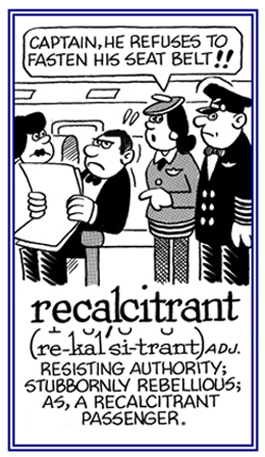
© ALL rights are reserved.
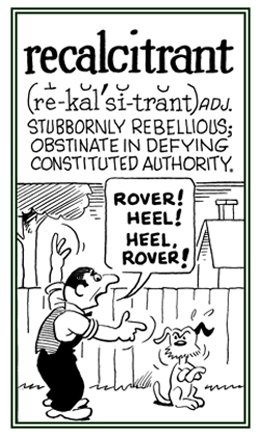
© ALL rights are reserved.
Go to this Word A Day Revisited Index
2. Etymology: from Latin recalcitrantem; literally, "kicking back", past participle of recalcitrare, "to kick back"; from re-, "back" + calcitrare, "to kick."
Being "stubborn as a mule" is just one good example of being recalcitrant.
Go to this Word A Day Revisited Index
so you can see more of Mickey Bach's cartoons.
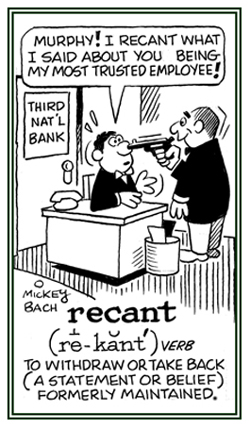
recant (verb), recants; recanted; recanting
1. To formally reject or to disavow a formerly held belief, usually under pressure: The witness was pressured to recant her testimony in court.
2. To deny believing in something or to withdraw something previously said: When confronted with new evidence, the spy recanted her evidence which had sounded so believable before.
3. To make a formal retraction or disavowal of a previously held statement or belief: The senator agreed to recant his allegations about the President and signed a formal statement indicating his new position.
4. Etymology: from about 1535, from Latin recantare, "to recall, to revoke"; from re-, "back" + cantare, "to sing, to chant".
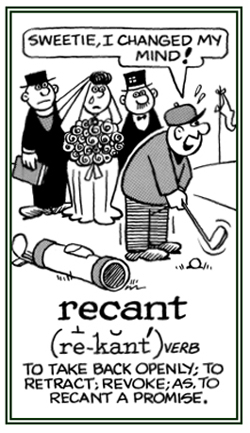
© ALL rights are reserved.
© ALL rights are reserved.
Go to this Word A Day Revisited Index
2. To deny believing in something or to withdraw something previously said: When confronted with new evidence, the spy recanted her evidence which had sounded so believable before.
3. To make a formal retraction or disavowal of a previously held statement or belief: The senator agreed to recant his allegations about the President and signed a formal statement indicating his new position.
4. Etymology: from about 1535, from Latin recantare, "to recall, to revoke"; from re-, "back" + cantare, "to sing, to chant".
A loan-translation of Greek palinoidein, "recant", from palin, "back" + oeidein, "to sing".
Go to this Word A Day Revisited Index
so you can see more of Mickey Bach's cartoons.
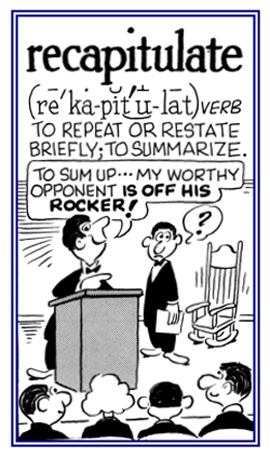
recapitulate (verb), recapitulates; recapitulated; recapitulating
1. To summarize the main ideas: When the professor had finished his lecture, a student recapitulated the talk in a few words.
2. To repeat briefly: The speaker was told that his point was understood and that it was not necessary to recapitulate anything.
3. Etymology: from Latin recapitulare, "to sum up"; from re-, "again" + capitulare, "to draw up under headings"; from capitulum, "little head", "chapter"; from caput, "head".
© ALL rights are reserved.
Go to this Word A Day Revisited Index
2. To repeat briefly: The speaker was told that his point was understood and that it was not necessary to recapitulate anything.
3. Etymology: from Latin recapitulare, "to sum up"; from re-, "again" + capitulare, "to draw up under headings"; from capitulum, "little head", "chapter"; from caput, "head".
Go to this Word A Day Revisited Index
so you can see more of Mickey Bach's cartoons.
recapitulation
recede (verb), recedes; receded; receding
1. To move back or away from a limit, point, or mark; for example, the people waited for the flood waters to recede before they could return to their homes.
2. To slope backward.
3. To become or seem to become fainter or more distant.
4. To withdraw or to retreat.
5. Etymology: from French receder, from Latin recedere, "to go back, to withdraw"; from re-, "back" + cedere, "to go".
2. To slope backward.
3. To become or seem to become fainter or more distant.
4. To withdraw or to retreat.
5. Etymology: from French receder, from Latin recedere, "to go back, to withdraw"; from re-, "back" + cedere, "to go".
receive (verb), receives; received; receiving
1. To get, to acquire, or to take into one's possession: "Jane received many birthday gifts."
2. Etymology: from Old North French (the dialect of northern France before the 1500s), receivre, Old French recoivre; from Latin recipere, receptus "to regain, to take back, to recover, to take in"; from re-, "back" + -cipere, a combining form of capere, "to take".
2. Etymology: from Old North French (the dialect of northern France before the 1500s), receivre, Old French recoivre; from Latin recipere, receptus "to regain, to take back, to recover, to take in"; from re-, "back" + -cipere, a combining form of capere, "to take".
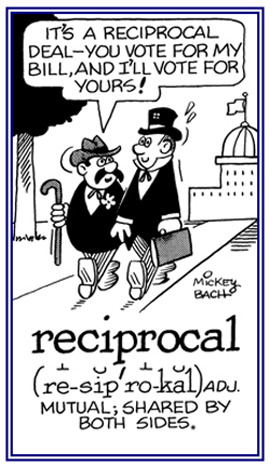
reciprocal (adjective) (not comparable)
1. A reference to something that is mutual or done in return; given or felt by each toward the other; mutual: James and Jerry had reciprocal respect for each other.
2. Descriptive of something given, performed, felt, etc., in return; concerning something given or shown by each of two sides or people to the other: After the German exchange group visited Tamworth, the English students planned on a reciprocal visit the following year.
3. Conveying a corresponding; matching; complementary; equivalent: The members of the fitness studio were able to have reciprocal privileges at other health clubs.
4. In grammar, with reference to a pronoun or verb; expressing mutual relationship or action: "Each other” and “one another” are reciprocal pronouns.
5. Pertaining to something which is inversely related or proportional; opposite: The contrasting, or reciprocal, color of fabric used for the lining was bright red as opposed to the bright blue color of the dress.
6. Etymology: from Latin reciprocus, "turning back the same way, alternating", which stands for reco-procos and is a compound of the adjectives recos, "turning backward", and procos, "turning forward"; therefore, reciprocus originally meant "turning backward and forward".
© ALL rights are reserved.
Go to this Word A Day Revisited Index
2. Descriptive of something given, performed, felt, etc., in return; concerning something given or shown by each of two sides or people to the other: After the German exchange group visited Tamworth, the English students planned on a reciprocal visit the following year.
3. Conveying a corresponding; matching; complementary; equivalent: The members of the fitness studio were able to have reciprocal privileges at other health clubs.
4. In grammar, with reference to a pronoun or verb; expressing mutual relationship or action: "Each other” and “one another” are reciprocal pronouns.
5. Pertaining to something which is inversely related or proportional; opposite: The contrasting, or reciprocal, color of fabric used for the lining was bright red as opposed to the bright blue color of the dress.
6. Etymology: from Latin reciprocus, "turning back the same way, alternating", which stands for reco-procos and is a compound of the adjectives recos, "turning backward", and procos, "turning forward"; therefore, reciprocus originally meant "turning backward and forward".
Reciprocal, when all things are considered, is a compound adjective based on the elements re-, "back, backward" and pro-, "for, forward".
Go to this Word A Day Revisited Index
so you can see more of Mickey Bach's cartoons.
A relation of mutual dependence or action or influence: Jane was very happy with the reciprocality among the neighbours in the condo building because of the friendliness and returned help when asked for or needed.
reciprocally (adverb), more reciprocally, most reciprocally
Descriptive of how something affects the other and is equally affected by it; interchangeably; mutually: After being humiliated by her classmate, Judy responded reciprocally by calling her a real jerk and an imbecile..
The quality or condition of being equally mutual in returning something: Mary appreciated the reciprocalness of her friend helping her with the shopping after she did the same a week before.
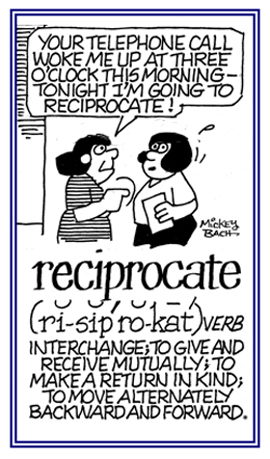
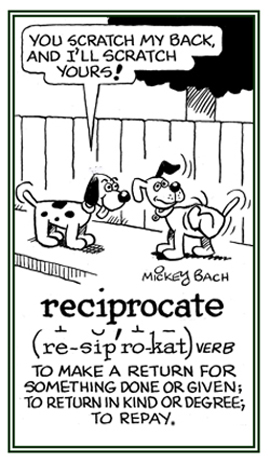
reciprocate (ri SIP ruh kayt") (verb), reciprocates; reciprocated; reciprocating
1. To give, to feel, to do something similar in return for what each one has done to the other one: Monica was treated very nicely by her boyfriend and so she reciprocated by giving him a hug.
3. Etymology: from Latin reciprocare "to move back" and "forth"; from re-, "backward" + pro, "forward" + -cate, "normally a verb ending".
© ALL rights are reserved.
© ALL rights are reserved.
Go to this Word A Day Revisited Index
Anyone who reciprocates is returning the same kind of treatment that another person has done to him or to her, whether it is good or bad.
2. To interchange; each person or group giving or doing to the other the same thing; to give, to feel, etc., in return: Alice loved her daughter Lucy very much, and this love was certainly reciprocated by Lucy towards her mother as well.3. Etymology: from Latin reciprocare "to move back" and "forth"; from re-, "backward" + pro, "forward" + -cate, "normally a verb ending".
Go to this Word A Day Revisited Index
so you can see more of Mickey Bach's cartoons.
reciprocating (adjective), more reciprocating, most reciprocating
Pertaining to something that causes or moves backward and forward: Mr. Young read about the reciprocating engine that was supposed to power fabric mills throughout the country.
1. An action or an arrangement that involves two people or groups of people who behave in the same way or agree to help each other and give each other advantages: Sally was impressed with the reciprocation of kindness among her friends.
2. A returning, usually for something given: Mary wanted to invite her neighbor over for lunch as a reciprocation for taking her to the doctor's offie the week before.
3. A mutual giving and receiving: The two sisters thought that the reciprocation of giving each other Christmas presents every year was a great thing.
4. In prosthodontics, the means by which one part of an appliance is made to counter the effect created by another part: Prosthodontics refers to a dental specialty concerned with the restoration and maintenance of oral function by the reciprocation or replacement of missing teeth and structures by artificial devices or prostheses.
2. A returning, usually for something given: Mary wanted to invite her neighbor over for lunch as a reciprocation for taking her to the doctor's offie the week before.
3. A mutual giving and receiving: The two sisters thought that the reciprocation of giving each other Christmas presents every year was a great thing.
4. In prosthodontics, the means by which one part of an appliance is made to counter the effect created by another part: Prosthodontics refers to a dental specialty concerned with the restoration and maintenance of oral function by the reciprocation or replacement of missing teeth and structures by artificial devices or prostheses.
reciprocative (adjective), more reciprocative, most reciprocative
Relating to something given, done, or owed to each other: The two neighbouring countries were interested in reciprocative trade, and, in addition, in reciprocative aid in case of a of disaster of any kind.
