
rap-, rav-
(Latin: tearing away, seizing, swift, rapid; snatch away, seize, carry off; from Latin rapere, "to seize by force and to carry off")
2. Etymology: from Latin correptio, then from corripere, "to seize".
Susie's enrapt audience wanted to hear more of her singing.
2. To have a powerful, agreeable, and often overwhelming emotional effect on people: Mary and the other school children were enraptured by the Mrs. Thompson's stories.
2. Feeling great pleasure or delight; ecstatic, impassioned, or enthusiastic: The enraptured response of the people to the music at the concert was greatly appreciated by the conductor, Mr. Johnson, and the musicians.
2. Washing away or the washing off of loose material; such as, earth, sand, etc. as a result of flowing water: Large waves, or a series of waves, caused by an earthquake that moved large quantities of water in the ocean, created all kinds of fluviraptions when they hit land.
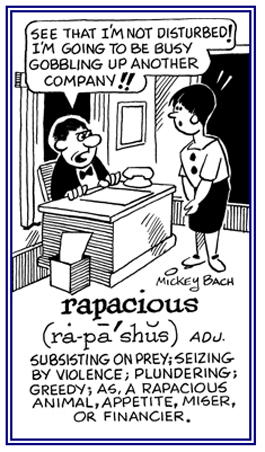
2. Relating to someone or those who are ravenous or greedy: The children ate in a rapacious way by grabbing and filling their mouths full and eating voraciously.
3. A reference to an animal that lives by preying on other animals, especially by catching live prey: The rapacious wolves devoured the deer as quickly as they could.
Go to this Word A Day Revisited Index
so you can see more of Mickey Bach's cartoons.
3. A reference to the devouring or craving food in great quantities: Despite her liver condition, she was rapaciously eating large quantities of fatty foods.
2. Extreme gluttony: For many people, obesity has been the result of rapaciousness in what has been eaten and the excessive quantities of their consumptions.
3. An excessive desire or greediness for wealth (usually in large amounts): The rapaciousness of some lawyers and certain business people is antagonizing more and more people; especially, those who are finding it more difficult to survive in these bad economic conditions.
2. An act of plunder, violent seizure, or abuse: The rape of the countryside was committed by military forces which were out of control.
3. The act of seizing and carrying off by force: History has many examples of the rapes of ancient cities.
4. Etymology: "to seize prey, to take by force," from Anglo-French raper, Old French raper, "to seize, to abduct"; a legal term, from Latin rapere, "to seize, to carry off by force, to abduct".
Latin rapere was used for "sexual violation", but only very rarely; the usual Latin word being stuprum; literally, "disgrace".
The sense of "sexual violation" or "ravishing of a woman" was first recorded in English as a noun, in 1481 A.D. The noun sense of "taking anything (including a woman) away by force" is from about 1400 A.D.
According to the law, the marital status of the person who is raped is usually irrelevant; moreover, the crime is codified under various names, including first degree sexual assault, sexual battery, unlawful sexual intercourse, and first degree sexual abuse.
2. To plunder or to pillage: The Romans raped (sacked or plundered) many places during their years of conquering.2. A reference to something taking place within a short time or quickly: With the heavy rainfall, the rapid growth of the forest was predictable.
3. Descriptive of moving or acting with great speed: Because of her rapid skills in sorting the tray of polished stones, the new worker, Janet, earned a bonus in her pay.
4. Characterized by speed: The rapid gesture of the swordsman distracted his opponent during the competition and that’s how Tom won the contest.
5. Etymology: rapid is traced back to 1634, from Latin rapidus, "hasty, snatching", from rapere, "hurry away, carry off, seize, plunder" (related to Greek ereptomai, "devour"; harpazein "snatch away").
Rapids is from 1765, from French rapides, applied by French voyagers to North American rivers.
Like "rape" and "rapture", rapid came ultimately from Latin rapere, "seize by force". From this was derived the adjective rapidus, which originally indicated "carrying off by force".
The notion of "swiftness" soon became incorporated into the meaning and although the Latin adjective retained its original connotations of "violence" (it suggested "impetuous speed" or "haste); by the time it reached English, it had simply become synonymous with "quick" or "fast".
The new student, Jennifer, amazed the teacher and the class with her rapidity in solving mental math calculations.
2. With great speed, celerity, or velocity; swiftly: The velocity of the winds was rapidly increasing the intensity of the hurricane.
3. With quick progression; such as, to run with great speed; to grow or to improve quickly: During the foot race, their team member, Toby, was observed rapidly gaining on the racer from the other school.
4. With fast utterance or talking: It was difficult to understand Mildred, the speaker, because she tended to speak too rapidly. Maybe she was too nervous.
