
pro-, por-, pur-
(Greek > Latin: a prefix signifying before; forward, forth; for, in favor of; in front of; in place of, on behalf of; according to; as, to place before; to go before or forward, to throw forward)
portend (verb), portends; portended; portending
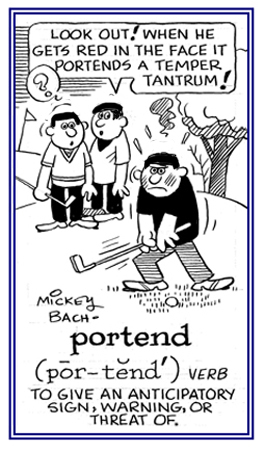
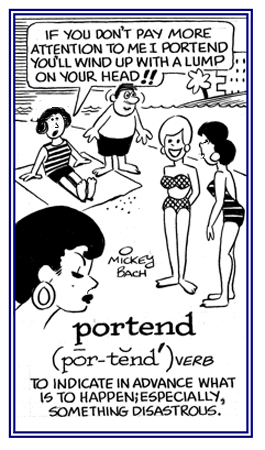
1. To foreshadow or to warn people that something is going to happen: The thunder and lightening portended that a storm was about to take place.
2. To indicate or to signify in advance: The icy roads and winter snow storm were portending several auto accidents.
3. To predict or to forecast: The economist on TV was saying that leading economic indicators were portending a recession.
4. Etymology: from early 15th century, from Latin portendere, "to foretell"; originally, "to stretch forward"; from por-, a variant of pro-, "forth, forward" + tendere "to stretch, to extend."
© ALL rights are reserved.
© ALL rights are reserved.
Go to this Word A Day Revisited Index
2. To indicate or to signify in advance: The icy roads and winter snow storm were portending several auto accidents.
3. To predict or to forecast: The economist on TV was saying that leading economic indicators were portending a recession.
4. Etymology: from early 15th century, from Latin portendere, "to foretell"; originally, "to stretch forward"; from por-, a variant of pro-, "forth, forward" + tendere "to stretch, to extend."
Go to this Word A Day Revisited Index
so you can see more of Mickey Bach's cartoons.
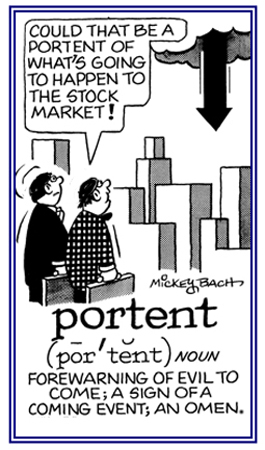
1. An omen that indicates that an event is about to occur; especially, an unfortunate one: When Kate slipped on the floor of the store, after coming in from the rain, she had the portent of severe injury to her right wrist that would result in pain for a long time while it was healing.
2. A sign or a warning that something which is usually bad or unpleasant is going to take place: The dark clouds and thunder and lightning were portents that it would soon be raining very hard.
3. Etymology: from Latin portentum, "a sign or an omen" from portemdere, "to foretell or to predict."
© ALL rights are reserved.
Go to this Word A Day Revisited Index
2. A sign or a warning that something which is usually bad or unpleasant is going to take place: The dark clouds and thunder and lightning were portents that it would soon be raining very hard.
3. Etymology: from Latin portentum, "a sign or an omen" from portemdere, "to foretell or to predict."
Go to this Word A Day Revisited Index
so you can see more of Mickey Bach's cartoons.
portentous (adjectives), more portentous, most portentous
1. That which gives a sign or a warning that something which is usually undesirable or bad is going to happen rather soon: "She had a portentous dream that she was going to slip and fall down on an icy sidewalk and break her arm."
2. Arousing awe or amazement or trying to seem important, serious, or impressive: "The politician spoke in a portentous tone about the future of his country."
2. Arousing awe or amazement or trying to seem important, serious, or impressive: "The politician spoke in a portentous tone about the future of his country."
portentously (adverb), more portentously, most portentously
A reference to statements or signs which are important because they show that something unpleasant is very likely to happen: "The economics minister talked portentously about the economic situation."
That which is ominously significant or indicative of something that is about to happen: "The injury to the star football quarterback was a portentousness for defeat."
1. A shortened term for a person who is paid to participate in an activity or a sport: Jim is striving to become a tennis pro.
2. Anyone who has a great deal of experience or skill in some particular activity or work.
3. A person or side in a debate, argument, or campaign that is in favor of doing something.
2. Anyone who has a great deal of experience or skill in some particular activity or work.
3. A person or side in a debate, argument, or campaign that is in favor of doing something.
pro (adjective), more pro, most pro
Referring to or typical of an activity, especially a sport, from which someone is paid and so earns a living with his or her athletic skills.
Pro aris, Pro focis. (Latin terms)
Translation: "For the altar. For the hearth."
Also "For the altar (church or religion), For the hearth (home)."
Pro bono humani generis. (Latin statement)
Translation: "For the good of humankind [mankind or humans]."
Motto of The Rockefeller University, New York, New York, USA.
Pro bono publico. (Latin statement)
Translation: "For the public good."
The full phrase for the expression of pro bono in English. There are some attorneys who devote a portion of their working time to legal cases in which they represent the poor or seek redress for public grievances, and a necessary condition of true pro bono work requires forgoing one's customary professional fees.
Pro Christo et humanitate.
For Christ and humanity.
Motto of Olivet College, Olivet, Michigan, USA.
Pro Christo et patria.
For Christ and country.
Motto of Geneva College, Beaver Falls, Pennsylvania, USA.
Pro Christo et Republica.
For Christ and the Republic.
Motto of Birmingham-Southern College, Birmingham, Alabama, USA.
Pro Deo et ecclesia.
For God and church.
Pro Deo et patria.
For God and country.
Motto of the University of Dayton School of Law, Dayton, Ohio, USA; as well as, Loras College, Dubuque, Iowa, USA.
