
postero-, poster-
(Latin: after, behind, following; denoting relationship to the posterior or back part)
A posteriori is a conclusion which is reached by examination and analysis of the specific facts, as happens in a science laboratory, where a person reasons from actual observation of data and comes to a conclusion from the observed facts. Contrasted with a priori.
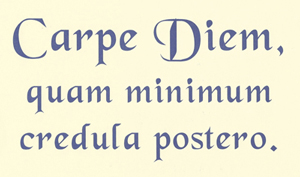
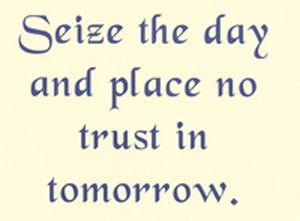
"Enjoy the present moment and don't depend on there being a tomorrow." -Horace
A continuing traditional theme in lyric poetry, dating back at least to Koheleth's "Eat, drink, and be merry" (based on Ecclesiastes 8:15). The phrase carpe diem exemplifies the spirit of hedonism and Epicureanism, i.e., the enjoyment of the moment and recognition of the transient nature of life.
So, carpe diem came from ancient times until the present with the advice often and variously expressed as: "Enjoy yourself while you have the chance"; "Eat, drink, and be merry, for tomorrow we die"; "Make hay while the sun shines"; "Enjoy yourself, it's later than you think."
William Safire had a different attitude regarding carpe diem when he wrote: "Seize the day has come to mean ‘strike while the iron is hot.' No longer is carpe diem the what-the-hell attitude of the dwellers in the present; it has become the battle cry of the gutsy opportunist with an eye on the future."
Many famous poems develop this "live it up now" theme; such as , the following by Robert Herrick (1591-1674):
Old Time is still a-flying,
And this same flower that smiles today
Tomorrow will be dying.
Translation:
Also interpreted to mean: "The sins of the fathers." Is it possible that what we say and do now may affect future generations?
2. The fleshy part of the human body that that a person sits on.
3. At or near the hind end in quadrupeds or toward the spine in primates.
4. In humans and other bipeds, towards the back surface of the body; also called, the dorsal.
5. In quadrupeds, a term sometimes used as a synonym for caudal.
2. Etymology: from Latin posteritas from posterus, "following, coming after" from post, "after".
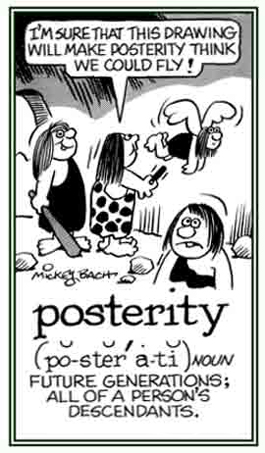
Go to this Word A Day Revisited Index
so you can see more of Mickey Bach's cartoons.
2. Malocclusion in which the mandibular arch is in a posterior (distal or remote) position in relation to the maxillary arch.
