
pon-, posit-, pos-, -poning, -poned, -ponency, -ponent, -ponement, -pound
(Latin: to place, to put, to set; placement, positioning)
Wind-borne soil accumulations: There were a lot of people who had to clean the aeolian deposits off their windows after the severe wind storm finally ended.
appose (verb), apposes; apposed; apposing
1. To place side by side or in close proximity; to juxtapose: Jane placed the two boxes so that they were apposing each other on the shelf.
2. To be put near something, or to place by moving one object next to another one: Susan apposed the pictures in her album so they would be in the sequence in which she took them.
2. To be put near something, or to place by moving one object next to another one: Susan apposed the pictures in her album so they would be in the sequence in which she took them.
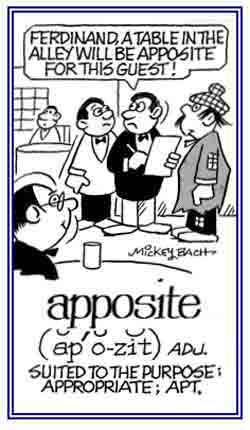
apposite (adjective), more apposite, most apposite
1. Especially well-suited to the circumstances; particularly appropriate: Those red flowers are the most apposite flowers for the table setting that Linda could think of.
2. Suitable, pertinent, and relevant: Bernhard, the mayor, gave apposite answers to the challenging questions that were presented to him by members of the city council.
© ALL rights are reserved.
Go to this Word A Day Revisited Index
2. Suitable, pertinent, and relevant: Bernhard, the mayor, gave apposite answers to the challenging questions that were presented to him by members of the city council.
Go to this Word A Day Revisited Index
so you can see more of Mickey Bach's cartoons.
appositely (adverb), more appositely, most appositely
Agreeable for the purpose; fitting; properly applicable: Shirley appositely answered the teacher's question.
The successful dictionary composer is known as a master of appositely written definitions and sentences that clearly show those definitions in action.
Being especially reasonable and proper for the situation or occasion: The appositeness of wearing a warm coat to the soccer match was a good decision because it became chillier as the game was being played.
1. The relative position of two things that are next to each other: The vases were placed in apposition to each other on the shelf.
2. The quality of being side by side, not being front-to-front, but next to each other: The members of the marching band stood in apposition to each other as they prepared to play the national anthem.
3. A placing of two things conjointly or the fitting together of two things: The two pieces of the puzzle fit in perfect apposition.
4. A grammar relationship between noun phrases in which the relationship between two usually consecutive nouns or noun phrases that refer to the same person or thing and have the same relationship to other sentence elements: In the sentence, "My son, an actor, lives with me"; the phrase, "My son, an actor" is an example of an apposition. 5. In physiology, cell growth in which layers of material are deposited on existing ones: Dr. McMahon told Henry that the growth on the bottom of his heel was an example of cellular apposition.
2. The quality of being side by side, not being front-to-front, but next to each other: The members of the marching band stood in apposition to each other as they prepared to play the national anthem.
3. A placing of two things conjointly or the fitting together of two things: The two pieces of the puzzle fit in perfect apposition.
4. A grammar relationship between noun phrases in which the relationship between two usually consecutive nouns or noun phrases that refer to the same person or thing and have the same relationship to other sentence elements: In the sentence, "My son, an actor, lives with me"; the phrase, "My son, an actor" is an example of an apposition. 5. In physiology, cell growth in which layers of material are deposited on existing ones: Dr. McMahon told Henry that the growth on the bottom of his heel was an example of cellular apposition.
Words, or phrases, that refer to the same person or thing and have the same relationship to other sentence elements: In the sentence, "His friend, Martin, was a good student" the name "Martin" is in apposition to "His friend".
appositive (adjective), more appositive, most appositive
Relating to someone or something or an adjective directly following the noun it modifies: The "Tea Party", which is an appositive movement of conservatives in the United States, has been gaining more influence in political meetings.
appositively (adverb), more appositively, most appositively
An immediate reference that follows something else in order to explain the first reference: The words shown in bold in the following sentences are examples of appositively written statements.
The professor at the university, a devoted scholarly person, had a loyal following .
James Jones, the president of the company, was a very successful businessman.
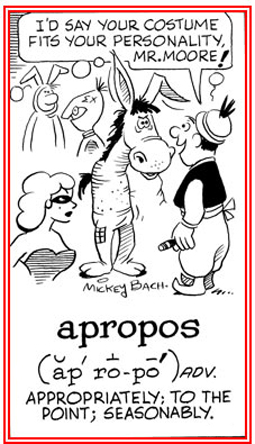
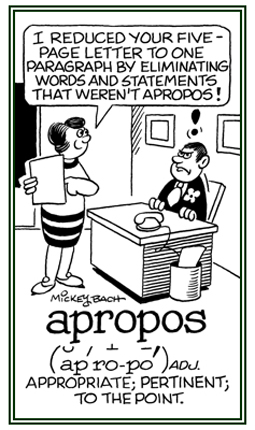
apropos, à propos (ap" ruh POH) (adjective); more apropos, more à propos; most apropos, most à propos
1. Appropriate or proper in a specific situation: Mr. Allen read an apropos passage to his class from the author’s new book.
2. At an opportune time: There is never an apropos time to tell a child that a favorite pet has died.
3. Being at once opportune and to the point; being relevant: It is very apropos to discuss going on a diet after an indulgent weekend of eating.
4. Etymology: from French à propos, "to the purpose" from propos, "purpose, plan", from Latin propositium, past participle of proponere, "to set forth, to propose".
© ALL rights are reserved.
© ALL rights are reserved.
Go to this Word A Day Revisited Index
2. At an opportune time: There is never an apropos time to tell a child that a favorite pet has died.
3. Being at once opportune and to the point; being relevant: It is very apropos to discuss going on a diet after an indulgent weekend of eating.
4. Etymology: from French à propos, "to the purpose" from propos, "purpose, plan", from Latin propositium, past participle of proponere, "to set forth, to propose".
Go to this Word A Day Revisited Index
for a list of additional Mickey Bach illustrations.
compone, componé, compony (adjective) (no comparatives)
In heraldry, divided into a single line made up of squares that alternate between metal and color, color and fur, or fur and metal: The compone style of the new Parisian dresses, alternating squares of color and/or texture, reminded Glenda of the heraldry that she saw in ancient castles during her trip to France.
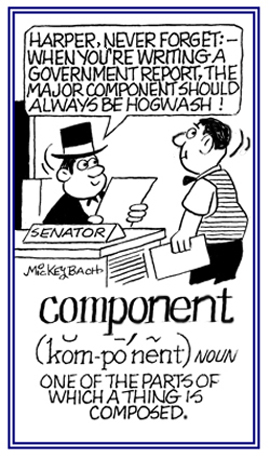
1. A separate part of a whole, usually of something bigger: Mike worked for a company that manufactured automobile components.
3. A device, such as a resistor or transistor, that is part of an electronic circuit: The electrician has to replace one of the electrical components in the house wiring before the residents can turn on their lights, TV sets, refrigerators, etc. again.
4. In chemistry, one of the substances necessary to describe each phase of a chemical system: For their chemistry examination, Timothy and the other students were asked to determine the components of a substance in the various test tubes.
5. Etymology: from Latin componentem, "putting together"; from com, "together" + ponere, "to put".
© ALL rights are reserved.
Go to this Word A Day Revisited Index
Fresh fruits and vegetables are considered to be essential components of a healthy diet.
A component is what is "put together with" other parts in order to make a whole structure.
The university course has four main components: business law, finance, computing, and management skills.
2. A smaller, self-contained part of a larger entity, which often refers to a manufactured object that is part of a larger device: This box contains the necessary components to complete the model doll house.3. A device, such as a resistor or transistor, that is part of an electronic circuit: The electrician has to replace one of the electrical components in the house wiring before the residents can turn on their lights, TV sets, refrigerators, etc. again.
4. In chemistry, one of the substances necessary to describe each phase of a chemical system: For their chemistry examination, Timothy and the other students were asked to determine the components of a substance in the various test tubes.
5. Etymology: from Latin componentem, "putting together"; from com, "together" + ponere, "to put".
Go to this Word A Day Revisited Index
so you can see more of Mickey Bach's cartoons.
compose (verb), composes; composed; composing
1. To make up the constituent parts of; to constitute or to form: Esther and the other art students had an exhibit composed of modernistic paintings.
2. To make or to create by putting together parts or elements: The delicious dessert which was served was composed of fruit, cream, and cookies.
3. To create or to produce something; such as, a literary or musical piece: They were told that Oscar Levant composed some of the melodies for the lyrics in which he was an actor.
4. To make (oneself) calm or tranquil: Sherry had to compose herself so she could deal calmly with the additional work that was assigned to her.
5. To settle or to adjust; to reconcile: Gregory and his wife Janet managed to compose their differences.
6. To arrange aesthetically or artistically; for example, to arrange things in order to achieve an effect: The garden was composed of rows of complimentary flowers, shading from pale blue to darkest blue.
7. To arrange or to set type in preparation for printing: Jerry, the typesetter, was very adroit at composing eye catching headlines for each edition of the newspaper.
2. To make or to create by putting together parts or elements: The delicious dessert which was served was composed of fruit, cream, and cookies.
3. To create or to produce something; such as, a literary or musical piece: They were told that Oscar Levant composed some of the melodies for the lyrics in which he was an actor.
4. To make (oneself) calm or tranquil: Sherry had to compose herself so she could deal calmly with the additional work that was assigned to her.
5. To settle or to adjust; to reconcile: Gregory and his wife Janet managed to compose their differences.
6. To arrange aesthetically or artistically; for example, to arrange things in order to achieve an effect: The garden was composed of rows of complimentary flowers, shading from pale blue to darkest blue.
7. To arrange or to set type in preparation for printing: Jerry, the typesetter, was very adroit at composing eye catching headlines for each edition of the newspaper.
1. Something made from different parts: This new law is a composite of previously suggested legislation over the years.
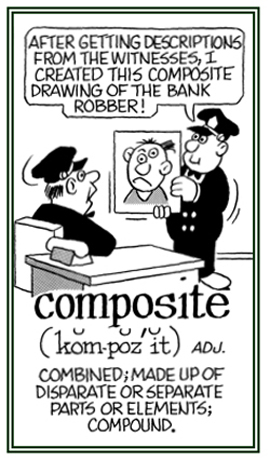
2. An image of a suspect's face which is created by a police artist or photographer, based on input from a witness or witnesses: Anita, the victim, described the thief and Christopher, the police artist, created a composite to be circulated among the police stations.
3. A structure or an entity made up of distinct elements; a mixture: The country road was a composite of gravel and packed stones.
4. A complex material; such as, wood or fiberglass, in which two or more distinct, structurally complementary substances; especially metals, ceramics, glasses, and polymers, are combined to produce structural or functional properties not present in any individual part or system: The composite used to make Becky's new bookcase looked just like fine mahogany.
5. A colloquial term for resin materials used in restorative dentistry: Doug's dentist, Dr. Jones, used a new composite to build up his chipped tooth.
2. An image of a suspect's face which is created by a police artist or photographer, based on input from a witness or witnesses: Anita, the victim, described the thief and Christopher, the police artist, created a composite to be circulated among the police stations.
3. A structure or an entity made up of distinct elements; a mixture: The country road was a composite of gravel and packed stones.
4. A complex material; such as, wood or fiberglass, in which two or more distinct, structurally complementary substances; especially metals, ceramics, glasses, and polymers, are combined to produce structural or functional properties not present in any individual part or system: The composite used to make Becky's new bookcase looked just like fine mahogany.
5. A colloquial term for resin materials used in restorative dentistry: Doug's dentist, Dr. Jones, used a new composite to build up his chipped tooth.
composite (adjective), more composite, most composite
Pertaining to something that is made up of different parts or elements: The witnesses gave the police artist a variety of composite descriptions which made it difficult to identify the man the police were looking for.
© ALL rights are reserved.
Go to this Word A Day Revisited Index
Go to this Word A Day Revisited Index
so you can see more of Mickey Bach's cartoons.
Related word families intertwined with "to place, placing, to put; to add; to stay; to attach" word units: fix-; prosth-; stato-; the-, thes-.
