
apt-, ept-
(Latin: fit, fitted, suited, suitable, appropriate; join, fasten)
adapt (verb), adapts; adapted; adapting
1. To make suitable by changing or adjusting something to accommodate, assimilate, harmonize with, or conform to: Some people must adapt themselves to the heavy rain that falls in their area.
2. To fit for a new use; to transform, to rework, to convert, to make suitable, to modify, to alter: The drama that James was watching had been adapted from a short story.
3. To undergo modifications in order to fit new circumstances or situations: The auto mechanic was adapting Ed's car for winter driving.
4. Etymology: from Latin adaptare, "to adjust" from ad-, "to" plus aptare, "to join" from aptus, "fitted".
2. To fit for a new use; to transform, to rework, to convert, to make suitable, to modify, to alter: The drama that James was watching had been adapted from a short story.
3. To undergo modifications in order to fit new circumstances or situations: The auto mechanic was adapting Ed's car for winter driving.
4. Etymology: from Latin adaptare, "to adjust" from ad-, "to" plus aptare, "to join" from aptus, "fitted".
The capacity to change or to be changed in order to fit or to work better in a situation or for some purpose: The adaptability provided by the device combining a screwdriver with pliers proved to be very useful in Sam's work and the device could be adjusted easily to fit the job at hand.
adaptable (adjective), more adaptable, most adaptable
A reference to the accommodation of character, nature, or design to a certain use, situation, or purpose: The computer program that Paul is using is adaptable to the needs of many users.
Someone or something that can be conformed to fit different situations: Shara's teacher had an adaptableness with his curriculum so students of all abilities would be able to benefit from it.
adaptably (adverb), more adaptably, most adaptably
A reference to how something can be modified, or how a person can adjust to different conditions or situations: The movie that George was producing consisted of his effort to adaptably prepare one that would have greater interest for viewers when they went to see it in theaters.
Something that is modified in order to fit or to work better in a situation or for some purpose; especially a movie, book, play, etc.: Trudy's motion picture adaptation of her novel with the same title was a great success.
A device that is used to connect two pieces of equipment that are not designed to be connected to each other: Using a travel adapter in a country with a different kind of electrical supply presents a safety hazard if the connected device does not support both input voltages.
1. Fat or adipose tissue: Adeps can be seen as an excess of body flesh, causing obesity, and hanging downward from the abdomen which can be seen mostly in men, also referred to as a "beer belly".
2. The rendered fat of swine: In order to prepare the ointment for the customer in the pharmacy, Janet had to use adeps, or lard.
2. The rendered fat of swine: In order to prepare the ointment for the customer in the pharmacy, Janet had to use adeps, or lard.
adept (adjective), more adept, most adept
1. Referring to an individual who is highly proficient or an expert at something; knowledgeable; skillful: Shirley is an adept person for organizational work in her community while her husband is adept in working with wood for shelves and other items for their home.

© ALL rights are reserved.
Go to this Word A Day Revisited Index
Shirley was an adept author when writing her column in the local newspaper every day.
2. Etymology: from Latin adeptus, "attained, achieved".
Go to this Word A Day Revisited Index
so you can see more of Mickey Bach's cartoons.
adeptly (adverb); more adeptly, most adeptly
Referring to how a person is superior at doing something which is not easy to do; skillfully; proficiently: Sarina is adeptly getting information and writing articles in the local newspaper about what is going on in her city.
The skillful performance or ability to do something without difficulty: Patricia's quick adeptness of successfully accomplishing things that she is working on is a result of her previous practical experiences.
Carl and Sylvia worked well together, reflecting his respect for her as an actress and also his enjoyment of her adeptness with witty comments.
Tom, and the other players on his basketball team, are champions based upon their adeptnesses and general conduct as well as their ability to perform under mental and physical pressures.
apt (adjective); more apt, most apt
1. A reference to a description or remark that is exactly suitable, fitting, and appropriate for a situation: Henry presented an apt reply as to what happened at the car accident.
2. Relating to a natural tendency or inclination to do something: Helen's mother is apt to be easily offended when criticised.
3. Pertaining to someone who is quick to learn or to understand: Henry was an apt student of chemistry and math in his high school.
2. Relating to a natural tendency or inclination to do something: Helen's mother is apt to be easily offended when criticised.
3. Pertaining to someone who is quick to learn or to understand: Henry was an apt student of chemistry and math in his high school.
1. A natural ability to do something or to have the talent to obtain knowledge: Since Kelsey can speak five languages, she obviously has a great aptitude for learning languages.
3. Etymology: from Latin aptitudo, "fitness"; from Latin aptus, "joined, fitted"; meaning from "natural capacity to learn" is from the 1540s; that of "quality of being fit for a purpose or position" is from the 1640's + -tude, "quality, condition of".
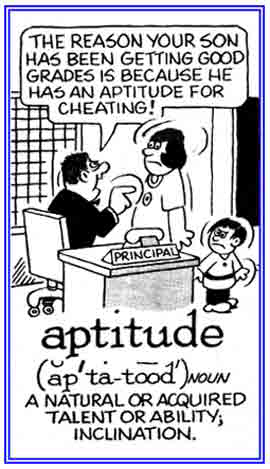
© ALL rights are reserved.
Go to this Word A Day Revisited Index
Sam's son had no aptitude for sports, however he did have an aptitude for computer technology and so he spent more of his time studying to be a computer programmer.
2. An inherent competency, as for learning: Dwayne's son said that he would be taking a new test at school which was supposed to measure his aptitude for learning.3. Etymology: from Latin aptitudo, "fitness"; from Latin aptus, "joined, fitted"; meaning from "natural capacity to learn" is from the 1540s; that of "quality of being fit for a purpose or position" is from the 1640's + -tude, "quality, condition of".
Go to this Word A Day Revisited Index
so you can see more of Mickey Bach's cartoons.
aptly (adverb); more aptly, most aptly
Relating to how something is done, said, etc. in a manner that is appropriate, proper, or suitable depending on the circumstances: Squeak was aptly named for the family's cat that normally had a high-pitched peeping or whiny and complaining meow.
aptness (noun) (no plural)
A tendency to do or behave in a certain manner: Sharon told her daughter not to wake her father because there was the aptness or probability that he would be very angry with her if she did it.

Showing page 1 out of 2 pages of 27 main-word entries or main-word-entry groups.