
-phemia, -phemic, -phemism, -pheme, -phemy
(Greek: speak, talk; speech)
A form of partial aphasia or the loss of the ability to articulate ideas or words or even to comprehend one's language: Kerri's allophemia resulted in her being incapable of saying a word, or words, which she wanted to say.
A medical condition in which a person is unable to use or to understand some words: When Bruce had allophemy, he couldn't express what he wanted to say, or he often used the words improperly.
The loss of the ability to understand written language as a result of a cerebral lesion; also known as "alexia": When people are afflicted with aphemesthesia, they have a loss of the sense of articulate speech, as well as the inability to recognize what they are reading.
Loss of the ability to speak, while being able to write because of a disorder of the brain: Aphemia is characterized by the inability to express ideas in spoken words.
aphemic (adjective), more aphemic, most aphemic
A reference to the loss of the ability to speak, while still being able to write.
A medical condition that results in the lack of proper coordination of the speech muscles: After Trisha's uncle had a stroke, it appeared that he developed ataxiophemia and was unable to use his speech muscles that produce the ability to speak clearly.
bimorphemic (adjective) (not comparable)
Pertaining to that which consists of two morphemes or the smallest meaningful elements of speech or writing: A few bimorphemic words include, waited, rays, and dogs.
blame (verb), blames; blamed; blaming
1. To consider someone to be responsible for something wrong, or unfortunate, that has happened.
2. To hold someone, or something, responsible and to criticize for faults or wrongs.
3. Etymology: from Old French blasmer, "to speak evil of"; from Late Latin blasphemare "to revile, to reproach".
2. To hold someone, or something, responsible and to criticize for faults or wrongs.
3. Etymology: from Old French blasmer, "to speak evil of"; from Late Latin blasphemare "to revile, to reproach".
blaspheme (verb), blasphemes; blasphemed; blaspheming
1. To swear in a way that insults religion.
2. To treat God, or sacred things, disrespectfully through words and actions.
3. To speak evil of; to slander; to abuse.
2. To treat God, or sacred things, disrespectfully through words and actions.
3. To speak evil of; to slander; to abuse.
1. A person who speaks disrespectfully of sacred things.
2. To speak of or to address with irreverence.
2. To speak of or to address with irreverence.
blasphemous (adjective), more blasphemous, most blasphemous
1. Grossly irreverent toward what is held to be sacred.
2. Characterized by profanity or cursing.
3. Expressing, or involving, disrespect for God or sacred things; to speak evil of: Henry's blasphemous acts and statements were an indignity or irreverence displayed toward divine powers or their representatives, or toward the king, or toward something sacred; such as, a temple or church.
2. Characterized by profanity or cursing.
3. Expressing, or involving, disrespect for God or sacred things; to speak evil of: Henry's blasphemous acts and statements were an indignity or irreverence displayed toward divine powers or their representatives, or toward the king, or toward something sacred; such as, a temple or church.
In Mosaic law, blasphemous statements were capital offenses (Leviticus 24:16); including curses, profanity, disrespect, or impious behavior.
1. A contemptuous or profane act, utterance, or writing concerning God or something sacred: A mentally deranged man yelled words of blasphemy at the minister while he was preaching.
2. An irreverent or impious act, attitude, or utterance in regard to something considered holy: Using the name of the Lord as a curse word is pure blasphemy; such as yelling: "Jesus Christ, why did you do that!".
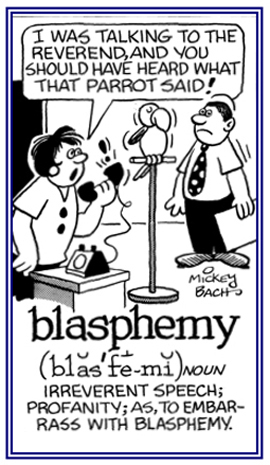
© ALL rights are reserved.
Go to this Word A Day Revisited Index
2. An irreverent or impious act, attitude, or utterance in regard to something considered holy: Using the name of the Lord as a curse word is pure blasphemy; such as yelling: "Jesus Christ, why did you do that!".
Go to this Word A Day Revisited Index
so you can see more of Mickey Bach's cartoons.
A slowing-down of the rhythm of spoken words.
The substitution of an offensive term for one considered to be acceptable: When he was being particularly obnoxious, the stand up comic used frequent cacophemisms in his routine, insulting many who were in the audience.
cacophemistic (adjective), more cacophemistic, most cacophemistic
A reference to the substitution of an offensive term for one that is considered to be inoffensive or acceptable.
Cross references of word families related directly, or indirectly, to: "talk, speak, speech; words, language; tongue, etc.":
cit-;
clam-;
dic-;
fa-;
-farious;
glosso-;
glotto-;
lalo-;
linguo-;
locu-;
logo-;
loqu-;
mythico-;
-ology;
ora-;
-phasia;
phon-;
phras-;
Quotes: Language,Part 1;
Quotes: Language, Part 2;
Quotes: Language, Part 3;
serm-;
tongue;
voc-.
Cross references of word families that are related directly, or indirectly, to: "divination, diviner; seer, soothsayer, prophecy, prophesy, prophet": augur-; auspic-; fa-, fate; Fates in action; futur-; -mancy; omen; sorc-, sorcery; vati-.
