
per-
(Latin: through, across, over; beyond, by means of)
Ad astra per aspera. (Latin motto)
Translation: "To the stars through difficulties" or "To the stars in spite of difficulties."
The motto of the state of Kansas, USA and Campbell University, Buies Creek, North Carolina, USA.
This motto suggests that we achieve great things only by encountering and overcoming adversities. It will be rough going, but we will make it.
Ad augusta per angust. (Latin phrase)
Translation: "To honors through difficulties."
Augusta refers to holy places and angusta to narrow spaces, therefore sometimes we cannot achieve great results without suffering by squeezing through narrow spaces.
Ad perpetuam rei memoriam. (Latin)
Translation: "For the perpetual remembrance of the thing."
These words are traditionally used to open papal bulls.
Ad virtutem per sapientiam. (Latin phrase)
Translation: "To virtue through wisdom."
Motto of Castle Jr. College, Windham, New Hampshire, USA.
ampersand
entoperipheral
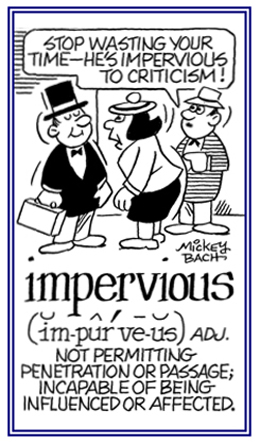
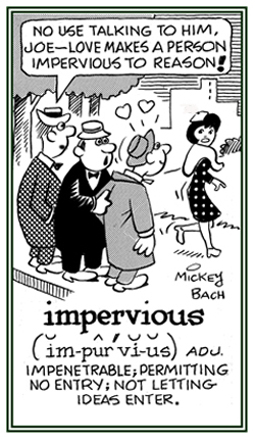
impervious (adjective), more impervious, most impervious
1. Pertaining to something which does not allow passage or entrance; impenetrable: Jerry wore his new jacket which was supposed to be impervious to wind, rain, or snow and to keep him dry and warm.
2. Referring to something which or someone who is not capable of being disturbed, damaged, or harmed: Doug was so sure of himself that no one was able to mention the flaws in his undertaking and he seemed to be impervious to any criticism from anyone.
3. Etymology: from Latinimpervius, "that which cannot be passed through"; from in-, "not, opposite of" + pervius, "letting things through"; from per, "through" + via, "road, way".
© ALL rights are reserved.
© ALL rights are reserved.

© ALL rights are reserved.
Go to this Word A Day Revisited Index
2. Referring to something which or someone who is not capable of being disturbed, damaged, or harmed: Doug was so sure of himself that no one was able to mention the flaws in his undertaking and he seemed to be impervious to any criticism from anyone.
3. Etymology: from Latin
Go to this Word A Day Revisited Index
so you can see more of Mickey Bach's cartoons.
per
1. By means of; through.
A person authorized to sign someone else's name to any document should add his or her own signature preceded by per.
2. According to; by: "He acted per his supervisor's instructions.""The work was done per his directions."
Per actum intentio.
The intention [must be judged] by the act.
Per actus conamine.
You attempt by doing it.
Per actuta belli.
Through the asperities [hardships] of war.
Per angusta ad augusta (Latin motto)
Through difficulties to honor because sometimes we can not achieve great results without suffering by squeezing through narrow spaces.
per annum
per annum; p.a., per an.
By the year.
