
palp-, palpo-, palpi-
(Latin: to touch gently, to stroke; to pat)
The quality of being untouchable or not being able to perceive what is being touched: When Jacob slipped and fell down on the sidewalk, he suffered with an impalpability of his hands for several days.
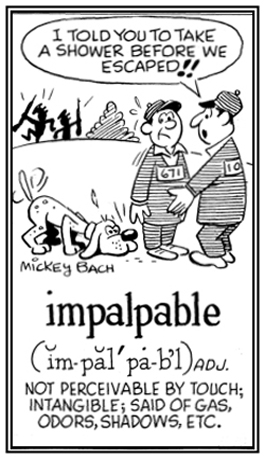
impalpable (adjective), more impalpable, most impalpable
1. A reference to an incapability of perceiving something by the sense of touch; intangible or untouchable: People have to accept the fact that there could be impalpable spirits because there is no way we can feel them.
2. Pertaining to something which is difficult for the mind to grasp readily or easily: The impalpable distinctions of the word meanings of homonyms can be confusing, especially for foreigners who are learning English.
3. Descriptive of something impossible to detect by touching it because it is extremely fine or small: The flour that Jim was rubbing between his fingers was so impalpable that no grit could be felt.
4. Etymology: from Late Latin directly, or via French, impalpabilis; literally, "not touchable" from in, "not" + palpare, "to touch gently".
© ALL rights are reserved.
Go to this Word A Day Revisited Index
2. Pertaining to something which is difficult for the mind to grasp readily or easily: The impalpable distinctions of the word meanings of homonyms can be confusing, especially for foreigners who are learning English.
3. Descriptive of something impossible to detect by touching it because it is extremely fine or small: The flour that Jim was rubbing between his fingers was so impalpable that no grit could be felt.
4. Etymology: from Late Latin directly, or via French, impalpabilis; literally, "not touchable" from in, "not" + palpare, "to touch gently".
Go to this Word A Day Revisited Index
so you can see more of Mickey Bach's cartoons.
impalpably (adverb), more impalpably, most impalpably
Conveying an inability to detect or to recognize anything by feeling it: As a result of it being so cold outside while Mark was walking home from the bus stop, when he arrived at his house, it was impalpably difficult for him to get and to use his key to unlock the door.
One of the labial or surface areas next to lips or a feeler; especially, one of the jointed sense organs attached to the mouth organs of insects: Dragonfly nymphs catch prey with their extensible labipalpi located in their lower jaws, which are lined with spines and hooks and they hunt small insects, mosquito larvae, and small crustaceans and capture them with their labipalpi or labia.
Fingertip contacts of the abdominal and thoracic surfaces of a person's body to determine the condition of the underlying organs that exist there: The internist used the method of light-touch palpation to feel if Sally's stomach and intestines were in normal condition or not.
Having long feelers: The longipalpi are jointed sense organs attached to the mouth parts of insects, arachnids, crustaceans, and annelids.
The probing or physical manipulation of a ptotic or enlarged kidney with one hand while the other hand is placed under the lumbar region, the subject being examined in the dorsal decubitus or reclining position: Jack was feeling quite ill and when he was examined by his physician, a lumbar palpation was used to determine the condition of his internal organs and especially of the organ that cleans blood and removes the waste.
Not able to be determined by feeling or touching: When the doctor was trying to ascertain what was causing Jim so much pain, nonpalpability without any tactile contact, was required for an adequate diagnosis.
nonpalpable (adjective), more nonpalpable, most nonpalpable
Obscure and not understandable: Sharon had a sudden nonpalpable pain in her left leg, the cause of which she could not explain to herself or to anyone else.
The quality of being perceivable or obvious by touching: The palpability or tangibility of Pamela's fingers proved to be of great value when she noticed the exact temperature to be correct for bathing her baby.
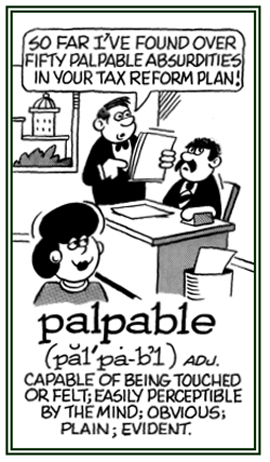
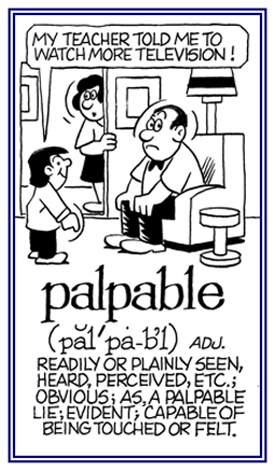
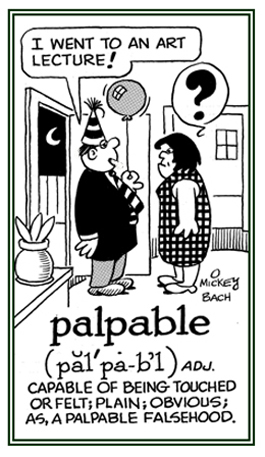
palpable (adjective), more palpable, most palpable
1. A reference to a situation that is mentally perceived, understood, or apparent; obvious: There is a palpable difference in the ages of the two brothers, one who is 10 years old and the other one who is 16.
2. In medicine, descriptive of something which can be felt with the fingers or hands: The palpable lump that was causing Herb's pain was diagnosed with the therapist's examination by using her medically trained hands.
3. Etymology: from Late Latin palpabilis, "that which may be touched or felt", from Latin palpare, "to touch gently, to stroke".
© ALL rights are reserved.
© ALL rights are reserved.
© ALL rights are reserved.
Go to this Word A Day Revisited Index
2. In medicine, descriptive of something which can be felt with the fingers or hands: The palpable lump that was causing Herb's pain was diagnosed with the therapist's examination by using her medically trained hands.
3. Etymology: from Late Latin palpabilis, "that which may be touched or felt", from Latin palpare, "to touch gently, to stroke".
Go to this Word A Day Revisited Index
so you can see more of Mickey Bach's cartoons.
A condition that is obvious and so it can be easily seen or known: The palpableness of Jane's happiness at her wedding could not be doubted.
palpably (adverb), more palpably, most palpably
Descriptive of something that is undeniably true: The excessive demands by Jerry's boss were palpably revealing a dislike for each other.
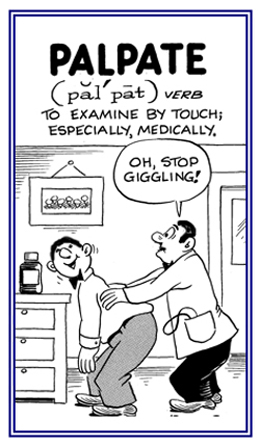
palpate (verb), palpates; palpated; palpating
1. To examine a part of the body by feeling with the hands and fingers; especially, to distinguish between swellings that are solid and those that are filled with fluid: Just as the Latin word means "to touch" or "to feel lightly", that is how a doctor palpates the abdomen.
2. To touch or to feel: The edge of an enlarged liver may be palpated below the rib cage.
3. Etymology: from Latin palpatus, past participle of palpare, "to touch with the palm of the hand, to feel gently".
© ALL rights are reserved.
Go to this Word A Day Revisited Index
2. To touch or to feel: The edge of an enlarged liver may be palpated below the rib cage.
3. Etymology: from Latin palpatus, past participle of palpare, "to touch with the palm of the hand, to feel gently".
Go to this Word A Day Revisited Index
so you can see more of Mickey Bach's cartoons.
1. A simple technique in which a doctor presses lightly on the surface of the body to feel the organs or tissues underneath: Mary's physician was using palpation in order to determine if her kidney had enlarged or if there were any tumors and to make sure that her condition was normal or needed medical care.
2. An examination by touching or manipulating a section of the body with the hands or fingers in order to ascertain its condition for medical diagnosis: Dr. Brown was feeling Joe's pulse beat to determine if his palpation was normal.
3. Etymology: from Latin palpationem, "stroking"; from palpare, "to touch gently".
2. An examination by touching or manipulating a section of the body with the hands or fingers in order to ascertain its condition for medical diagnosis: Dr. Brown was feeling Joe's pulse beat to determine if his palpation was normal.
3. Etymology: from Latin palpationem, "stroking"; from palpare, "to touch gently".

Showing page 1 out of 2 pages of 28 main-word entries or main-word-entry groups.