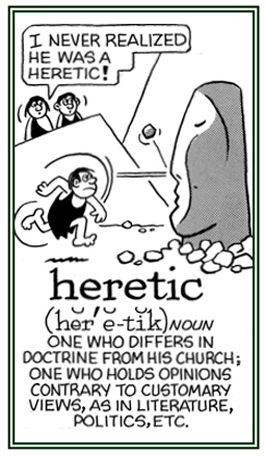
pago-, pag-, pagan-
(Latin: originally, country area, province; villager; more recent meanings: heathen, atheist; idolatrous, idol worshippers; heretic, heretical)
Adherents of neopaganism often have deep ecological concerns and an attachment to nature; so, many worship an earth-mother goddess and center their rituals on the change of the seasons.
Neopaganism is considered to be a combination of historical inspiration and present-day creativity.
Those who are part of neopaganism rely on pre-Christian and folkloric sources and so many of them follow a spirituality, which they consider to be entirely modern, while others attempt to reconstruct or to revive religions from historical sources as accurately as possible.
Some pagans worshiped the gods of fire and rain.
Pagans are still defined by some religious leaders as those who are not members of their particular religious groups or those whose religions are regarded as questionable.
Pagan in the religious sense is often said to derive from conservative rural adherence to the old gods after the Christianization of Roman towns and cities.
2. Etymology: from about 1375, Late Latin paganus, "rustic, peasant", in classical Latin, "villager, rustic, civilian", from pagus, "rural district".The ancient Romans considered those who lived in outlying villages as uncouth, uneducated people who didn't know much about culture, manners, or the dominant religion of the time.

Go to this Word A Day Revisited Index
so you can see more of Mickey Bach's cartoons.
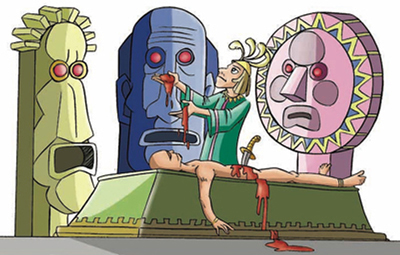
It is said that some pagan idols were destroyed by Christian missionaries.
The altar of Zeus, the greatest of the pagan gods in the ancient the Greek religion, was located at the Pergamum located in the western part of what is now modern Turkey.
2. Applied by some people to anyone who apparently has no religious beliefs; a heathen: Those who are members of religions consider pagan people to be non-religious; such as, atheists, agnostics, etc.Some neopagans have indicated that they came to their adopted faiths because they are allowed to have greater freedom, diversity, and tolerance of worship in the pagandoms.
2. Etymology: from Late Latin paganisnus, "heathenism"; from paganus "villager, civilian"; from pagus, "rural district, village" or "country area" because ancient idol worship continued in rural areas after Christianity had been generally accepted in the towns and cities of the Roman Empire as the true religion.
When new customs and manners reach the big cities, the rural areas are usually behind the times and remain old-fashioned as they tend to keep the "old-time religion" or paganism.
Go to this Word A Day Revisited Index
so you can see more of Mickey Bach's cartoons.