
pac-, peac-, peas-
(Latin: peace, peaceful, calm, quiet; eased anger or agitation)
A variant of Vade in pace. or "Go in peace."
2. A reference to how to satisfy or relieve: She quenched her thirst appeasably by drinking a cool bottle of water.
3. Concerning how to pacify, or how to attempt to pacify, an enemy by granting concessions, often at the expense of principles: In the story James was reading, the two foes didn't want fight, so they solved their issues appeasably with friendly gestures.
2. To calm, to satisfy: May's boss, Mr. Big, wanted to appease his secretary for his outburst by giving her a raise in her salary.
3. To bring calm to; to soothe: Trudy tried to appease her daughter with comforting words after she had had a terrible quarrel with her boyfriend.
4. To satisfy or to relieve: The nurse tried to appease the man’s thirst by giving him some water to drink.
5. To pacify or to attempt to pacify an enemy by granting concessions, often at the expense of principles: The nation appeased the government of the opposing country by accepting its demands in an attempt to avert a war.
6. Etymology: from Old French apeserm "to pacify", from the phrase a paisier, "bring to peace"; from a-, "to" + pais, from Latin pacem, pax, "peace".
"Appeasement" was first recorded in 1919 in the international political sense; and it was not pejorative until the failure of Arthur Neville Chamberlain's policy toward Germany in 1939. "Methods of appeasement" was British Prime Minister Chamberlain's description of his policy.
We can speak of hunger being appeased by food. Appeasing usually involves giving something; whereas, "pacifying" tends to refer to anything from stroking a baby to using armed forces to stop an uprising.
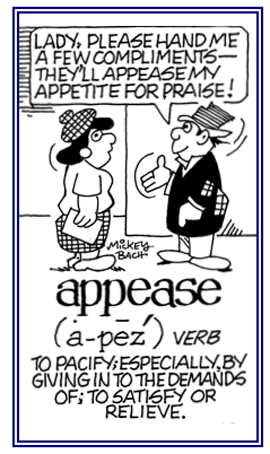
Go to this Word A Day Revisited Index
so you can see more of Mickey Bach's cartoons.
2. An attempt to stop complaints or to reduce difficulties by making concessions.
2. Those who triy to bring a situation to a state of peace or quiet.
2. Descriptive of an effort to pacify or to show a desire to soothe: "The father appeasingly allowed his children to have an ice cream before they went home after shopping."
2. By the leave of; with all deference to, in peace; used when expressing polite disagreement: "Senator Shawn said in response to another senator's statement, 'I must say, pace the distinguished senator, that his conclusions are entirely erroneous.' "
2. Capable of being reduced to a submissive state: Ivy, Lisa's baby, didn't want to go to sleep although she was tired, but Lisa knew she was pacifiable when she sang a lullaby or two to sooth her into sleep.
2. Gentle and peaceful by nature; mild; dovelike: Catherine always loved to take walks in the forest where she could hear the pacific and soothing chirping of the birds.
3. Unaggressive; avoiding the use of force: Clive was a pacifist, opposed the use of force, and was considered by his friends and family to be very pacific.
4. Relating to the Pacific Ocean, or to the territories that surround it or are surrounded by it: The Pacific Ocean, that is the "Peaceful Ocean", was named by Portuguese navigator, Ferdinand Magellan (1480-1521) because it seemed so calm after the storms of Cape Horn.
2. The act of appeasing someone or causing someone to be more favorably inclined to cooperate or participate in a peaceful action.
3. The procedure of making people calm when they are angry or upset.
2. Having ended a war, fighting, or violence in; established peace in: "After a few years, the pacified countries were able to work together for their mutual benefits."
3. Caused to be more favorably inclined: "The pacified customer was calmer after he received a full refund."
2. A rubber or plastic nipple or teething ring for a baby to suck or to chew on.
3. Someone who tries to bring peace.
This artificial nipple, usually made of plastic, is used so an infant can gain some solace and quiet down. A pacifier is called by other names in other countries including a "dummy" in the U.K.
2. The refusal to take up arms or participate in war because of moral or religious beliefs.
3. The belief that international conflicts should be settled by negotiation rather than war.
4. Opposition to war or violence as a means of resolving disputes.
Cross references directly, or indirectly, involving "calm, calmness, peace, quiet": plac-; quies-, quiet-; seren-.
