
oscillo-, oscill-
(Latin: swing, vibrate, move, motion; from oscillum, a diminutive form of osoris, "mouth, face, small face")
By extension, "small mask of the god Bacchus" that was hung in Roman vineyards to honor the god of wine while scaring off grape-eating birds as it vibrated and swang in the breeze.
oscilla
A word applied in Latin usage to small figures, most commonly masks or faces, which were hung up as offerings to various deities, either for propitiation or expiation, and in connection with festivals and other ceremonies. It is usually taken as the plural of oscillum (diminutive of os), "a little face". As the oscilla swang in the wind, oscillare came to mean to swing, hence in English oscillation, the act of swinging backwards and forwards, periodic motion to and fro, hence any variation or fluctuation, actual or figurative.
Many oscilla or masks, representing the head of Bacchus or of different rustic deities, are still preserved. There is a marble oscillum of Bacchus in the British Museum. Others still in existence are made of earthenware, but it seems probable that wax and wood were the ordinary materials. Small rudely shaped figures of wool, known as pilae, were also hung up in the same way as the oscilla.
oscillance
An oscillation; a swinging back and forth.
oscillancy
The state of oscillating; a seesaw kind of motion.
oscillaria
In botany, a genus of dark green, or purplish black, filamentous, fresh water algae, the threads of which have an automatic swaying or crawling motion.
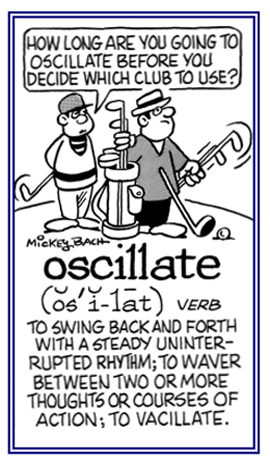
oscillate (verb), oscillates; oscillated; oscillating
1. To swing backwards and forwards; to move to and fro between two points; to vibrate: When the strings of a violin are played with a bow, they oscillate and produce tones!
2. To alternate between two states, opinions, principles, purposes, etc.; to vary or fluctuate alternately between two limits: Brain activity oscillates at different frequencies depending on what people are doing, how high their stress levels are, and other factors; such as, the amount of sleep, nourishment, and stimulation people have.
3. To be indecisive in purpose or opinion; to vacillate: Yesterday, Hank seemed certain about buying a new pair of shoes, but today he is oscillating because he's not sure whether he should wait until next week or not.
4. Etymology: from Latin oscillat-, "swung, from the verb oscillare.
© ALL rights are reserved.
Go to this Word A Day Revisited Index
2. To alternate between two states, opinions, principles, purposes, etc.; to vary or fluctuate alternately between two limits: Brain activity oscillates at different frequencies depending on what people are doing, how high their stress levels are, and other factors; such as, the amount of sleep, nourishment, and stimulation people have.
3. To be indecisive in purpose or opinion; to vacillate: Yesterday, Hank seemed certain about buying a new pair of shoes, but today he is oscillating because he's not sure whether he should wait until next week or not.
4. Etymology: from Latin oscillat-, "swung, from the verb oscillare.
Go to this Word A Day Revisited Index
so you can see more of Mickey Bach's cartoons.
oscillating
1. That which swings or moves to and fro; vibrating.
2. Of an electric current: undergoing very rapid periodic reversal of direction.
3. In astronomy, a model of the universe in which expansion is followed by contraction, explosion, and expansion once more, in an infinite cycle.
2. Of an electric current: undergoing very rapid periodic reversal of direction.
3. In astronomy, a model of the universe in which expansion is followed by contraction, explosion, and expansion once more, in an infinite cycle.
oscillation, oscillational
1. The action of oscillating; movement to and fro; periodic motion about a position of equilibrium, as the swinging of a pendulum.
2. Vacillation, fluctuation, or wavering between two states, opinions, principles, purposes, etc.
3. Variation consisting of alternate increase and decrease without convergence to a limit or divergence.
2. Vacillation, fluctuation, or wavering between two states, opinions, principles, purposes, etc.
3. Variation consisting of alternate increase and decrease without convergence to a limit or divergence.
oscillative
1. Characterized by oscillating, oscillatory.
2. Tending to oscillate; vibratory.
2. Tending to oscillate; vibratory.
oscillator
1. A person who oscillates or vacillates in action or thought; a waverer.
2. Something that moves to and fro; a system or device that oscillates.
3. An apparatus for generating oscillatory electric currents, or for generating electromagnetic waves by means of such currents. Also, a device for generating sound waves.
2. Something that moves to and fro; a system or device that oscillates.
3. An apparatus for generating oscillatory electric currents, or for generating electromagnetic waves by means of such currents. Also, a device for generating sound waves.
oscillatory
1. Swinging, vibrating.
2. Moving, or characterised by motion, backward and forward like a pendulum; swinging; oscillating; vibratory; as, oscillatory motion.
2. Moving, or characterised by motion, backward and forward like a pendulum; swinging; oscillating; vibratory; as, oscillatory motion.
oscillogram
A record produced by an oscillograph (a device for making a record of the wave forms of fluctuating voltages or currents).
oscillograph
1. In medicine, it is used for recording electrical activity of the brain, the heart, and other muscular tissues.
3. A device for recording oscillations: especially, those of an electric current.
Electrocardiographs and electroencephalographs are examples of the application of this technique.
2. An instrument that registers the movements of an electric current and photographically records the variation.3. A device for recording oscillations: especially, those of an electric current.
oscillographic
Of, relating to, or using an oscillograph.
oscillographous
1. The study of the records made by an oscillograph.
2. The use of oscillographs.
2. The use of oscillographs.
oscillography
The study of the records made by an oscillograph (an instrument that records oscillations, usually electrical).

Showing page 1 out of 2 pages of 22 main-word entries or main-word-entry groups.