
-ory
(Latin: a suffix of adjectives ending in -ory; of or relating to; like; resembling)
accessory (adjective), more accessory, most accessory
1. A reference to having a secondary, a supplementary, or a subordinate function.
2. Relating to something that is added but is not necessary.
2. Relating to something that is added but is not necessary.
acclamatory (adjective), more acclamatory, most acclamatory
Descriptive of something that expresses strong approval: The editorial in the newspaper was written in an acclamatory style praising the success of the local doctor who saved a child's life.
amendatory (adjective), more amendatory, most amendatory
Pertaining to anything that is intended to correct or to improve something.
bibitory (adjective), more bibitory, most bibitory
Of or pertaining to drinking or tippling.
compulsory (adjective), more compulsory, most compulsory
1. Referring to something that is required, demanded, designated, or enforced by an authority: Long ago, the city made compulsory education a policy for all the children up to the age of 15 who lived there.
2. Etymology: from Latin compellere, "to compel".
2. Etymology: from Latin compellere, "to compel".
consolatory (adjective), more consolatory, most consolatory
A reference to anything that is intended to make anyone who is disturbed or dejected feel better: Visits to Mrs. Carsten, the police officer's widow, by her fellow church members were the most consolatory things they could have done at the time.
contradictory (adjective), more contradictory, most contradictory
1. Relating to having the quality or character of denying that a thing stated is completely true: The students in class gave contradictory stories about the fight that took place outside on the playground.
2. Pertaining to being inconsistent in itself; containing elements opposed to each other: The people who saw the accident happen gave contradictory accounts to the police, each one saying something different.
2. Pertaining to being inconsistent in itself; containing elements opposed to each other: The people who saw the accident happen gave contradictory accounts to the police, each one saying something different.
Kate gave contradictory statements regarding where she was when the thief stole her money; first, she said she was in the store, then she claimed that she was in the park.
cursory (adjective), more cursory, most cursory
A reference to an action done hastily and with little attention given to its details: That Rene's son
had performed his chores in a cursory manner was obvious as shown by the clothes and
toys that were still on the floor in his bedroom.
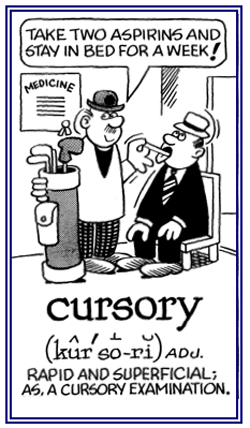
© ALL rights are reserved.
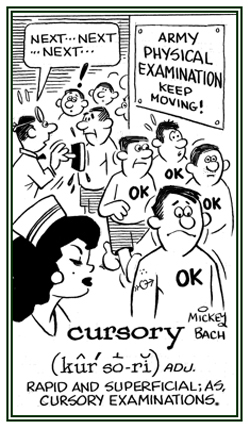
© ALL rights are reserved.
Go to this Word A Day Revisited Index
Go to this Word A Day Revisited Index
so you can see more of Mickey Bach's cartoons.
declamatory (adjective), more declamatory, most declamatory
Descriptive of a rhetorical style of speaking, characterized by forcefully putting forth an opinion or point of view in a way that is loud and forceful: As a university student during the 1960's, Maureen remembers hearing some very declamatory speeches about civil rights and liberties from pro and negative viewpoints that were often loud and emotional.
decoratory (adjective), more decoratory, most decoratory
A reference to beautifying and enhancing: The architect designed the outside of the building to be more functional than just being a decoratory structure.
delusory (adjective), more delusory, most delusory
1. Tending to mislead or to deceive; deceptive: When captured, the escaped convict gave the most delusory explanation about where he had been the night of the crime.
2. Having the nature of and likely to mislead someone: Jennifer was described by the village gossips as having a delusory personality because she seemed to be always trying to get others into trouble.
2. Having the nature of and likely to mislead someone: Jennifer was described by the village gossips as having a delusory personality because she seemed to be always trying to get others into trouble.
depilatory (adjective), more depilatory, most depilatory
Regarding the feature of removing hair: In order to accomplish the depilatory morning job of making his face smooth again, he used his new electric razor.
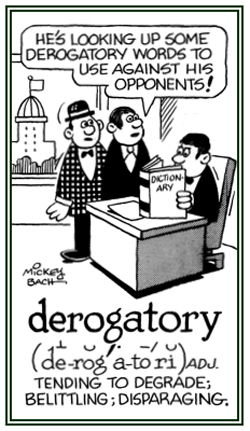
derogatory (adjective), more derogatory, most derogatory
1. Conveying an expression of criticism or a low opinion: Maxine was accused of making derogatory remarks about her employer because she said that he was always trying to control every detail of what the workers were doing instead of letting them complete their assignments without constantly badgering or pestering them.
2. A reference to tendencies to diminish the merits or reputations of people or things: The Republican candidates have been making too many derogatory remarks about each other which provides the Democrats with all kinds of reasons for the voters not to vote for any Republicans.
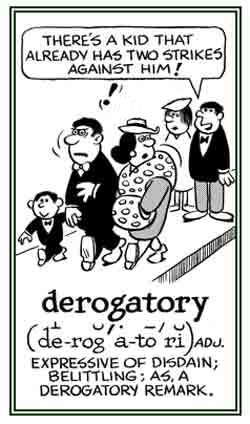
© ALL rights are reserved.
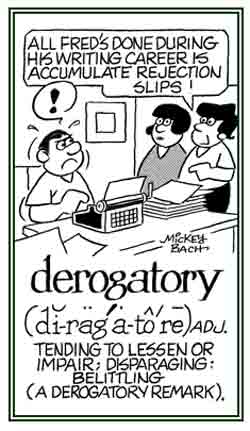
© ALL rights are reserved.
© ALL rights are reserved.
Go to this Word A Day Revisited Index
2. A reference to tendencies to diminish the merits or reputations of people or things: The Republican candidates have been making too many derogatory remarks about each other which provides the Democrats with all kinds of reasons for the voters not to vote for any Republicans.
Go to this Word A Day Revisited Index
so you can see more of Mickey Bach's cartoons.
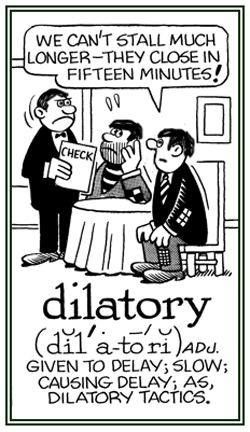
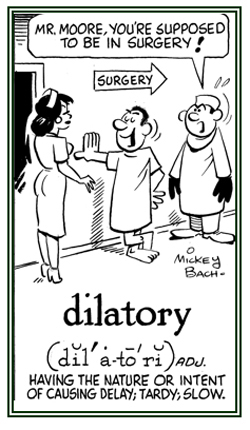
dilatory (adjective), more dilatory, most dilatory
1. A reference to an inclination or intention to waste time, to cause a delay, or to lag behind: Because of the auto accident on the street, it took Monroe a great deal of dilatory time to get home after work.
2. Using cautious slow strategy to wear down the opposition; and so, avoiding direct confrontation and deferring a decision: The congressman, Mr. Gould, used a dilatory strategy to keep the bill from being passed.
3. Etymology: from Latin dilatorius; from dilator, "procrastinator", from dilatus, the past participle form of differe, "to delay".
© ALL rights are reserved.
© ALL rights are reserved.
Go to this Word A Day Revisited Index
2. Using cautious slow strategy to wear down the opposition; and so, avoiding direct confrontation and deferring a decision: The congressman, Mr. Gould, used a dilatory strategy to keep the bill from being passed.
3. Etymology: from Latin dilatorius; from dilator, "procrastinator", from dilatus, the past participle form of differe, "to delay".
Go to this Word A Day Revisited Index
so you can see more of Mickey Bach's cartoons.
An index or a listing: Janice had to look in the telephone directory in order to find the phone number of the mechanical repair and service station near where she lived.
