
antho-, anth-, anthero-, anther-, -antherous, -anthemous, -anthic, -anthous, -anthus, -anthy
(Greek: flower, flowers; blossom, blossoms; that which buds or sprouts)
A rose by any other name probably means the speaker is ignorant about the names of flowers.
acranthous
Having the inflorescence borne on the tip of the main axis.
Inflorescence refers to the group or arrangement in which flowers are borne on a plant.
aianthous
1. Flowers all year; semperflorus.
2. Continuously in bloom or flower.
2. Continuously in bloom or flower.
amaranth
1. A legendary flower that never fades or dies.
2. Any plant of the genus Amaranthus, some of which are grown especially for their flowers and colored leaves.
3. Any of various annuals of the genus Amaranthus having dense green or reddish clusters of tiny flowers and including several weeds, ornamentals, and food plants. Also called "pigweed".
4. A deep reddish purple to dark or grayish, purplish red.
5. A dark red to purple azo dye.
2. Any plant of the genus Amaranthus, some of which are grown especially for their flowers and colored leaves.
3. Any of various annuals of the genus Amaranthus having dense green or reddish clusters of tiny flowers and including several weeds, ornamentals, and food plants. Also called "pigweed".
4. A deep reddish purple to dark or grayish, purplish red.
5. A dark red to purple azo dye.
amaranthine (adjective), more amaranthine, most amaranthine
1. Relating to the annual plant amaranth, which has tiny flowers with colors of deep purple-red or green: Toby put the tiny amaranthine grains into his cereal for breakfast because he knew that they were very healthy for him.
2. Eternally beautiful and unfading; everlasting: Sharon was a woman of amaranthine loveliness.
3. A reference to an imaginary flower that never fades: In the story Janet was reading, the princess was told to find an amaranthine blossom which would keep her young forever, just as the blossom would never become pale and wither away.
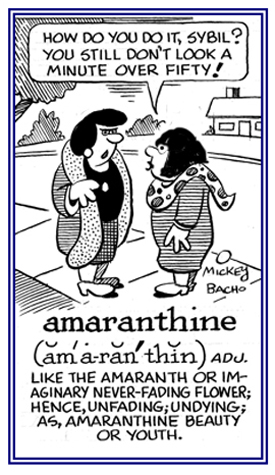
© ALL rights are reserved.
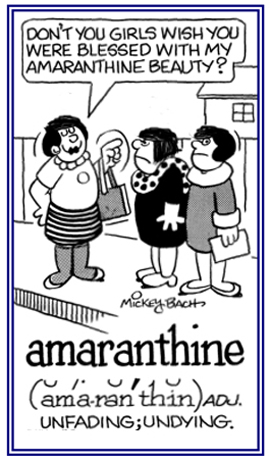
© ALL rights are reserved.
Go to this Word A Day Revisited Index
2. Eternally beautiful and unfading; everlasting: Sharon was a woman of amaranthine loveliness.
3. A reference to an imaginary flower that never fades: In the story Janet was reading, the princess was told to find an amaranthine blossom which would keep her young forever, just as the blossom would never become pale and wither away.
Go to this Word A Day Revisited Index
so you can see more of Mickey Bach's cartoons.
amblyanthus, amblyantha, amblyanthum
Blunt flower.
amphanthium
A dilated receptacle found in some inflorescences.
anantherous
Destitute of anthers (pollen-producing producing part of a flower).
ananthous (adjective), more ananthous, most ananthous
In botany, having no flowers: Ernestine has a very interesting ananthous plant in her garden which has an abundance of leaves but no blossoms.
1. The study of pollination and the relationships between insects and flowers.
2. The interrelationship of flowers and flowering plants with their environments.
2. The interrelationship of flowers and flowering plants with their environments.
anther
1. The pollen-bearing part of the flower stamen.
2. The apical part of a flower stamen which produces the pollen or microspores.
2. The apical part of a flower stamen which produces the pollen or microspores.
antheridium, antherid
The male sex organ of the lower plants, usually producing numerous motile, flagellate gametes (antherozoids).
One of very many male gametes produced in the antheridia; spermatozoid: Alice thought it was quite interesting that antherozoids were found in algae, fungi, and spore-bearing vascular plants, like the ferns in her garden that developed antherozoids.
anthesis
1. The period of flowering.
2. A stage, time, or period at which a flower bud opens.
3. The period of maximum physicological activity in plants.
4. Flowering; florescence; a period of flowering.
2. A stage, time, or period at which a flower bud opens.
3. The period of maximum physicological activity in plants.
4. Flowering; florescence; a period of flowering.
anthesmotaxis
The organization and arrangement of the various parts of a flower.
anthine
A reference to flowers.
