
nox-, noxi-, noc-, nui-, nec-
(Latin: harmful, to do harm; injury, injurious; hurt, damage)
innocence
1. The state, quality, or virtue of being innocent; such as, freedom from sin, moral wrong, or guilt through a lack of knowledge of evil; guiltlessness of a specific legal crime or offense.
2. Freedom from legal or specific wrong; guiltlessness: "The accused prisoner proved his innocence."
3. Freedom from guile, cunning, or deceit; simplicity or artlessness.
4. A lack of worldliness or sophistication; harmlessness; innocuousness; naiveté.
5. A lack of knowledge or understanding; ignorance.
6. Freedom from harmfulness; inoffensiveness.
2. Freedom from legal or specific wrong; guiltlessness: "The accused prisoner proved his innocence."
3. Freedom from guile, cunning, or deceit; simplicity or artlessness.
4. A lack of worldliness or sophistication; harmlessness; innocuousness; naiveté.
5. A lack of knowledge or understanding; ignorance.
6. Freedom from harmfulness; inoffensiveness.
innocency
1. An innocent quality or action.
2. Properly, freedom from any quality that can injure; innoxiousness; harmlessness; as the innocence of a medicine which can do no harm.
3. In a moral sense, freedom from crime, sin or guilt; untainted purity of heart and life; unimpaired integrity.
4. Freedom from guilt or evil intentions; simplicity of heart; such as, the innocence of a child.
5. Freedom from the guilt of a particular sin or crime.
2. Properly, freedom from any quality that can injure; innoxiousness; harmlessness; as the innocence of a medicine which can do no harm.
3. In a moral sense, freedom from crime, sin or guilt; untainted purity of heart and life; unimpaired integrity.
4. Freedom from guilt or evil intentions; simplicity of heart; such as, the innocence of a child.
5. Freedom from the guilt of a particular sin or crime.
This is the sense in which the word is most generally used, for perfect innocence cannot be predicated of man. A man charged with theft or murder may prove his innocence.
innocent
1. Uncorrupted by evil, malice, or wrongdoing; sinless: "She was just an innocent child and should not have been harmed."
2. Not guilty of a specific crime or offense; legally blameless: "He was declared innocent of all charges by the judge."
3. Within, allowed by, or sanctioned by the law; lawful.
4. Not dangerous or harmful; innocuous: "It was just an innocent prank and he meant no harm."
5. Candid; straightforward; such as, a child's innocent stare.>BR? 6. Not experienced or worldly; naive; betraying or suggesting no deception or guile.
7. Not exposed to or familiar with something specified; ignorant: "American tourists are wholly innocent of French when they go to Paris."
8. Unaware: "She remained innocent of the complications she had caused."
9. Lacking, deprived, or devoid of something: "He wrote a novel which was innocent of literary merit."
10. A person, especially a child, who is free of evil or sin.
11. A simple, guileless, inexperienced, or unsophisticated person; for example, a very young child.
12. Etymology: from about 1340, "doing no evil, free from sin or guilt"; from Old French innocent (11th century); from Latin innocentem, innocens, "not guilty, harmless, blameless"; from in-, "not" + nocentem, nocens; present participle of nocere, "to harm".
2. Not guilty of a specific crime or offense; legally blameless: "He was declared innocent of all charges by the judge."
3. Within, allowed by, or sanctioned by the law; lawful.
4. Not dangerous or harmful; innocuous: "It was just an innocent prank and he meant no harm."
5. Candid; straightforward; such as, a child's innocent stare.>BR? 6. Not experienced or worldly; naive; betraying or suggesting no deception or guile.
7. Not exposed to or familiar with something specified; ignorant: "American tourists are wholly innocent of French when they go to Paris."
8. Unaware: "She remained innocent of the complications she had caused."
9. Lacking, deprived, or devoid of something: "He wrote a novel which was innocent of literary merit."
10. A person, especially a child, who is free of evil or sin.
11. A simple, guileless, inexperienced, or unsophisticated person; for example, a very young child.
12. Etymology: from about 1340, "doing no evil, free from sin or guilt"; from Old French innocent (11th century); from Latin innocentem, innocens, "not guilty, harmless, blameless"; from in-, "not" + nocentem, nocens; present participle of nocere, "to harm".
The meaning "free from guilt of a crime or charge" is from 1382. The earliest use was as a noun, "a person who is innocent of sin or evil" from about 1200.
innocently
1. In a naively innocent manner; such as, the child smiled at her innocently.
2. Characterized by being free from guilt or sin especially through lack of knowledge of evil.
3. A reference to being blameless; harmless in effect or intention.
2. Characterized by being free from guilt or sin especially through lack of knowledge of evil.
3. A reference to being blameless; harmless in effect or intention.
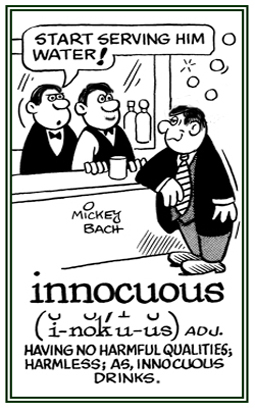
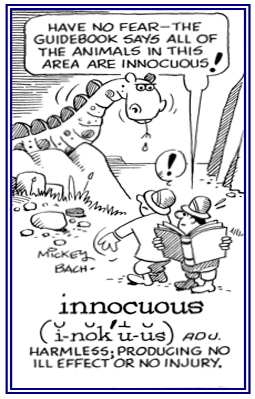
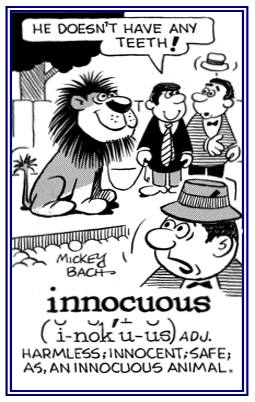
innocuous (adjective), more innocuous, most innocuous
1. A reference to having no adverse effect; harmless: Where Manfred lives, it has been an innocuous summer with mild temperatures and occasionally some rain which usually fell at night when most people were asleep.
2. Not intended to cause offense nor to provoke a strong reaction and unlikely to do so: Because little Joey was only four years old, his mother’s oldest friend was not displeased or annoyed when he asked her an innocuous question about her age.
3. A reference to probably not being irritating nor to offend; inoffensive: Jane and Janice exchanged innocuous conversations about their husbands during lunch.
4. Descriptive of being uninteresting and not stimulating nor significant; pallid; insipid: Mike and his wife said they just saw an innocuous movie that bored them very much.
© ALL rights are reserved.
© ALL rights are reserved.
© ALL rights are reserved.
Go to this Word A Day Revisited Index
2. Not intended to cause offense nor to provoke a strong reaction and unlikely to do so: Because little Joey was only four years old, his mother’s oldest friend was not displeased or annoyed when he asked her an innocuous question about her age.
3. A reference to probably not being irritating nor to offend; inoffensive: Jane and Janice exchanged innocuous conversations about their husbands during lunch.
4. Descriptive of being uninteresting and not stimulating nor significant; pallid; insipid: Mike and his wife said they just saw an innocuous movie that bored them very much.
Go to this Word A Day Revisited Index
so you can see more of Mickey Bach's cartoons.
innocuously
1. Not injurious to physical or mental health.
2. Not causing disapproval: "She made an innocuous remark."
3. Unlikely to harm or tp disturb anyone.
4. Lacking intent or capacity to injure in any way.
5. Without harm; without injurious effects.
2. Not causing disapproval: "She made an innocuous remark."
3. Unlikely to harm or tp disturb anyone.
4. Lacking intent or capacity to injure in any way.
5. Without harm; without injurious effects.
innocuousness
Not likely to give offense or to arouse strong feelings or hostility; inoffensive (causing no harm or injury); insipid (lacking in qualities that interest, stimulate, or challenge).
innoxious
1. Free from mischievous qualities; innocent; harmless; as an innoxious drug.
2. Not producing evil; harmless in effects; not injurious.
3. Free from crime; pure; innocent.
2. Not producing evil; harmless in effects; not injurious.
3. Free from crime; pure; innocent.
innoxiously
Harmlessly; without mischief.
innoxiousness
1. Harmlessness; innocuous.
2. Freedom from harmful qualities or effects; harmless.
2. Freedom from harmful qualities or effects; harmless.
nocent
1. Guilty, criminal; having a tendency to cause harm or injury.
2. Harmful; mischievous; injurious; doing harm: "The criminal had nocent qualities which had to be stopped."
2. Harmful; mischievous; injurious; doing harm: "The criminal had nocent qualities which had to be stopped."
nocuous
1. Harmful; likely to cause injury or damage.
2. Likely to cause damage or injury; harmful; noxious.
2. Likely to cause damage or injury; harmful; noxious.
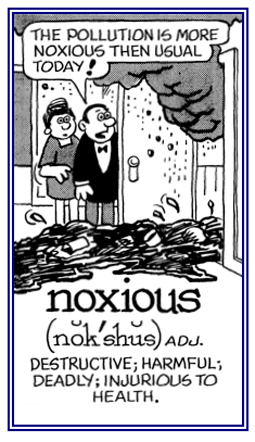
noxious (adjective), more noxious, most noxious
1. Injurious to physical or mental health: Depressions have made some people have noxious feelings that can result in serious ailments.
2. Physically harmful to lives or health; especially, because of poisonous conditions: The noxious air in some countries has been a result of excessive industrial emissions which have caused many people to suffer.
3. Likely to cause moral, spiritual, or social harm or corruption: The noxious words the father used about the man who was dating his daughter resulted in a cancellation of his TV career.
4. Disgusting; very unpleasant: There was a terrible noxious odor coming from the blocked plumbing in Mildred's house.
5. Etymology: from Latin noxius, "harmful"; derived from noxa, "damage, injury".
© ALL rights are reserved.
Go to this Word A Day Revisited Index
2. Physically harmful to lives or health; especially, because of poisonous conditions: The noxious air in some countries has been a result of excessive industrial emissions which have caused many people to suffer.
3. Likely to cause moral, spiritual, or social harm or corruption: The noxious words the father used about the man who was dating his daughter resulted in a cancellation of his TV career.
4. Disgusting; very unpleasant: There was a terrible noxious odor coming from the blocked plumbing in Mildred's house.
5. Etymology: from Latin noxius, "harmful"; derived from noxa, "damage, injury".
Go to this Word A Day Revisited Index
so you can see more of Mickey Bach's cartoons.
noxiously (adverb), more noxiously, most noxiously
1. In a detrimental manner.
2. Characterized by being harmful to living things; injuriously to health.
2. Characterized by being harmful to living things; injuriously to health.
1. The quality of being noxious.
2. Harmfulness; the quality that injures, impairs, or destroys.
2. The quality that corrupts or perverts; such as, the noxiousness of doctrines.
2. Harmfulness; the quality that injures, impairs, or destroys.
2. The quality that corrupts or perverts; such as, the noxiousness of doctrines.
Cross references of word families that are related directly, or indirectly, to: "wound, harm, hurt, injure": noci-; traumat-; vulner-.

Showing page 1 out of 2 pages of 21 main-word entries or main-word-entry groups.