
nomo-, nom-, -nomy, -onomy, -nome, -nomic, -nomous, -nomical, -nomically
(Greek: law, order, arrangement, systematized knowledge of [something]; usage)
Don’t confuse this element with the Latin nomo- which means "name" or another Greek nomo- which means "meadow" or "pasture".
The science of making use of animal and plant products for food, fuel, fiber, etc.: Jack was interested in agronomy as a career that dealt with the production of plants and animals useful to humans, and agronomy also involved soil cultivation, the breeding of livestock, and the management of crops.
anomic (adjective), more anomic, most anomic
1. A descriptive term for an anxious awareness that the prevailing beliefs of society have little or no personal relevance to one's living existence or condition: Hank seemed to have an anomic view of society, that none of its standards or values made any difference in his life.
2. Characteristic of a condition of society characterized by the relative absence of humane behaviors or moral standards: After the revolution, the country was going through an anomic phase when the prevailing attitude was one of immorality and lawlessness.
2. Characteristic of a condition of society characterized by the relative absence of humane behaviors or moral standards: After the revolution, the country was going through an anomic phase when the prevailing attitude was one of immorality and lawlessness.
1. A condition in society in which acceptable standards of conduct and belief are weak or lacking; also, a similar condition in an individual commonly characterized by disorientation, anxiety, and isolation: The anomy of the public scene was disrupted by riots on the streets; thus, breaking down the usual standards of conduct.
2. A reference to a lack of social or ethical standards when the absence of self-control has permitted desires to grow beyond all hope of satisfaction: There is such a thing as suicide that can result from suffering anomy when a person is convinced that there is no hope of satisfying his or her goals or objectives.
3. Apathy, alienation, or personal distress resulting from the loss of previously valued goals: Emile Durkheim popularized the term anomie when he listed it as a principal reason for suicide.
2. A reference to a lack of social or ethical standards when the absence of self-control has permitted desires to grow beyond all hope of satisfaction: There is such a thing as suicide that can result from suffering anomy when a person is convinced that there is no hope of satisfying his or her goals or objectives.
3. Apathy, alienation, or personal distress resulting from the loss of previously valued goals: Emile Durkheim popularized the term anomie when he listed it as a principal reason for suicide.
anomocarpous
anomophyllous
antinomian
antinomy
astronomic
1. Inconceivably large.
2. Relating to or belonging to the science of astronomy.
2. Relating to or belonging to the science of astronomy.
astronomy
1. The scientific study of matter in outer space, especially the positions, dimensions, distribution, motion, composition, energy, and evolution of celestial bodies and phenomena.
3. The scientific study of the universe, especially of the motions, positions, sizes, composition, and behavior of astronomical objects.
Astronomy literally means "law of the stars" or "culture of the stars"; depending on the translation, and it is derived from the Greek αστρονομία, astronomia, from the words άστρον, astron, "star" and νόμος, nomos, "laws" or "cultures".
2. The science that deals with the material universe beyond the earth's atmosphere.3. The scientific study of the universe, especially of the motions, positions, sizes, composition, and behavior of astronomical objects.
These objects are studied and interpreted from the radiation they emit and from data gathered by interplanetary probes.
The sun, moon, and the stars would have disappeared long ago, had they happened to be within reach of predatory human hands.
autonomic
Functioning independently of the will; not under voluntary control: a reference to that part of the nervous system that regulates the activities of blood vessels, secretory glands, and viscera. It comprises parasympathetic and sympathetic components.
autonomism
The belief in or a movement toward autonomy.
autonomist
Someone who strives for autonomy or independence.
autonomous, autonomously
1. Not controlled by others or by outside forces; independent: "an autonomous judiciary; an autonomous division of a corporate conglomerate".
2. Independent in mind or judgment; self-directed.
3. Independent of the laws of another state or government; self-governing.
4. Of or relating to a self-governing entity: an autonomous legislature.
5. Self-governing with respect to local or internal affairs: an autonomous region of a country.
6. In biology, independent and self-governing to the extent that the organism is able to act on the basis of endogenous forces and not only in response to external influences.
2. Independent in mind or judgment; self-directed.
3. Independent of the laws of another state or government; self-governing.
4. Of or relating to a self-governing entity: an autonomous legislature.
5. Self-governing with respect to local or internal affairs: an autonomous region of a country.
6. In biology, independent and self-governing to the extent that the organism is able to act on the basis of endogenous forces and not only in response to external influences.
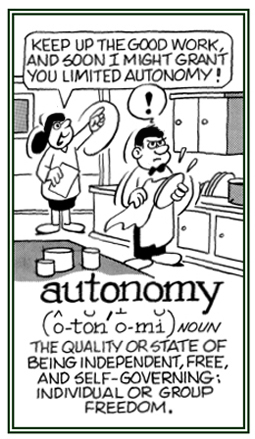
1. The state of existing or acting separately from others with the power or right of self-governing: A certain country was granted autonomy after the war and so it became an independent nation.
© ALL rights are reserved.
Go to this Word A Day Revisited Index
After World War II, many of the British colonies were granted autonomy.
2. The quality or state of being independent, free, and self-directing: After her divorce, Lina wanted autonomy from any further restrictions in her life.Go to this Word A Day Revisited Index
so you can see more of Mickey Bach's cartoons.
Deuteronomy
1. A book in the Bible that repeats the Ten Commandments and records much of the Mosaic Law. It is the fifth book of the Pentateuch.
2. Etymology: from Greek Deuteronomion; literally, "second law", from deuteros, "second" + nomos, "law". From the 14th century via late Latin from Greek Deuteronomion, "second law"; because the book contains a repetition of the Decalogue and parts of Exodus.
2. Etymology: from Greek Deuteronomion; literally, "second law", from deuteros, "second" + nomos, "law". From the 14th century via late Latin from Greek Deuteronomion, "second law"; because the book contains a repetition of the Decalogue and parts of Exodus.
