
neg-, ne-
(Latin: no, not; to refuse, to nullify; to deny)
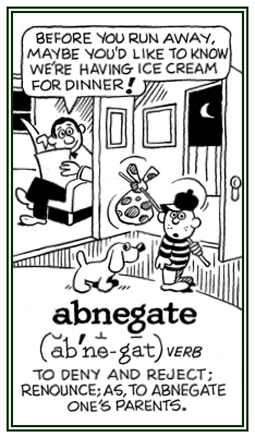
2. To deny something to oneself; to restrain, especially from indulging in some pleasure: The minister of the church abnegated the material luxuries of life.
When Agnes Marcia became a nun after the deaths of her son and husband in an auto accident, she was abnegating a life of comfort and ease in order to dedicate her life to God.
Indulging in an ice cream sundae abnegates the healthful effects of having a salad for lunch.
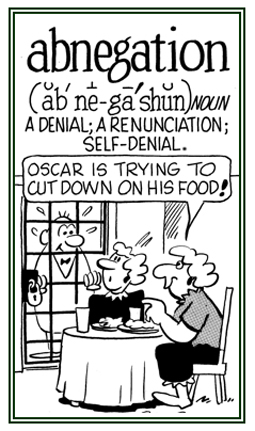
Because Lucy wants to lose weight, she is abnegating the consumption of so much food during her meals.

Go to this Word A Day Revisited Index
so you can see more of Mickey Bach's cartoons.
The vice principal's abnegation of her position to allow for the promotion of a younger person was admired by all.
The Board of Directors was faced with a couple of uncertainties regarding the abnegations of the entire staff at the shelter for women.
Samuel's sudden abnegation of a wild life to become a Christian missionary was a great surprise for everyone who knew him.
2. The denial and rejection of a doctrine or a belief: There are those who have an abnegation of the existence of God.3. Etymology: from Latin abnegare, "to refuse, to deny"; from ab-, "off, away from" + negare, "to deny".
Go to this Word A Day Revisited Index
so you can see more of Mickey Bach's cartoons.
2. Relating to an issue which is painful and sad, but is actually not true or real: The tragic news was deniable regarding Jane's husband to have died the day before, because he was at work the very next day!
2. A rejection to accept the truth of a statement or allegation: After reading the letter saying that he had to pay the outstanding amount immediately, Jack sent off a denial, contradicting the claim as not official.
3. In law, the opposition by a defendant of an allegation of the plaintiff: Mr. Jones was accused of committing the robbery, but his answer was a denial, stating that the accusations were not true because he was far away on holiday during that time!
4. A rejection to acknowledge or to believe something, such as a belief: When Nancy was attending church with her girlfriend, she listened to the minister, but her denial of Christ, in the way the minister presented him, could not be swayed.
5. In psychology, an unconscious defense mechanism characterized by refusal to acknowledge painful realities, thoughts, or feelings: Jane's terrible experience with her parents resulted in a denial or defense process that negated grievous and harrowing truths.
6. The act of disowning or disavowing; repudiation: The authority's denial of refusing to accept Janet's passport was a complete surprise because it was still valid!!
7. Abstinence; the quality of doing without: By refraining from drinking wine and beer, Jeffrey practiced denial.
2. Choosing to contradict a reality as a way to avoid a disturbing actuality based on an empirically verifiable truth: AIDS denialism describes the disaffirmation of the facts which have been proven by relying on observation and tests.
3. An essentially irrational action that withholds validation of an historical experience or event: There are some people who still today use the term Holocaust denialism to present their views by refusing to admit that this part of the past ever occurred.
Apparently the term denialism is a neologism created by Michael Specter (a staff writer at The New Yorker since 1998) for his book, Denialism: How Irrational Thinking Hinders Scientific Progress, Harms the Planet, and Threatens Our Lives, published in 2009; Penguin Press; New York; in which Specter reveals that Americans have come to mistrust institutions and especially the institution of science more today than ever before.
2. Anyone who has increasingly come to maintain personal beliefs even in the face of solid scientific evidence: A denialist refers to a person who opposes a range of issues from childhood vaccines to genetically modified foods, maintaining that living in a totally natural and healthier way is better.
One political person is a climate change denier who evidently doesn't understand that this has scientifically been proven as taking place.
2. Anyone who refuses to let someone have or to do something: Since her mom was a denier, Susan wasn't allowed to play outside until her homework was done!
3. A person who refuses to gratify his or her own needs or desires: Grace turned out to be her own denier when she decided not to go on the cruise around the Mediterranean Sea because she didn't want to get into debt because of it.
2. To refuse to let someone have or to do something: Tim's father denied him the possibility of taking the car because he needed it to go to work that day.
3. To refuse to acknowledge or to recognize someone; to disavow: When the police showed Mike the photo of the culprit, Mike denied having seen him in the shop where the shooting took place.
4. Etymology: from Old French denier, from Latin denegare, from de-, "away" + negare, "to refuse, to say 'no' "; from Old Latin nec, "not", from an Italic base nek-, "not".
2. Having the power to attract electrons: Something is likely to become negatively charged when it is combined with a less electronegative matter.
Nonmetals like glass and wooden objects are considered to be electronegative materials.
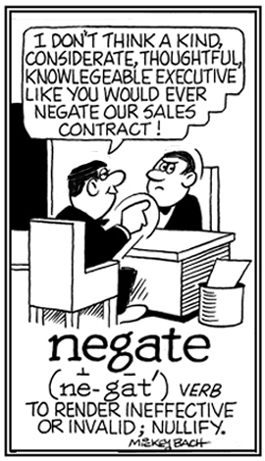
Electric charge is the physical property of matter that causes it to experience a force when placed in an electromagnetic field. There are two-types of electric charge; positive and negative (commonly carried by protons and electrons respectively). Like charges repel and unlike attract.2. To destroy, to reverse, or to make ineffective: Mark's uncle works for a company in which this year's losses negate last year's profits.
Go to this Word A Day Revisited Index
so you can see more of Mickey Bach's cartoons.
2. The absence or opposite of some positive thing or quality: Darkness is the negation of sunshine.
