
nasc-, nat-
(Latin: born, birth)
1. A reference to something that is growing next to or is adhering to something else: There are adnascent parts in plants and even adnascent segments in animals that are connected to each other.
2. Etymology: from Latin adnascens, past participle of anaasi, "to be born, to grow".
2. Etymology: from Latin adnascens, past participle of anaasi, "to be born, to grow".
adnate (AD nayt) (adjective), more adnate, most adnate
1. A reference to something that is congenitally united or grown together: The adnate parts of flowers include stamens or the pollen-producing organs of flowers that are attached to petals or the modified leaves that surround the reproducing parts of flowers.
2. Concerning the union or cohesion of parts not normally joined together: When there is an adnate organ, it is considered to be of a different kind and not a usual one.
3. Etymology: from Latin agnatus, from agnasci, "to become"; from ad, " to" + nasci, "to be born".
2. Concerning the union or cohesion of parts not normally joined together: When there is an adnate organ, it is considered to be of a different kind and not a usual one.
3. Etymology: from Latin agnatus, from agnasci, "to become"; from ad, " to" + nasci, "to be born".
That which has united to something else or a growth with one side sticking to a stem: Adnation in plants is the union of parts that are not like the others, organically united, or fused with another dissimilar part, such as stamens that are attached to petals.
1. A relative through the male descent or on the father's side only: In early patriarchal societies, succession usually gave preference to agnates instead of the mother's descendants.
2. Etymology: from Latin agnatus, "born in addition, added by birth"; from agnisci; from ad-, "in addition" + gnasci, "to be born".
2. Etymology: from Latin agnatus, "born in addition, added by birth"; from agnisci; from ad-, "in addition" + gnasci, "to be born".
antenatal (adjective) (not comparable)
Referring to a condition that occurs or exists before birth: Florence made sure that she had the best antenatal care possible before her baby was born.
1. One of two or more words that have the same root or origin in different languages: English "father", German "Vater", and Latin "pater" are cognates; so are English "frigid", Spanish "frio", French "Froid", Italian "freddo", and Latin "frigidus".
2. Etymology: from Latin cognatus; literally, "born together"; from gnatus, and (g)nasi, "to be born".
2. Etymology: from Latin cognatus; literally, "born together"; from gnatus, and (g)nasi, "to be born".
cognate (adjective), more cognate, most cognate
1. Resembling or pertaining to having the same linguistic root or origin as another language: The English word "eat" and the German "essen" are cognate words.
2. Related by blood or having an ancestor in common with each other: Romance languages, such as French, Italian, Portuguese, Rumanian, and Spanish, are cognate languages.
3. Etymology: from Latin cognatus, from co-, "together with" + natus, "born".
2. Related by blood or having an ancestor in common with each other: Romance languages, such as French, Italian, Portuguese, Rumanian, and Spanish, are cognate languages.
3. Etymology: from Latin cognatus, from co-, "together with" + natus, "born".
connate (adjective), more connate, most connate
1. Relating to living things being born together; a reference to coexisting since birth: The twins lived a connate life together until they went to different colleges.
2. Regarding something being in close agreement or harmony: While walking through the forest, Tom felt more connate with nature than with the big city life where he lived.
3. Concerning plants that are united together with a structure of the same type or kind: Sepals or petals are considered to be connate.
4. Etymology: from Late Latin connatus, connasci, "to be born at the same time"; from Latin com-, "together" + nasci, "to be born".
2. Regarding something being in close agreement or harmony: While walking through the forest, Tom felt more connate with nature than with the big city life where he lived.
3. Concerning plants that are united together with a structure of the same type or kind: Sepals or petals are considered to be connate.
4. Etymology: from Late Latin connatus, connasci, "to be born at the same time"; from Latin com-, "together" + nasci, "to be born".
connately (adverb), more connately, most connately
Descriptive of how something is present in a person since birth: Ever since Mary can remember, she always seemed to make decisions connately by having an unfailing sense or right and wrong.
The removal of an organization or activity from government control: The denationalization of certain documents was turned over to a private group.
denationalize (verb), denationalizes; denationalized; denationalizing
To transfer an industry or institution from a public to a private ownership: Instead of having the firm owned by the government, it was denationalized and changed to an independent and nonpublic-enterprise.
1. The act or process of changing or destroying the quality or nature of something: Some areas of the region showed the effects of denaturalization by being turned into high-rises, shopping malls, and large parking lots.
2. The removal or deprivation of the rights and duties of a citizen: At some points of time, immigrants in the U.S. suffered under the measures of denaturalization.
2. The removal or deprivation of the rights and duties of a citizen: At some points of time, immigrants in the U.S. suffered under the measures of denaturalization.
denaturalize (verb), denaturalizes; denaturalized; denaturalizing
1. To revoke or deny someone of the rights and duties of citizenship: In the novel Susan was reading, the government was overcome and the head of the ruling party was put into prison, while the rest of the party members were denaturalised and banned from the country.
2. To make something unnatural or abnormal: The adopted child is naturalized and denaturalized regarding its kinship.
2. To make something unnatural or abnormal: The adopted child is naturalized and denaturalized regarding its kinship.
denature (verb), denatures; denatured; denaturing
1. To make something unsuitable for eating or drinking by adding a toxic or bad-tasting substance: The alcohol was denatured by using it to remove some dried spills of latex paint.
2. To change the nature of something, or to take away natural qualities: The photos taken of Sam certainly denatured his real appearance, because his hair is black and not grey!
2. To change the nature of something, or to take away natural qualities: The photos taken of Sam certainly denatured his real appearance, because his hair is black and not grey!
innate (adjective), more innate, most innate
1. Pertaining to something which is congenital or in people's blood; natural; inborn; native: Mark has an innate ability to sing and so he is working to succeed in this profession.
3. Etymology: from Latin innatus, "inborn", past participle of innasci, "to be born in, to originate in"; from in-. "in, into" + nasci, "to be born".
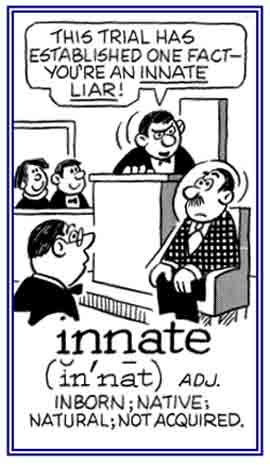
© ALL rights are reserved.
Go to this Word A Day Revisited Index
Shirley has an innate sense of dancing and is entertaining others in as many performances as she can for practice and public approval.
2. Regarding something which is part of the basic nature of something: There are still some innate problems with privacy on the internet.3. Etymology: from Latin innatus, "inborn", past participle of innasci, "to be born in, to originate in"; from in-. "in, into" + nasci, "to be born".
Go to this Word A Day Revisited Index
so you can see more of Mickey Bach's cartoons.
Related "birth, born, childbirth, offspring" words: abort-; feto-; lochio-; proli-; toco-, toko-.
