
myria-, myrio-, myri-
(Greek: ten thousand; very numerous, countless)
A combining form meaning "10,000", used especially, in the names of some metric units equal to 10,000 of the unit denoted by the base word; such as, myriagram; myriameter; however, it is not in official use in the International System of Units.
2. A vast number; a very great or indefinitely great number of people or things: Mike discovered the myriads of bees in the hives of his garden.
3. Etymology: Myriad has been used as a noun ever since its introduction into English in the mid-16th century. It was ultimately borrowed from a Greek word meaning "ten thousand", and from a Greek adjective meaning "countless".
Recent criticism of the use of myriad as a noun, both in the plural form myriads and in the phrase "a myriad of", seems to reflect a mistaken belief that the word was originally and is still properly only an adjective.
The noun is in fact the older form, dating to the 16th century.
The noun myriad has appeared in the works of such writers as Milton (plural myriads) and Thoreau (a myriad of), and it continues to occur frequently in acceptable English. There is no reason to avoid it.
In fact, from the 16th to the 19th century, the English noun was used to mean "ten thousand", primarily in translations from Greek or Latin, or in reference to the Greek numerical system.
The noun is used in both the singular (a myriad of voices) and in the plural (the myriads of voices; the voices of myriads).

Since myriad seems to be used in the picture more as an adjective instead of a noun, would it be more accurate for the character in the cartoon to be saying: "I have a myriad of doubts about the legality of our business contract!!" or "I have myriads of doubts about the legality of our business contract!!"?
Go to this Word A Day Revisited Index
so you can see more Mickey Bach illustrations.
2. So many that they cannot be counted: The myriad stars are impossible to count.
The fishermen saw myriad fish in the ocean.
3. Composed of numerous and diverse elements or groups: The politician was amazed by the myriad nationalities of people who were living in the city.4. Etymology: at the beginning of the 19th century, myriad started its life as an adjective meaning "countless, innumerable", but it was used mostly in poetry or in poetic prose.
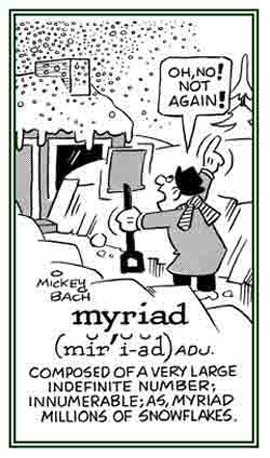

Go to this Word A Day Revisited Index
so you can see more Mickey Bach illustrations.
It is equal to 2,642 United States gallons.
2. A member of the Myriapoda; a centipede or millipede.
2. Arthropods having the body composed of numerous double somites (actual or ideal serial segments) of which an animal is composed each with two pairs of legs: "millipedes".
