
mot-, moto-, -motile, -motility, -motorial, -motoric, -motive, -motored; mov-
(Latin: move, motion)
A machine that responds to sound: The engineers were developing special acousticomotors for wheel chairs that could be controlled by the voices of handicapped people who were unable to physically maneuver them.
A motorized tractor for agricultural work: Jim's uncle had an agrimotor which he used on his farm.
algiomotor (noun), more algiomotor, most algiomotor
1. An almost extinct term, relating to an activity produced by pain: When Susan accidentally burned her finger on the stove, an algiomotor contraction of her hand took place.
2. Concerning a pain caused by a movement: Judy lifted the heavy flower pot with her injured arm and it caused an algiomotor shooting throb..
2. Concerning a pain caused by a movement: Judy lifted the heavy flower pot with her injured arm and it caused an algiomotor shooting throb..
anemotactic (adjective) (not comparable)
Concerning a directed reaction of a motile organism towards (positive) or away from (negative) wind or air currents: Mr. Smart, Jill's biology teacher, told the students to find information regarding anemotactic forms of life which alter their positions or moved depending on the direction of the wind.
An orientation or movement of a free-living organism in response to wind: Some insects show anemotaxis in that they fly into wind currents because of an airborne food supply that triggers their attention.
arteriomotor
automotive
1. Moving by itself; self-propelling or self-propelled.
2. Of or relating to self-propelled vehicles.
3. Relating to motor vehicles; such as, "automotive supplies".
2. Of or relating to self-propelled vehicles.
3. Relating to motor vehicles; such as, "automotive supplies".
biomotor
An apparatus for producing artificial respiration.
The movement or activity of the tiny blood vessels: The capillariomotor regulates the local flow of blood and blood pressure in the tissues in order to regulate the blood circulation throughout the body.
cardiomotility
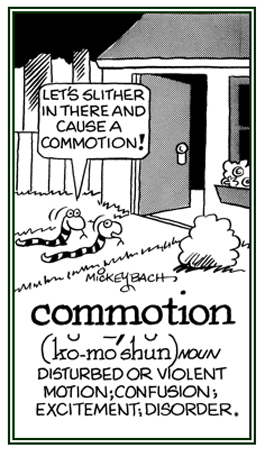
1. A state of confusion and noisy disturbances: Shirley was upset by all of the commotion that was going on across the street from her house where they were having a late party.
2. Etymology: from Latin com-, "together" + movere, "to move".
© ALL rights are reserved.
Go to this Word A Day Revisited Index
2. Etymology: from Latin com-, "together" + movere, "to move".
Go to this Word A Day Revisited Index
so you can see more of Mickey Bach's cartoons.
countermove
countermoving
demote
demotic (adjective), more demotic, most demotic
1. Relating to or involving ordinary people.
2. Relating to a simplified form of hieroglyphics, the writing system used in ancient Egypt. Literally, "of the people".
2. Relating to a simplified form of hieroglyphics, the writing system used in ancient Egypt. Literally, "of the people".
