
mimo-, mim-, -mimesis, -mimia, -mimetic, -mime, -mimic, -mimical, -mimically
(Greek: represent, impersonate, copy; imitate, act as; simulate, simulation)
2. The state of a woman who lives full-time as a man. Unlike transvestic fetishism, in which cross-dressing appears episodically because it is required for erotic arousal and orgasm, the anderomimetic adopts the male role and appearance full-time and may undergo hormonal masculinization, hysterectomy, breast removal, or full sex-reassignment surgery.
The counterpart of andromimesis in the male is gynemimesis.
Utilizing nature in the present and in the future with engineering designs with biomimetics or biomimesis; that is, mimicking nature with technology.
Don't confuse this field of science with a similar term known as biometrics.
Perspectives about how some scientists are utilizing the forces of nature through biomimetics or biomimesis; that is, mimicking nature with technology.
Don't confuse this field of science with a similar term known as biometrics.
You will learn about Velcro, a well-known product of nature and now with practical applications for clothing and other items of interest to people.
2. Imitating nature in man-made systems or an attempt to mold technology on nature.
See an extended example of biomimicry by going to this Velcro page.
This acronym is NOT related to meanings indicated in this unit of mimo- elements, but it is presented so people won't confuse its origin with the "imitate" or "simulation" meanings shown in the other mimic words located here.
2. To imitate a person, a manner, etc.; especially, for satirical effects: In their English class at school, Sally had to mime a painter and the other students had to guess whom she was trying to represent.
3. Etymology: "a buffoon who practices gesticulations" from, 1603, from French mime, from Latin mimus; from Greek mimos, "imitator, actor, buffoon".
The verb meaning "to act without words" is from 1616 and the sense of "to imitate" is from 1733.
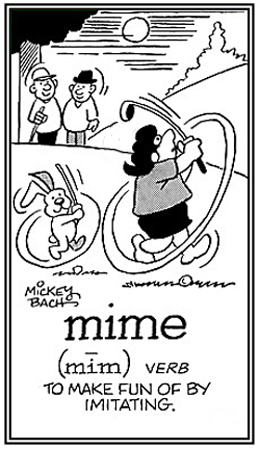
Go to this Word A Day Revisited Index
so you can see more of Mickey Bach's cartoons.
2. A performer who did not speak, but relied solely on gestures, facial expressions, and actions to communicate with an audience.
3. In ancient Greek and Roman theater, it was a lewd comedy which included dialogues, dances, and gestures.
2. Etymology: "a copying machine", from about 1889, invented by Edison; from Greek mimeomai, "I imitate"; from mimos, "mime" + -graphos; from graphein, "to write".
