
-ment
(Latin: a suffix; result of, means of, act of; place of action)
The suffix -meant is a final word element derived through Middle English and French from the Latin suffix -ment(um), originally used to form agent and action nouns from verbs, now used to form nouns and denominative verbs in several related senses:
- "An action, process, or skill" denoted by the combining root: rearmament, tournament, management.
- "A result, object, or agent of an action" named by the joining root: entombment, enthrallment, agreement.
- "The means or instrument of an action": implement, medicament, reinforcement.
- "The place of an action" named by the first root: battlement, ambushment, settlement.
- "A state or condition" specified by the first root: bewilderment, predicament, bereavement.
The verb combinations show no change in basic form: cement, compliment, lament.
Principal parts: -menting, -mented, -mented.
Related forms: -mentum (singular); -menta, -menti, -ments (plurals).
1. That which has been annulled, done away with , or destroyed: With the abolishment of the school rule about wearing nail polish, the girls were much happier.
2. Anything that has come to an end or stopped: When Vicki was reading the newspaper, she read the column listing all the abolishments which had been carried out by the city council.
2. Anything that has come to an end or stopped: When Vicki was reading the newspaper, she read the column listing all the abolishments which had been carried out by the city council.
1. The act or process of reducing; a shortening of time or labor; a curtailment of privileges: The city council voted for an abridgment of the mayor's power.
2. A compendium of a larger work, with the details and less important things omitted, but retaining the sense and substance; an epitome, or abstract: Did you see the new abridgment of Gibbon's Roman History?
2. A compendium of a larger work, with the details and less important things omitted, but retaining the sense and substance; an epitome, or abstract: Did you see the new abridgment of Gibbon's Roman History?
The professor really liked the abridgment of the latest novel by his favorite writer that was published in the newspaper.
3. Etymology: Abridgment, or abridgement was borrowed from Old French abregement, from abregier, "to shorten, to diminish"; from Latin abbreviare, "to make short".
accompaniment
accouterment (uh KOO tuhr muhnt), accoutrement (uh KOO truh muhnt) (s) (noun); accouterments, accoutrements (pl)
1. Clothing that is worn or carried, but not part of one's main clothing; personal clothing, accessories, etc.
2. The equipment, excluding weapons and clothing, of a soldier.
3. Outward forms of recognition; trappings; such as, cathedral ceilings, heated swimming pools, and other accoutrements signaling great wealth.
4. Etymology: from Middle French accoustrement; from accoustrer + -ment, "result of an action"; from Old French acostrer, "to arrange, to sew up".
2. The equipment, excluding weapons and clothing, of a soldier.
3. Outward forms of recognition; trappings; such as, cathedral ceilings, heated swimming pools, and other accoutrements signaling great wealth.
4. Etymology: from Middle French accoustrement; from accoustrer + -ment, "result of an action"; from Old French acostrer, "to arrange, to sew up".
1. Something accomplished; especially, by superior ability, special effort, great courage, etc.
2. The act of achieving; attainment or accomplishment.
3. In heraldry, the full display of the armorial bearings (bearing a coat or coats of arms) of an individual or corporation.
2. The act of achieving; attainment or accomplishment.
3. In heraldry, the full display of the armorial bearings (bearing a coat or coats of arms) of an individual or corporation.
An accomplishment, ability, or power that has been developed through training: Virtuosity on the piano for Rene was his acquirement after many years of daily practicing.
1. The act of delaying something until another place or time: The meeting was completed with just two brief adjournments.
2. The end or the conclusion of something: The adjournment of Congress is expected to be delayed until the budget is passed.
2. The end or the conclusion of something: The adjournment of Congress is expected to be delayed until the budget is passed.
1. A change in something that makes it better, more accurate, or more effective.
2. An action which someone makes in his or her behavior or attitude by making or becoming suitable or adjusting to circumstances.
3. In sociology, a process of modifying, adapting, or altering individual or collective patterns of behavior is order to bring them into conformity with other such patterns; for example, as with those provided by a cultural environment.
4. Regarding insurance, the act of determining the amount of indemnity that the party insured is entitled to receive under the policy and of settling a claim.
5. A means of modifying something; especially, a physical mechanism that requires regulating or correcting.
2. An action which someone makes in his or her behavior or attitude by making or becoming suitable or adjusting to circumstances.
3. In sociology, a process of modifying, adapting, or altering individual or collective patterns of behavior is order to bring them into conformity with other such patterns; for example, as with those provided by a cultural environment.
4. Regarding insurance, the act of determining the amount of indemnity that the party insured is entitled to receive under the policy and of settling a claim.
5. A means of modifying something; especially, a physical mechanism that requires regulating or correcting.
That which comes or happens; an event, incident: The advenement of Jill's illness caused the family to postpone their trip to Canada.
advertisement
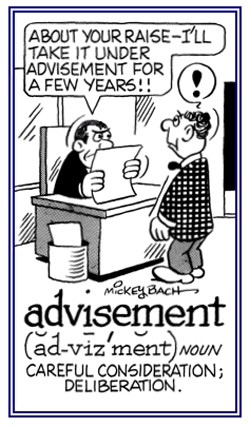
To consider something carefully: The press received a message from the congressman saying, "Thank you for your suggestion. We'll take the matter under advisement."
© ALL rights are reserved.
Go to this Word A Day Revisited Index
Go to this Word A Day Revisited Index
so you can see more of Mickey Bach's cartoons.
The increase or enhancement of prestige, power, or influence of someone: The president of the company used fancy letterheads on his memos, etc. to emphasize the aggrandizement of his new position.
