
luto-, lut-, luv-, lu-
(Latin: wash, clean; washing of water against the shore; a flood)
From Latin luere, "to wash" which is related to lavare, "to wash".
There are usually several different abluents available in supermarkets that are used to clean all kinds of things in one's home.
The abluent effects of vinegar are said to be of great value.
In some religions, an ablution may be a prescribed washing of part or all of the body or of possessions, such as clothing or ceremonial objects with the intent of purification or dedication.
2. The liquid used in showering which may refer to the practice of removing sins, diseases, or earthly defilements through the use of ritual deputation or to become purified or cleansed: Before saying his prayers, Gregory used an ablution that represented the spiritual cleansing of his sins.Like most ritual acts, ablutions may carry a wide range of meanings for those who perform it, for example the act of cleansing may be only a gesture that is symbolic of a desired purity of the soul.
3. A scrubbing of a person's body or body parts; a bathing, a cleaning: Because of the heat, Charlene felt the need for a refreshing ablution.After consecutive ablutions at the sink, Pearl was finally able to wash the smell of garlic off her hands.
Gertrude's husband performed an ablution of his feet every night before going to bed.
4. Etymology: from Latin abluere, "to wash off"; ab-, "away" + luere, "to wash".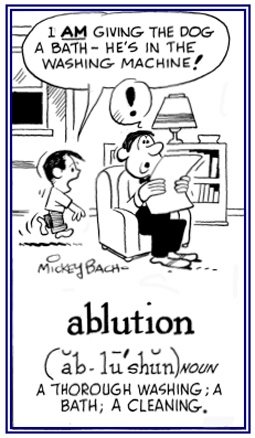
Go to this Word A Day Revisited Index
so you can see more of Mickey Bach's cartoons.
2. A reference to a religious purification of the body by washing, especially a ritual washing of the hands, etc.: Robert completed his ablutionary ceremonies of soaping up, rinsing, and the drying of his hands each morning before going to prayer in the chapel.
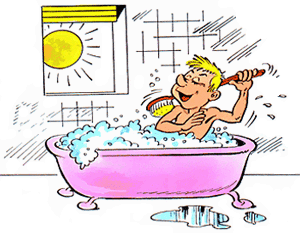
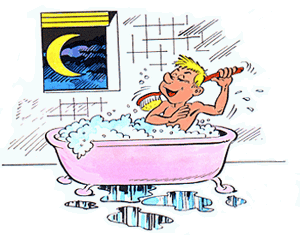
2. A mental illness in which patients are driven to repeat the same act, such as washing their hands, over and over again, usually for many hours: Some compulsive disorders, as indicated in ablutomanias, are often considered to be "obsessive-compulsive psychoneuroses".
Some ablutomanias are enormously time-consuming. A woman named Beth felt compelled to wash her hands in a certain way after touching "unclean" objects, namely from fingers to wrist, from wrist to elbow, and from elbow to upper arm, and then to repeat the performance several times until her anxiety was over. As a result, Beth's hands often became painfully raw.
Arthur had ablutomanias that involved washing in a certain ritualistic order whenever he had a bath or cleaned objects. He said, "When I wash clothes or clean anything—floor, carpet, windows, and so on—I have to clean them in a specific way to make sure I do not miss anything. I can never hurry because I would not feel that it has been done properly."
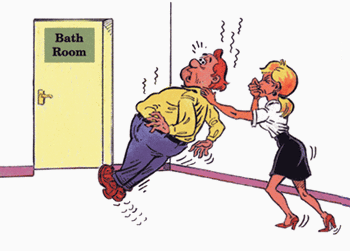
2. A dread of water or of being seen in the nude: Some people who have ablutophobias are overly anxious that their bodies will be criticized or compared with those of others, while some simply have an abnormal fear of being in warm or cold water.
The ablutophobias which Susan's sister suffered from, included being terribly afraid of going near swimming pools.
David's roommate at the university was ablutophobic which made living in the same room with him too difficult, so David made arrangements to move in with a non-ablutophobic student.
The department of psychiatry at t the hospital started a group program for ablutophobic individuals in hopes of generating a better solution for their psychological conditions.
The recent abluvion that was swept away by the flood included a picnic table.
All of the abluvions which had collected under the bridge were cleared away by the underwater divers.
The most alluvial deposits that have ever been recorded in Fred's community took place recently during the severe flooding.
2. Etymology: borrowed from Medieval Latin alluvium, alluvius, "washed against", from Latin alluere, "to wash against"; from al-, a form of ad- before l, "to, against", + -luere, a combining form of lavere, "to wash".Click on the link for additional information about the historical background of washing and ablutions or cleanliness via washing.
Related "wash" words: balneo-; clys-; lav-; plyno-.
