
lud-, ludi-, lus-
(Latin: play, make sport of, jest; sportive; pastime)
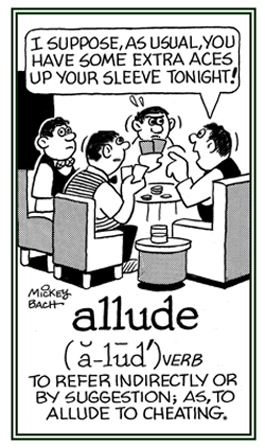
2. To refer to something in a figurative way, to compare symbolically to something else: Kirk told Cathy that he was interested in hearing more about the technology that she alluded to during her presentation.
3. To make an indirect or passing reference to something; to glance at: Charles was alluding to his first wife when he referred to his first love.
4. To hint at indirectly without any specific identification or details, to mention, to refer to: Bill often alluded to his childhood on a farm but he rarely indicated anything specific.
The candidate alluded to the recent war by saying, "We’ve all made sacrifices."
5. Etymology: from Middle French alluder; from Latin alludere, "to joke, to jest"; from ad-, "to" and ludere, "to play". Originally "to mock", later, "to make a fanciful reference to."The Oxford English Dictionary says that allude is often used ignorantly as if it were equal to "refer" in its general sense.
Go to this Word A Day Revisited Index
so you can see more of Mickey Bach's cartoons.
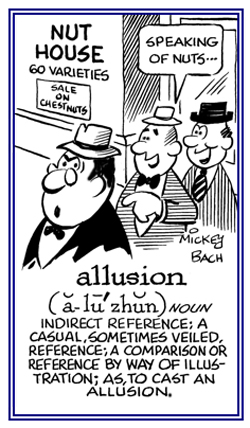
An allusion is never an outright or explicit designation of a person or anything that the speaker seems to have in mind.
The history book about America which Sam was reading made a brief allusion to the ancient Greek idea of what a democracy was.
Heidi made an allusion to her first marriage, but she said nothing more revealing about it.
2. A play on words, a word-play, a pun (now considered obsolete): The editor of the dictionary was delighted to find out about a book of allusions with which he was unfamiliar.3. A covert, implied, or indirect reference; a passing or incidental reference: The main thing to remember is that an allusion is a brief hint or a quick mention of something which the readers or listeners are expected to have some knowledge about.
4. Etymology: from Latin allusionem, allusio, "a playing with, a reference to"; from allus-, a stem of alludere, "to play, to joke, to jest."
Go to this Word A Day Revisited Index
so you can see more of Mickey Bach's cartoons.
2. Symbolical, metaphorical, figurative: Andre's most allusive comments are when he compares higher education to spans on a bridge that lead to greater achievements.
3. Having many indirect references: Sherlock, the detective, made allusive inquiries during his search for the true culprit of the crime.
The politician's allusively subtle comments were perceived as jokes instead of something that should be taken seriously.
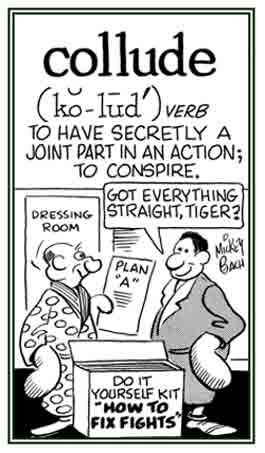
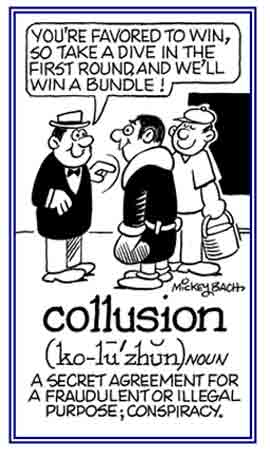
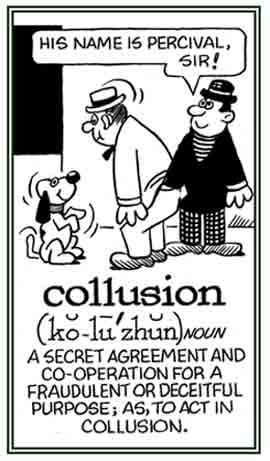
2. To act slyly in concert with someone else, primarily in order to trick or to baffle another person or group: The underaged smokers, Mary and Sally, were colluding with an older youth to get him to make the clerk at the store think he was buying cigarettes for himself and not for them.
3. To play into one another's hands; to conspire, to plot, or to behave falsely: Joyce could not believe that her best friend was colluding against her in order to be chosen as the leading actress in the theater drama.
4. To act in unison or in agreement in order to achieve a deceitful or illegal objective: Mr. Robinson, the politician, was accused of colluding with members of another political group in order to win more votes for his election.
Go to this Word A Day Revisited Index
so you can see more of Mickey Bach's cartoons.
The collusion of the truck drivers to secretly change the speed limit signs on the highway almost resulted in disastrous collisions during the heavy rain storm.
2. An agreement or understanding for purposes of trickery or fraud: The extent of collusion to which Jeff, the farmer, did to fool his neighbor into giving him pasture land was astonishing.3. A secret agreement or working together for what is typically an illegal purpose: When the oil well failed, the operators suspected a collusion between the teams of workmen.
The reporter revealed the collusion between some city officials and certain local businesses to keep the commercial taxes low.
4. Etymology: from Old French collusion; from Latin collusionem, "act of colluding"; from colludere, from com-, "together" + ludere, "to play"; from ludus "game".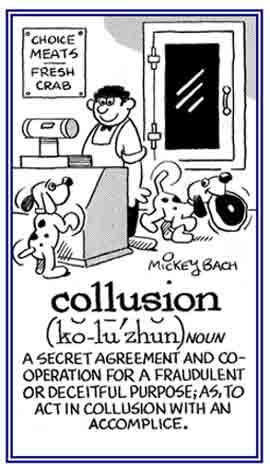
Go to this Word A Day Revisited Index
so you can see more of Mickey Bach's cartoons.
2. Secretly cooperating, or involving secret cooperation, in order to do something illegal or underhanded: The undercover police officer appeared to be acting in a collusive manner with the suspects in order to catch them actually committing the bank robbery.
2. To fool the mind or judgment of someone, so as to cause what is false to be accepted as true: Nadir's arguments were so impressive and seemingly so true that he completely deluded his audience about the true nature of the medicine he was selling.
Agnes said, "If Pedro thinks I care, then he is simply deluding himself."
Much of the spam on the internet is done to delude people with some scheme or trickery.
3. Etymology: from Latin deludere, "to mock, to deceive"; from de-, "down, to one's detriment" + ludere, "to play".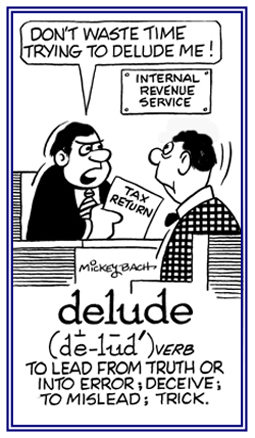
Go to this Word A Day Revisited Index
so you can see more of Mickey Bach's cartoons.
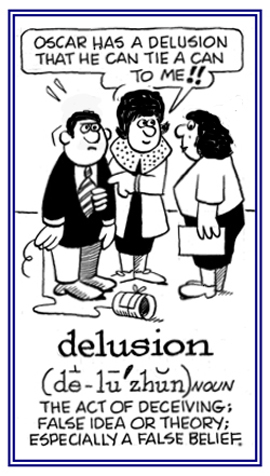
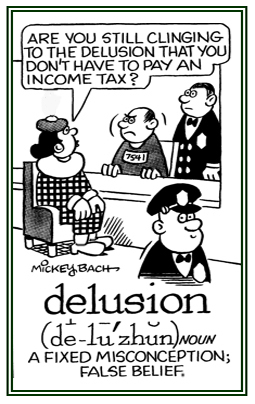
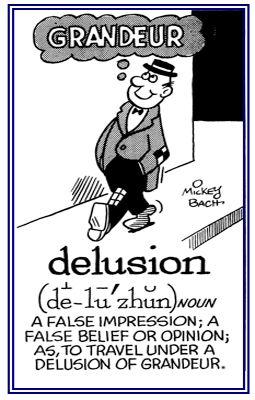
2. A mental disorder; a false belief strongly held in spite of invalidating evidence; especially, as a mental disorder: Mack had delusions of persecution by all women.
Kerri had delusions of grandeur as an actress.
Sam had the delusion that he was a muscular man as he lifted the weights at the fitness studio.
Zachary had a delusion that all women hated him.
Tanya had the delusion of being extraordinarily beautiful.
3. Something falsely disseminated or believed: Technically, a delusion is a belief that, though false, has been surrendered to and accepted by the whole mind as the truth.The investigators were under the delusion that the safety for the workers was a reality; however, since it was based on a report circulated to the supervisors, it became apparent that they were dishonest and it was made in order to avoid any responsibilities for anything that was really going on.
Go to this Word A Day Revisited Index
for a list of additional Mickey Bach illustrations.
2. Having the nature of and likely to mislead someone: Jennifer was described by the village gossips as having a delusory personality because she seemed to be always trying to get others into trouble.
