
ana-, an-, ano-, am-
(Greek: up, upward; back, backward, against; again, anew; used as a prefix)
The churches of western Christendom that separated from the Roman Catholic Church during the Reformation resulting in some Protestant movements in the 16th century that believed that the Bible was the most important guidance for Christians and so some of them were practitioners of Anabaptism because they were convinced that only those who were old enough to make decisions to become baptized believers, and not infants, were the true believers.
"Denying the validity of infant baptism, Anabaptists accepted adult baptism, which was regarded as a second baptism by those outside the group who identified them as Anabaptists (from the Greek for rebaptizers)."
"Anabaptists sought to restore the institutions and spirit of the primitive church."
2. To purify or to symbolically cleanse someone spiritually: In school Grace learned that people back in 1637 were anabaptized in order to sanctify and to lustrate them from guilt or defilement.
3. To introduce or to initiate someone into an activity which is to be accomplished: Adam was anabaptized once more when he applied for a job as an a reporter in TV productions.
Anabatic wind is caused by the difference in density between the warm ground air and the cooler air in the free atmosphere.
2. The condition of an organism that has passed into a resting stage, that is cyclic or seasonal, and is produced by a change in the environment; such as, the loss of moisture.
2. Acting as a stimulant or tonic.
3. A revivifying remedy, a powerful stimulant; revitalizing or restorative.
Starch, glycogen, fats, and proteins are all products of anabolic pathways.
2. The building up of the body's substance or the constructive phase of metabolism by which a cell takes from the blood the substance required for repair and growth, building it into a cytoplasm; thus, converting a nonliving material into the living cytoplasm of the cell.Anabolism is the opposite of catabolism, the destructive phase of metabolism.
2. The attraction to and a deposition within an inflammatory lesion of microbes or metal particles.
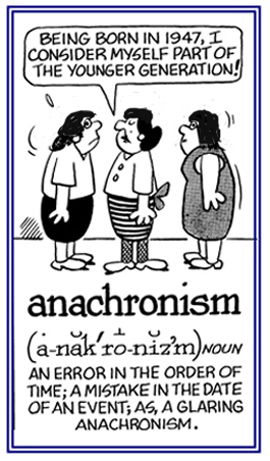
2. Anything done or existing out of date, hence anything that was proper to a former age but is, or if it existed, would be out of harmony with the present: In the novel, which took place in the 16th century, the main character used the term “taboo”, which entered the language much later, an anachronism that the author evidently forgot to delete!
3. A situation which depicts a person or something that is not placed in the correct historical or chronological period, especially a thing or individual that belongs to an earlier age of existence: A portrait of Abraham Lincoln sitting in front of a computer would be an example of an anachronism.
Go to this Word A Day Revisited Index
so you can see more of Mickey Bach's cartoons.
2. A reference to valleys, rivers, and similar structures that are progressing in a direction opposite to the dip in the surrounding rock strata.
