
locu-, loc- +
(Latin: talk, speak, say, word, speech)
Directly related to the loqu- family of "talk, speak" words.
2. A traditional formal question directed by a court to a defendant convicted of a felony before sentencing, asking whether or not the defendant has anything to say regarding why the sentence should not be pronounced against him or her: "I believe that to have interfered as I have done, as I have freely admitted I have done, in behalf of God's despised poor, I did no wrong, but right. Now, if this court should deem it necessary that I should forfeit my life for the furtherance of the ends of justice . . . I say let it be done."
So went the court room allocution of John Brown, American hero to the slaves.
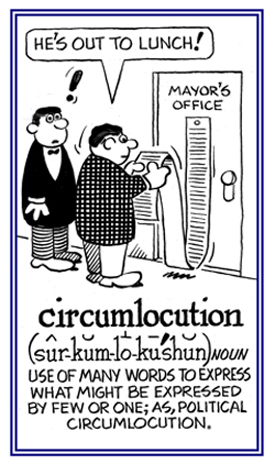
2. An evasion in speech or writing instead of speaking or writing directly to the point: Mr. Hill, the principal, usually used indirect statements or circumlocutions when the teachers asked him specific questions about what to do in certain situations while teaching.
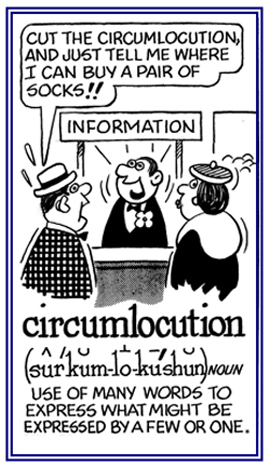
3. A roundabout or indirect way of expressing oneself: Mrs. Thompson told her student, “Now, no more circumlocution, let me know exactly what you want to tell me.”
4. A description of a person who is using long words; especially, when verbal construction utilizing less amplification might represent a more naturally efficacious phraseology: Billy's use of circumlocution lengthened his report to his teacher; however, it resulted in his having a lower grade.
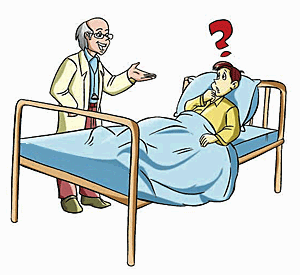
Now, we are going to try vis medicatrix naturae* during your final days in the hospital.
Go to this Word A Day Revisited Index
so you can see more of Mickey Bach's cartoons.
The noncircumlocutional title is, "All’s Well That Ends Well."
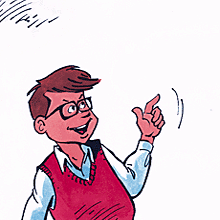
Mother, do you have the audacity to doubt my veracity and to insinuate that I prevaricate when I am as pure and undefiled as the icicles that hang from a church steeple?
2. An expression of something in more words than are necessary.
A cartoon's expressions of being circumlocutory
Hobbes: How are you doing on your new year's resolutions?
Calvin: I didn't make any. See, in order to improve oneself, one must have some idea of what's "good". That implies certain values. But as we all know, values are relative. Every system of belief is equally valid and we need to tolerate diversity. Virtue isn't "better" than vice. It's just different.
Hobbes: I don't know if I can tolerate that much tolerance.
Calvin: I refuse to be victimized by notions of virtuous behavior.
2. Any of the people engaged in a conversation
2. The art of speaking clearly and well, with correct enunciations: As a part of her teacher education, Lucy took a course in elocution so she could make herself easily understandable by her future students.
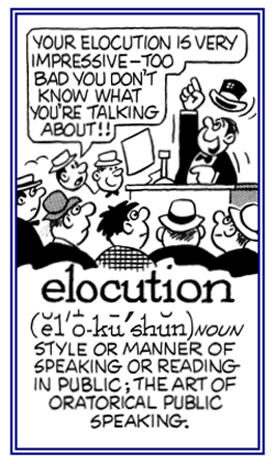
Go to this Word A Day Revisited Index
so you can see more of Mickey Bach's cartoons.
2. Pertaining to elocution or to public speaking; rhetorical.
2. Someone who practices or teaches elocution.
2. Someone who takes part in a conversation, often formally or officially.
3. The man in the middle of the line of performers in a minstrel troupe, who acts as the announcer and banters (lighthearted teasing or amusing remarks) with the end men.
2. Pronounced or decided during the course of an action, or suit, and merely temporary or provisional in nature.
3. Involving or characteristic of a conversation or a discussion.
2. A particular word, phrase, or expression; especially, one that is used by a particular person or group.
3. Style of speaking; phraseology; the way in which someone speaks.
Related "word, words" units: etym-; legi-; lexico-; logo-; onomato-; -onym; verbo-.
