
linguo-, lingu-, lingua-, -linguist, -linguistic, -linguistical, -linguistically +
(Latin: literally tongue; and by extension, speech, language)
From Old Latin dingua which is a cognate (kindred) with Old English tunge, The change of d (in Old Latin dingua) to l (in Latin lingua) was probably due to dialectal influence (the so-called "Sabine l"). It was facilitated by a folk-etymological association with lingere, "to lick", the tongue having been conceived as "the licking organ".
Audiolingual learning started during World War II
The next "revolution" in terms of language teaching methodology coincided with World War II, when America became aware that it needed people to learn foreign languages very quickly as part of its overall military operations. The "Army Method" was suddenly developed to build communicative competence in translators through very intensive language courses focusing on aural-oral skills. This, in combination with some new ideas about language learning coming from the disciplines of descriptive linguistics and behavioral psychology, went on to become what is known as the Audiolingual Method (ALM).
This new method incorporated many of the features typical of the earlier Direct Method, but the disciplines mentioned above added the concepts of teaching "linguistic patterns" in combination with "habit-forming". This method was one of the first to have its roots "firmly grounded in linguistic and psychological theory" (Brown 1994:57), which apparently added to its credibility and probably had some influence in the popularity it enjoyed over a long period of time. It also had a major influence on the language teaching methods that were to follow, and can still be seen in major or minor manifestations of language teaching methodology even to this day.
The method gained popularity because it was considered successful
Another factor that accounted for the method's popularity was the "quick success" it achieved in leading learners towards communicative competence. Through extensive mimicry, memorization and "over-learning" of language patterns and forms, students and teachers were often able to see immediate results. This was both its strength and its failure in the long run, as critics started to point out that the method did not deliver in terms of producing long-term communicative abilities.
Just as with the Direct Method that preceded it, the overall goal of the Audiolingual Method was to create communicative competence in learners, however it was thought that the most effective way to do this was for students to "overlearn" the language being studied through extensive repetition and a variety of elaborate drills.
The idea was to project the linguistic patterns of the language (based on the studies of structural linguists) into the minds of the learners in a way that made responses automatic and "habitual". To this end it was held that the language "habits" of the first language would constantly interfere, and the only way to overcome ths problem was to facilitate the learning of a new set of "habits" appropriate linguistically to the language being studied.
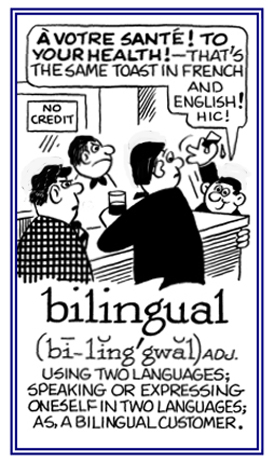
2. Descriptive of a text that is written, expressed, or conducted in two languages: Jerry is using a bilingual dictionary while he is learning German in his American school.
3. A reference to the use of two languages: A very good example of a bilingual nation is Canada, where the official means of communication are English and French.
Go to this Word A Day Revisited Index
so you can see more of Mickey Bach's cartoons.
2. The habitual use of two languages colloquially.
2. Characterized as that which is written, expressed, or conducted in two languages; such as, they speak bilingually (French and English) in Quebec, Canada.
2. The study of language functions as related to or derived from biological characteristics of an organism.
