
-lepsy, -lepsia, -lepsis, -leptic
(Greek: a suffix; a violent attack, a seizing)
2. The impossibility of complete discovery or comprehension; incomprehensibility: For Dave's cousin, advanced mathematics is an exercise in acatalepsy, reaching new degrees of not understanding.
3. The ancient doctrine that nothing can be known with certainty: Enrique's historical statement suggests that medical diagnostic or prognostic acatalepsy is inherently uncertain.
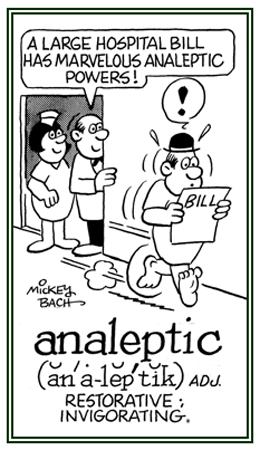
2. Restoring, invigorating, or giving strength after disease: An analeptic stimulation puts forth a restorative or invigorating action.
Go to this Word A Day Revisited Index
for a list of additional Mickey Bach illustrations.
2. The taking by one nation of the citizens or subjects of another, in order to compel the latter to do justice to the former.
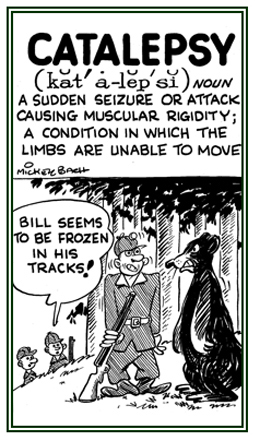
Nurses and physicians have been warned that, although a patient is in a trance of catalepsy, he or she may still be able to hear and to understand their conversations; so, the medical staff's actions and talks about such a patient, in his or her presence, should be the same as if that person were fully conscious.
2. Etymology: from Greek catalepsis; from kata-, "down" + lepsis, "seizure"; a derivative of lambanein, "to seize".
Go to this Word A Day Revisited Index
so you can see more of Mickey Bach's cartoons.
Chorea consists of jerky spasmodic movements of the limbs, trunk, and facial muscles, common to various diseases of the central nervous system.
2. A progressively fatal spasmodic disorder, possibly of malarial origin, occurring chiefly in Italy.It is a severe form of Sydenham's chorea, in which the spasms are rapid and of a specially rapid, jerky character.
Sydenham's chorea is a neurological disease of children and pregnant women, sometimes following rheumatic fever, in which those affected experience involuntary jerking movements of the body and it is also defined as an acute neurologic disorder that emerges several months following a streptococcal ("strep") infection.
It is named after Thomas Sydenham (1624-1689), English physician.
2. A figure by which the same word or clause is repeated after intervening material.
2. A medical disorder involving episodes of irregular electrical discharge in the brain and characterized by the periodic sudden loss or impairment of consciousness, often accompanied by convulsions.
When nerve cells in the brain fire electrical impulses at a rate of up to four times higher than normal, this causes a sort of electrical storm in the brain, known as a seizure.
A pattern of repeated seizures is referred to as epilepsy and known causes include head injuries, brain tumors, lead poisoning, maldevelopment of the brain, genetic and infectious illnesses.
Medication controls seizures for the majority of patients.
