
-ise
(Latin: a suffix; to act in a certain way; to treat in a certain way; to make into; to treat with; to do; to make; to cause)
Another closely related suffix family with the same meanings, but a different spelling, is located at this -ize unit.
advertise (verb), advertises; advertised; advertising
1. To publicize the qualities of a product, service, business, or event in order to encourage people to buy or to use it: The new cinema in town was advertising the latest movies during the past week so that everybody would come and watch!
2. To make something known publicly: There was a job opening in the shop downtown and it was advertised in Monday's newspaper.
2. To make something known publicly: There was a job opening in the shop downtown and it was advertised in Monday's newspaper.
advisedly (adverb), more advisedly, most advisedly
Relating to how something is done with careful consideration and thoughtfulness: Jeremiah was advisedly cautioned by his therapist to take time off from work so he could recover from his back injury.
apprise (verb), apprises; apprised; apprising
To give information to someone, to inform: Mike wanted to be apprised of the cost of the trip to Hawaii.

© ALL rights are reserved.
Go to this Word A Day Revisited Index
After the medical examination, Mildred asked the doctor to please apprise her of the results as soon as he got them.
Go to this Word A Day Revisited Index
so you can see more of Mickey Bach's cartoons.
chastise (verb), chastises; chastised; chastising
1. To punish or to scold someone: Nina chastised her two children for playing ball in the living room, especially since they broke a mirror on the wall!
2. To criticize severely or to rebuke: Mrs. Smith chastised the children in her classroom who were running around while others were still taking their tests.
3. To inflict punishment on; as by whipping, or to censure severely: Sometimes in the past, the slaves on some plantations were chastised or beaten for not doing enough work in the fields.
4. To castigate or to make a severe public censure; as in a newspaper editorial or a TV denunciation, etc.: Some people have been chastising or criticizing the government for allowing so many refugees into the country all at once.

© ALL rights are reserved.
Go to this Word A Day Revisited Index
2. To criticize severely or to rebuke: Mrs. Smith chastised the children in her classroom who were running around while others were still taking their tests.
3. To inflict punishment on; as by whipping, or to censure severely: Sometimes in the past, the slaves on some plantations were chastised or beaten for not doing enough work in the fields.
4. To castigate or to make a severe public censure; as in a newspaper editorial or a TV denunciation, etc.: Some people have been chastising or criticizing the government for allowing so many refugees into the country all at once.
Go to this Word A Day Revisited Index
so you can see more of Mickey Bach's cartoons.
comprise (verb), comprises; comprised; comprising
To include or to consist of something: The musical performance was comprised of musicians who were very popular in Ted's local community.
1. Two or more sides agree to accept less than they originally wanted: "After hours of negotiations a compromise was reached."
2. Something that someone accepts because what was wanted is unattainable.
3. Exposure to danger or disgrace.
2. Something that someone accepts because what was wanted is unattainable.
3. Exposure to danger or disgrace.
criticise
British spelling of criticize.
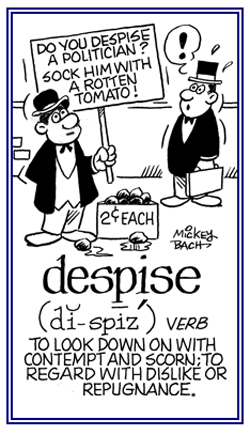
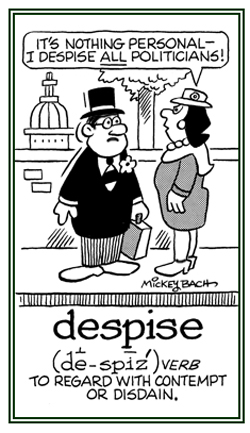
despise (verb), despises; despised; despising
To dislike and to hate something or someone very much: Although it was despised by the critics, the movie attracted a large audience.
© ALL rights are reserved.
© ALL rights are reserved.
Go to this Word A Day Revisited Index
Jim's father despises all the attention that is given to so many sports programs on TV; especially, on the weekends.
Go to this Word A Day Revisited Index
so you can see more of Mickey Bach's cartoons.
devise (verb), devises; devised; devising
To cleverly develop a plan or a system to succeed in doing something: Mr. Smith was devising vocabulary games that his students could play in his English class and make their learning more interesting.
hypnotise
Sometimes the British and Australian spelling for “hypnotize”.
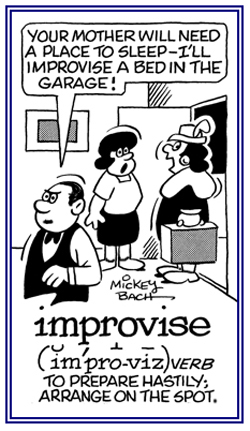
improvise (verb), improvises; improvised; improvising
1. To invent, to compose, or to perform extemporaneously; that is, with little or no preparation: The conductor of the jazz band had improvised some special musical renditions which the audience found very melodious and pleasant to hear.
2. To make or to provide something from available materials: Martin's wife had to improvise dinner from what she found in the refrigerator when her aunt and uncle came to visit without any warning.
© ALL rights are reserved.
Go to this Word A Day Revisited Index
2. To make or to provide something from available materials: Martin's wife had to improvise dinner from what she found in the refrigerator when her aunt and uncle came to visit without any warning.
Go to this Word A Day Revisited Index
so you can see more of Mickey Bach's cartoons.
praise
supervise
To oversee (a process, work, workers, etc.) during execution or performance; to superintend; to have the oversight and direction of an activity.
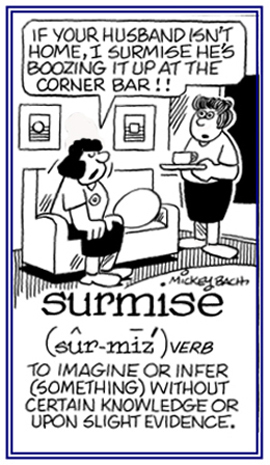
surmise (verb), surmises; surmised; surmising
1. To infer or to guess something without sufficient and conclusive evidence: Janet and David surmised that they had finally located the meeting point for the hikers because there were other people there with backpacks and sturdy shoes waiting together in the parking lot next to the forest.
2. An idea or opinion based on inadequate and unconvincing proof; a conjecture: When Nicole came home after the staff meeting, there wasn’t any dinner left for her; so, she surmised that it had tasted so good that her family could not stop eating all of it!
3. An idea or thought of something as being possible or likely: Jane surmised that the good-looking man must be a prominent person because everybody in front of the theater was asking him for his autograph!

© ALL rights are reserved.
© ALL rights are reserved.
Go to this Word A Day Revisited Index
2. An idea or opinion based on inadequate and unconvincing proof; a conjecture: When Nicole came home after the staff meeting, there wasn’t any dinner left for her; so, she surmised that it had tasted so good that her family could not stop eating all of it!
3. An idea or thought of something as being possible or likely: Jane surmised that the good-looking man must be a prominent person because everybody in front of the theater was asking him for his autograph!
Go to this Word A Day Revisited Index
so you can see more of Mickey Bach's cartoons.
televise
1. Broadcasting or being broadcast by television.
2. Transmitting a program, signal, etc. by television
2. Transmitting a program, signal, etc. by television
<img src="/img/left_arrow_sm.gif" alt="" /> <img src="/img/right_arrow_sm.gif" alt="" />
Showing 1 page of 15 main-word entries or main-word-entry groups.