
in-2
(Latin: in, into, within, inside, on, toward [il-, ir-, im-], in, into, etc.: involve, incur, invade; also, used intensively, as in the words inflame and inflammable, or without perceptible force.)
The in- changes or is assimilated to il- before l, as with "illuminate", to im- before b, as with "imbibe"; before m, as with "immediate"; before p, as with "implant"; and to ir- before r, as with "irrigate".
The form generally remains unassimilated in words formed in English; such as, inbreed.
Don't confuse this in-2, meaning "in, into, within", etc. with the Latin prefix in-1 meaning "not" nor with the prefix for English-origin words in-3 meaning "in, into; within".
2. To decorate something with lamps for a celebration: The youth groups planned to illuminate the statues in the city park with bright lanterns in time for the holidays.
3. To make something clear, or easier to understand and to appreciate: Dr. Murphy's explanation was illuminating on the subject of portrait photography and so Jim was able to appreciate black and white portraits easier.
Footnotes illuminated the difficult definitions in the dictionary of scientific terms.
4. To add colored letters, illustrations, and designs to a manuscript or the borders of a page: In the ancient monasteries, the resident monks used their time and skills to illuminate manuscripts, enhancing the beauty of the words with the beauty of the pages.5. To provide someone with knowledge or with intellectual or spiritual enlightenment: Mary Jo went on a spiritual retreat for the weekend and felt illuminated by the workshops and lectures she attended.
2. To drink alcoholic beverages.
3. To absorb or take in as if by drinking: “The whole body ... imbibes delight through every pore” (Henry David Thoreau).
4. To receive and absorb into the mind: “Gladstone had ... imbibed a strong prejudice against Americans” (Philip Magnus).
5. To permeate; saturate.
2 In botany and zoology; to become established in a new environment.
2. To induct into office with formal ceremonies; to install: "The President of the U.S. was inaugurated for his second term in office."
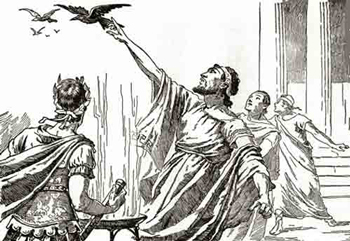
When we speak of the inauguration of a president, we use a word that carries us back to ancient times when people believed in omens, or signs that indicate what will happen in the future, and looked for them on every important occasion; however, the ceremony of inauguration today does not call for the observation of such predictions.
3. To introduce into public use by some formal ceremony: "Airmail service between Washington, D.C., and New York City was inaugurated in 1918."
4. Etymology: From Latin inaugurātus; past participle of inaugurāre, "to consecrate by augury" (a person chosen for the priesthood or other office; literally, "to take auguries").
The word inaugurate has its roots in the Latin term meaning, "to practice augury". In ancient Rome, a select few priests were charged with observing the flight and feeding of birds in order to discover signs of the future.
Such observations were known as auguries, and the practitioners of this art as augurs. For a few hundred years, the now-obsolete augurate meant, "to make an augury".
Presumably, it was the ceremonial connotation of auguring and not its "foretelling aspects" that brought inaugurate into print in English in 1606, with the meaning, "to induct into an office with suitable ceremonies".
2. Relating to something that is shining brilliantly.
. 3. Characterized by ardent emotion, intensity, or brilliance: The singer had an incandescent performance.
2. Easily aroused or excited, as to passion or anger; irascible: Her father had an inflammable disposition regarding the men she was dating.
2. To write or enter the name of (a person) upon an official document or list; to enroll.
3. To dedicate (a writing or work of art) to a person by a short inscription (placed at the beginning of a writing, or beneath a picture, etc.), less formal than an ordinary dedication.
2. To say something in a very forceful way which doesn't allow for any disagreement: Henry insisted that his son didn't mean to be impolite when he disagreed with what his aunt said about his web site.
The couple next to Karl and Janine insisted on talking during the movie.
2. The act of being persistent and unremitting: Mrs. Smart always expected her students to do their best and her insistence on this proved to be correct!
2. Persistent; continual; unrelenting: Greg woke up with the insistent and urgent ringing of his alarm clock.
2. Etymology: from Latin intricare, "to entangle, to perplex"; from in-, "in, into" + tricare, "to trick, to complicate, to perplex".
