
ambul-, ambulat-, -ambulate, -ambulating, -ambulation -ambulator, -ambulatory, -ambulant, -ambulic, -ambulism, -ambulist
(Latin: to walk, take steps, move around; from "to wander, to go astray")
Teresa ambled from her house to to the bus stop because she left in plenty of time.
2. The suckers on the feet of mites: Mites use ambulacra as a means of walking on and hanging on to their victims.
2. Formerly a field hospital; that is, on a field of battle where the wounded were carried out on stretchers, etc. by "walking bearers".
The term ambulance was borrowed from French hopital ambulant, mobile hospital, or literally, "walking hospital," from Latin ambulantem and ambulare, "to walk."
Historically, soldiers wounded in battle usually stayed where they fell until it was dark or until the end of some particular combat when they could be carried or dragged off for treatment.
This situation didn't change until 1240, when Italy's Misericordia di Firenze, the first known emergency-care service, was founded.
Although primitive horse-drawn conveyances for the wounded made occasional appearances—at the Battle of Málaga in 1487, for example—it wasn't until 1792 that ambulances became a regular part of the battlefield scene.
It was at this time that Baron Dominique-Jean Larrey, a French army surgeon, introduced what he called the ambulances volantes, or "flying field hospitals". Such conveyances were covered, portable litters filled with bandages to stop the flow of blood and to bind the wounds of soldiers on the battlefield. The transporter was also called the hopital ambulant; that is, "walking hospital" or "traveling hospital."
The English borrowed this idea and the name; however, they dropped the first word and anglicized the second so that today the vehicle used to transport the sick or wounded is now called an ambulance, even though neither it nor its patients are "ambulatory" and are certainly "not ambulating".
One of the first modern ambulances appeared during the American Civil War, when Dr. Jonathan Letterman, medical director of the Army of the Potomac, assigned two horse-drawn ambulances to every regiment of 500 infantrymen. The Geneva Convention, in 1864, recognized military ambulances, declaring that the vehicles, the wounded they carried, and the medics that operated them, should be considered and treated as neutrals.
2. An instrument for measuring distances: The surveyor was using an ambulator consisting of a wheel to roll along over the ground with a dial plate to measure the distance traveled from one point to another one.
2. The covered walk of a cloister with a wall on one side and a colonnade open to a quadrangle on the other.The visitors were walking around in the ambulatory of the historical monastery.
2. Adapted for walking, as the limbs of many animals: Some sea creatures are ambulatory, moving from place to place seeking better feeding grounds.
3. Moving around or from place to place; not stationary: The physiotherapist was helping the patients become more ambulatory in their goal to become more independent.
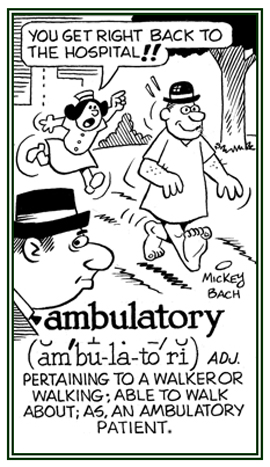
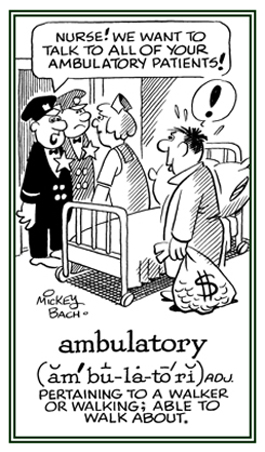
4. Not confined to bed; able or strong enough to walk: Glenda was an ambulatory patient who could go home instead of having to stay in a hospital bed.
An ambulatory health service is for people who are not required to be hospitalized because they are not physically handicapped and so they are able to proceed on foot in a normal way.
5. In law, not fixed; alterable or revocable: Mark left an ambulatory will for his daughter in case something were to happen to her and she couldn't be available to benefit from it.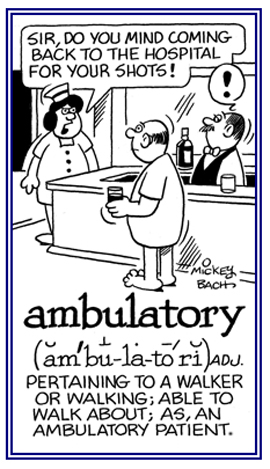
Go to this Word A Day Revisited Index
for a list of additional Mickey Bach illustrations.
During ambulatory automatisms, epileptic patients walk around and are able to carry out some functions without being clearly conscious of either themselves or their surroundings.
