
horti-
(a garden, of a garden, a gardener; enclosed space, enclosure)
A cohort of three soldiers were wandering the countryside, hoping to find a place to sleep and food to eat.
2. Any group of associates: The Board of Directors for the company consisted of three cohorts who were employees; as well as, three cohorts who were elected to the Board.Last week, the police arrested the local criminal leader of a gang and his cohorts.
3. Companions or followers: The dynamic priest had a cohort of believers who shared his enthusiasm for moral living and the worship of God.4. A group of people sharing a common factor; such as, the same age or the same income bracket; especially, in a statistical survey: A lack of focus was a common failure for students in a particular age cohort.
5. A disapproving reference to a supporter, an accomplice, or an associate of a leader; especially, someone to whom special treatment and preference is given: The police were observing the gang's leader and his cohorts or fellow criminals.
6. Etymology: from Latin cohortem, accusative form of cohors, "enclosure"; with the extended meaning applied to "infantry company" in the Roman army (a tenth part of a legion, 400 to 600 men) by way of the notion of an "enclosed group, a retinue"; from com-, "with" + hortus. "garden".

Go to this Word A Day Revisited Index
so you can see more of Mickey Bach's cartoons.
2. A short street, especially a wide alley walled by buildings on three sides.
3. A large open section of a building, often with a glass roof or skylight.
4. A large building, such as a mansion, standing in a courtyard.
5. The place of residence of a sovereign or dignitary; a royal mansion or palace.
6. The retinue of a sovereign, including the royal family and personal servants, advisers, and ministers.
7. A sovereign's governing body, including the council of ministers and state advisers.
8. A formal meeting or reception presided over by a sovereign.
9. In law, a person, or body of people, whose task is to hear and to submit a decision on cases of law.
The building, hall, or room in which such cases are heard and determined.
10. The regular session of a judicial assembly or a similar authorized tribunal having military or ecclesiastical jurisdiction.11. In sports, an open level area marked with appropriate lines, upon which a game; such as, tennis, handball, or basketball, is played.
12. Etymology: from Old French curt, from Latin cortem, cors (earlier cohors), "enclosed yard"; and by extension (and perhaps by association with curia, "sovereign's assembly"), "those assembled in the yard; company, cohort"; from com-, "together" + the stem, hort-, related to hortus, "garden, plot of ground".
Sporting sense is from 1519, originally of tennis. Legal meaning is from 1292 (early assemblies for justice were overseen by the sovereign personally); courthouse is from 1483.
Court-martial is first indicated in 1571; as a verb, 1859. Courtier is from 1228; courtly, "having manners befitting a court" is from 1450. Courtship, "paying court to a woman with intention of marriage" is from 1596.
2. Etymology: from Middle French courtisane, from Italian cortigiana, "prostitute"; literally, "woman of the court"; feminine of cortigiano, "one attached to a court", from corte, "court", from Latin cortem, "enclosed yard".
2. A reference to a simple form of agriculture based on working small plots of land without using draft animals, plows, or irrigation.
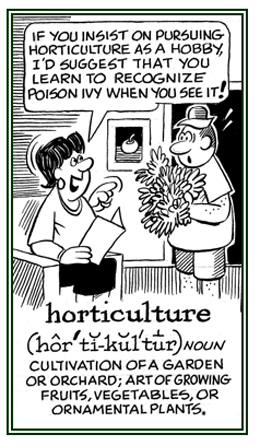
3. Etymology: the Latin words hortus "garden plant" and cultura "culture" together form horticulture, classically defined as "the culture or growing of garden plants".
Sam was striving to learn the art of horticulture so he could have more freshly grown food and even some beautiful flowers for his family.
Go to this Word A Day Revisited Index
so you can see more of Mickey Bach's cartoons.
2. Etymology: a Latin name Emberiza hortulana via Provençal French, "gardener"; from Latin hortulanus or hortus, "garden".
From Decimus Iunius (Junius) Iuvenalis (Juvenalis) (c. A.D. 60-117); Saturae, I, 74; who attacked the vices of the plutocrats, the wickedness and immorality of women and foreigners (particularly Greeks), and grieves about the decline of the ancient aristocratic virtues.